APRA proposes to simplify the capital adequacy framework by phasing out Additional Tier 1 (AT1)

APRA recently announced that it had concluded that AT1 instruments had not been shown to act effectively in a going concern scenario and were worse than Tier 2 capital in a resolution scenario leaving it with three choices:

  • Maintain the status quo while monitoring to see whether a solution emerged from international developments (either Basel redesigning the instruments or some kind of market solution)
  • Unilaterally redesign AT1 to make it more effective in Australia via some combination of a higher trigger for conversion, a new discretionary trigger and/or restrictions on the investor base
  • Simplify the capital adequacy framework by replacing AT1 with Common Equity Tier 1 (CET1) and/or Tier 2

APRA summarised their conclusion in favour of the “Simplify” option as follows:

“Replacing AT1 with more reliable forms of capital will enable banks to more quickly and confidently use their capital buffers in a crisis scenario and is expected to reduce compliance costs for banks. It will also strengthen the proportionality of the prudential framework by embedding a simpler approach to capital requirements for small and mid-size banks compared to the new requirements for large banks,” Mr Lonsdale said.

Under APRA’s proposed approach:

  • Large, internationally active banks would be able to replace 1.5 per cent AT1 with 1.25 per cent Tier 2 and 0.25 per cent Common Equity Tier 1 (CET1) capital.1
     
  • Smaller banks would be able to fully replace AT1 with Tier 2, with a corresponding reduction in Tier 1 requirements.

One thing we can all agree on is that phasing out AT1 does make the framework simpler, I have questions though:

  1. How does removing AT1 makes it easier to use capital buffers in a crisis?
  2. Does the option to convert to CET1 have no value in a going concern scenario?
  3. Just how risky are these AT1 instruments from an investor perspective?
  4. Will the debt market happily accept the smaller banks switching from AT1 to Tier 2 (i.e. if the debt market and rating agencies do see some value in having AT1 then will the smaller banks be required to hold CET1 instead)?
Does removing AT1 make it easier to use capital buffers in a crisis?

APRA questions whether AT1 discretionary distributions will in fact be cancelled when a bank is under stress and losses are eating into the capital buffers because “… the market signal effects from canceling distributions are considered more detrimental than the minor benefit of additional financial support“,

I don’t disagree that adverse signalling is a concern with any capital management action but I am not sure that this particular example is as big an issue as it is presented to be. This is partly because the dollar value of the AT1 distributions is so small that they don’t really help very much. By all means suspend them at the time that ordinary dividends have been suspended completely but otherwise respect the seniority of these instruments in the capital stack and loss hierarchy.

This brings us to adverse signalling concern that seems to be a significant factor in APRA’s analysis. Clearly you can cut ordinary dividends without the adverse signalling constraint so why is this a problem for AT1 distributions?

  • I suspect the problem is that the seniority of AT1 to CET1 creates the reasonable expectation on the part of AT1 investors that ordinary dividends should be required to do the initial heavy lifting on loss absorption and capital conservation and that AT1 distributions should come into play only when the ordinary dividend is cut to zero
  • APRA itself also acknowledges that the actual financial support created by cancelling the AT1 distributions is “minor” which begs the question why should the A1 distributions be cancelled when the loss absorption and capital conservation requirements can be easily achieved by increasing the reduction in ordinary dividends.
  • Once you get to the point where ordinary dividends are completely cancelled, there is room for AT1 distributions to be cancelled as well without the adverse signalling concern, especially if the bank is reporting losses.

Sometimes this is not the way it has played out. Part of the reason that this logical, predictable hierarchy of loss absorption can be disrupted lies I think with the overly complex way that the Capital Conservation Ratio (CCR) is applied. An explanation of why the CCR is overly complex is a whole topic in itself that I will leave for another day. The people who best understand this point are those working in stress testing who have had to calculate the CCR in a stress scenario (you really have to get into the detail to understand it).

The CCR issue could be addressed by simplifying the way it is calculated and I imagine there would be broad agreement that simplicity is always a desirable feature of any calculation that has to be employed under conditions of stress and uncertainty. The main point I want to make is that “simplifying” the application of the way the CCR is used to conserve capital might be a useful place to start before you decide to get rid of AT1 completely.

The bigger question I think is whether the option to convert AT1 into common equity has no value, either in a going concern scenario or in resolution.

APRA argues that

“Rather than acting to stabilise a bank as a going concern in stress, international experience has shown that AT1 absorbs losses only at a very late stage of a bank failure. … If AT1 was used in Australia APRA considers it would not fulfil its role in stabilising the bank before non-viability was reached.” 

In one sense, late conversion is a feature as opposed to a bug in the design of AT1 instruments. They are designed to convert as a last resort when the 5.125% CET1 Point of Non-Viability is crossed so it should not be a surprise that they convert relatively late in a stressed scenario. Perhaps more importantly the conversion option is calibrated to a point where a bank has run through the standard set of options for conserving and rebuilding capital buffers.

APRA acknowledges that the trigger could be set higher so that conversion happens earlier but asserts that “... this could undermine recovery plan actions and the usability of capital buffers“. So far as I could determine, the only reason cited to support this conclusion is that “A higher trigger, if exercised, may operate as a negative signal to the market at the very time when regulators are aiming to restore confidence“.

The statement regarding market signals is interesting. The conversion trigger, wherever it is set, is something that the “market” is well aware of, so the potential for adverse signalling seems to imply that the situation in the bank is much worse than was commonly understood by the market. If that was not the case then conversion is simply an outcome that the market should have been anticipating. A related concern for APRA is that international experience has shown that banks have failed with CET1 ratios much higher than 5.125 per cent, further reducing the potential value of the PONV trigger in their eyes.

It is obviously true that banking has an unfortunate history of seemingly solvent banks very quickly being found out not to be solvent (or maybe just perceived to be insolvent – much the same thing in practice), let’s call this Scenario 1. This still leaves a lot of other scenarios in which a bank has taken a large hit and just needs an infusion of new common equity to rebuild and survive.

Remember that APRA is proposing to replace 1.5% of AT1 with .25% of CET1 (and 1.25% of T2) for the big banks, while the smaller banks simply swap AT1 for Tier 2. For the bigger banks, the extra 0.25% CET1 arguably makes no real difference to the outcome for a Type 1 scenario, but a bigger block of convertible capital could be useful in the other adverse scenarios. For the smaller banks, they just have less options. So the capital framework proposed by APRA is simpler for sure but it is not obvious that it is better.

A related question is just how risky are these instruments from the investor perspective

The theory is that AT1 should be less risky than common equity because they pay investors a predetermined income distribution and have a more senior position in the loss hierarchy. Clearly we are all comfortable with retail investors holding common equity so in theory it should be ok for them to invest in something less risky.

This nice theoretical framework can get a bit messy in the real world for a couple of reasons:

  • Firstly, the CCR as currently implemented can result in AT1 distributions having to be cut in conjunction with the ordinary dividend thereby disrupting the simple hierarchy in which AT1 only comes into the frame once cutting the ordinary dividend has totally exhausted its capacity to satisfy the CCR
  • Secondly, there have been instances in which loss absorption has been achieved by the write down of the AT1 instrument rather than by conversion to common equity (thereby absorbing loss in a way that benefits common equity at the expense of AT1 investors and violating the loss hierarchy benefits that the AT1 investor though they were paying a premium for.
  • Even if conversion does play out as expected, there remains a risk that the value of the ordinary shares received on conversion continues to fall before the AT1 investors can convert them into cash. Indeed, the simple fact that a block of shares is being issued to investors who are not long term holders can itself contribute to a decline in the share price.

Most of these problems (not all) seem to be fixable:

  • Simplifying the way in which the CCR must be met would help reduce the potential for AT1 distributions to be required to absorb loss sooner than would be expected under the principle that AT1 ranks senior to ordinary equity
  • Similarly, loss absorption at the PONV can also be implemented in ways that respects the hierarchy of loss that AT1 investors believed they had contracted to. I am open to someone making the case that the option to write off AT1 has some value but mostly it just seems to introduce complexity and raise doubts about the seniority of the AT1 instruments.

The potential for AT investors to receive less than par value via the conversion is I think a risk that can’t be eliminated but I am not sure that it need to be eliminated. In the event that the shares received on conversion are sold for less than the conversion price, AT1 investors are still likely to have realised lower losses than those experienced by ordinary shares under the same scenario. Investing at this end of the capital stack is about relative risk and reward, the real question is whether the risk is correctly valued.

It is possible that APRA still concludes that retail investors are unable to accurately assess and price the risks. In that case, you retain the option of restricting the sale of the instruments to sophisticated investors and institutional money. That seems to me like a perfectly reasonable compromise that retains the useful features of these AT1 instruments. I just don’t see that the case has been made to completely eliminate the options that AT1 offers.

Last, but not least, we come to the question of what the debt market thinks about the proposal for smaller banks to completely replace AT1 with T2.and perhaps more importantly what do the rating agencies think?

I have to confess that I don’t know. It does seem to me however that something is being lost. The consultation on the proposal is currently open and more informed minds than my own will I hope be addressing that question in the feedback they offer.

I am speculating here but the only way that I can rationalise the policy option proposed by APRA is that they have concluded that the CET1 levels they have established in response to Unquestionably Strong target set by the 2014 Financial System Inquiry have rendered other forms of “going concern” capital redundant. The rating agencies will clearly have an opinion on this question.

I have been a long way from the front line on these issue for some time but that is my 2 cents worth – as always please let me know what I am missing.

Tony – From the Outside
Bank capital buffers – room for improvement

I recently flagged a speech by Sam Woods (a senior official at the UK Prudential Regulation Authority) which floated some interesting ideas for what he describes as a “radically simpler, radically usable” version of the multi-layered capital buffers currently specified by the BCBS capital accord. At the time I was relying on a short summary of the speech published in the Bank Policy Institute’s “Insights” newsletter. Having now had a chance to read the speech in full I would say that there is a lot to like in what he proposes but also some ideas that I am not so sure about.

Mr Woods starts in the right place with the acknowledgment that “… the capital regime is fiendishly complex”. Complexity is rarely (if ever?) desirable so the obvious question is to identify the elements which can be removed or simplified without compromising the capacity to achieve the underlying economic objectives of the regime.

While the capital regime is fiendishly complex, its underlying economic goals are fairly simple: ensure that the banking sector has enough capital to absorb losses, preserve financial stability and support the economy through stresses.

… my guiding principle has been: any element of the framework that isn’t actually necessary to achieve those underlying goals should be removed. …

With that mind, my simple framework revolves around a single, releasable buffer of common equity, sitting above a low minimum requirement. This would be radically different from the current regime: no Pillar 2 buffers; no CCoBs, CCyBs, O-SII buffer and G-SiB buffers; no more AT1.

In practice, Mr Woods translates this simple design principle into 7 elements:

1. A single capital buffer, calibrated to reflect both microprudential and macroprudential risks.

2. A low minimum capital requirement, to maximise the size of the buffer.

3. A ‘ladder of intervention’ based on judgement for firms who enter their buffer – no mechanical triggers and thresholds.

4. The entire buffer potentially releasable in a stress.

5. All requirements met with common equity.

6. A mix of risk-weighted and leverage-based requirements.

7. Stress testing at the centre of how we set capital levels.

The design elements that appeal to me:
  • The emphasis on the higher capital requirements of Basel III being implemented via buffers rather than via higher minimum ratio thresholds
  • The concept of a “ladder of intervention” with more room for judgment and less reliance on mechanical triggers
  • The role of stress testing in calibrating both the capital buffer but also the risk appetite of the firm
I am not so sure about:
  • relying solely on common equity and “no more AT1” (Additional Tier 1)
  • the extent to which all of the components of the existing buffer framework are wrapped into one buffer and that “entire buffer” is potentially usable in a stress

No more Additional Tier 1?

There is little debate that common equity should be the foundation of any capital requirement. As Mr Woods puts it

Common equity is the quintessential loss-absorbing instrument and is easy to understand.

The problem with Additional Tier 1, he argues, is that these instruments …

… introduce complexity, uncertainty and additional “trigger points” in a stress and so have no place in our stripped-down concept …

I am a huge fan of simplifying things but I think it would be a retrograde step to remove Additional Tier 1 and other “bail-in” style instruments from the capital adequacy framework. This is partly because the “skin in the game” argument for common equity is not as strong or universal as its proponents seem to believe.

The “skin in the game” argument is on solid foundations where an organisation has too little capital and shareholders confronted with a material risk of failure, but limited downside (because they have only a small amount of capital invested), have an incentive to take large risks with uncertain payoffs. That is clearly undesirable but it is not a fair description of the risk reward payoff confronting bank shareholders who have already committed substantial increased common equity in response to the new benchmarks of what it takes to be deemed a strong bank.

I am not sure that any amount of capital will change the kinds of human behaviour that see banks mistakenly take on outsize, failure inducing, risk exposures because they think that they have found some unique new insight into risk or have simply forgotten the lessons of the past. The value add of Additional Tier 1 and similar “bail-in” instruments is that they enable the bank to be recapitalised with a material injection of common equity while imposing a material cost (via dilution) on the shareholders that allowed the failure of risk management to metastasise. The application of this ex post cost as the price of failure is I think likely to be a far more powerful force of market discipline than applying the same amount of capital before the fact to banks both good and bad.

In addition to the potential role AT1 play when banks get into trouble, AT1 investors also have a much greater incentive to monitor (and constrain) excessive risk taking than the common equity holders do because they don’t get any upside from this kind of business activity. AT1 investors obviously do not get the kinds of voting rights that common shareholders do but they do have the power to refuse to provide the funds that banks need to meet their bail-in capital requirements. This veto power is I think vastly underappreciated in the current design of the capital framework.

Keep AT1 but make it simpler

Any efforts at simplification could be more usefully directed to the AT1 instruments themselves. I suspect that some of the complexity can be attributed to efforts to make the instruments look and act like common equity. Far better I think to clearly define their role as one of providing “bail-in” capital to be used only in rare circumstances and for material amounts and define their terms and conditions to meet that simple objective.

There seems, for example, to be an inordinate amount of prudential concern applied to the need to ensure that distributions on these instruments are subject to the same restrictions as common equity when the reality is that the amounts have a relatively immaterial impact on the capital of the bank and that the real value of the instruments lie in the capacity to convert their principal into common equity. For anyone unfamiliar with the way that these instruments facilitate and assign loss absorption under bail-in I had a go at a deeper dive on the topic here.

One buffer to rule them all

I am not an expert on the Bank of England’s application of the Basel capital accord but I for one have always found their Pillar 2B methodology a bit confusing (and I like to think that I do mostly understand capital adequacy). The problem for me is that Pillar 2B seems to be trying to answer much the same question as a well constructed stress testing model applied to calibration of the capital buffer. So eliminating the Pillar 2B element seems like a step towards a simpler, more transparent approach with less potential for duplication and confusion.

I am less convinced that a “single capital buffer” is a good idea but this is not a vote for the status quo. The basic structure of a …

  • base Capital Conservation Buffer (CCB),
  • augmented where necessary to provide an added level of safety for systemically important institutions (either global or domestic), and
  • capped with a variable component designed to absorb the “normal” or “expected” rise and fall of losses associated with the business cycle

seems sound and intuitive to me.

What I would change is the way that the Countercyclical Capital Conservation Buffer (CCyB) is calibrated. This part of the prudential capital buffer framework has been used too little to date and has tended to be applied in an overly mechanistic fashion. This is where I would embrace Mr Woods’ proposal that stress testing become much more central to the calibration of the CCyB and more explicitly tied to the risk appetite of the entity conducting the process.

I wrote a long post back in 2019 where I set out my thoughts on why every bank needs a cyclical capital buffer. I argued then that using stress testing to calibrate the cyclical component of the target capital structure offered an intuitive way of translating the risk appetite reflected in all the various risk limits into a capital adequacy counterpart. Perhaps more importantly,

  • it offered a way to more clearly define the point where the losses being experienced by the bank transition from expected to unexpected,
  • focussed risk modelling on the parts of the loss distribution that more squarely lay within their “zone of validity”, and
  • potentially allowed the Capital Conservation Buffer (CCB) to more explicitly deal with “unexpected losses” that threatened the viability of the bank.

I have also seen a suggestion by Douglas Elliott (Oliver Wyman) that a portion of the existing CCB be transferred into a larger CCyB which I think is worth considering if we ever get the chance to revisit the way the overall prudential buffers are designed. This makes more sense to me than fiddling with the minimum capital requirement.

As part of this process I would also be inclined to revisit the design of the Capital Conservation Ratio (CCR) applied as CET1 capital falls below specified quartiles of the Capital Conservation Buffer. This is another element of the Basel Capital Accord that is well intentioned (banks should respond to declining capital by retaining an increasing share of their profits) that in practice tends to be much more complicated in practice than it needs to be.

Sadly, explaining exactly why the CCR is problematic as currently implemented would double the word count of this post (and probably still be unintelligible to anyone who has not had to translate the rules into a spreadsheet) so I will leave that question alone for today.

Summing up

Mr Woods has done us all a service by raising the question of whether the capital buffer framework delivered by the Basel Capital Accord could be simplified while improving its capacity to achieve its primary prudential and economic objectives. I don’t agree with all of the elements of the alternative he puts up for discussion but that is not really the point. The important point is to realise that the capital buffer framework we have today is not as useful as it could be and that really matters for helping ensure (as best we can) that we do not find ourselves back in a situation where government finds that bailing out the banks is its least worst option.

I have offered my thoughts on things we could do better but the ball really sits with the Basel Committee to reopen the discussion on this area of the capital adequacy framework. That will not happen until a broader understanding of the problems discussed above emerges so all credit to Mr Woods for attempting to restart that discussion.

As always let me know what I am missing …

Tony – From the Outside

Bank of England official floats “radically usable” buffer for bank capital

I came across this proposal via the Bank Policy Institute’s weekly “Insights” email update

I have not read the speech yet but the summary offered by the BPI suggests that the proposal is worth reviewing in part because it highlights that a key part of the Basel III framework remains a work in progress

Here is the BPI’s summary

Prudential Regulatory Authority chief Sam Woods suggested making the U.K.’s bank capital framework simpler and more flexible. In a speech this week, Woods said regulators should make capital buffers more usable – in other words, entice banks to dip into them to lend during stressful times. The suggested framework, which Woods compared to a concept car and dubbed the “Basel Bufferati,” would be “radically simpler, radically usable, and a million miles away from the current debate but which might prove instructive over the longer term.” It centers on “a single, releasable buffer of common equity, sitting above a low minimum requirement.” It would also replace automatic thresholds with a “ladder of intervention” and feature a mix of risk-weighted and leverage-based requirements. The buffer would be determined using the results of the stress tests that would sit on top of standardized risk weights, which is a concept similar to the current U.S. regime. Therefore, “a lot of the sophistication which currently resides in modelling risk-weights would move into stress testing.”

Tony – From the Outside

Australian bank capital adequacy – building out the Unquestionably Strong framework

In this post, I lay out some problems that I have encountered in attempting to reconcile what it will mean for a D-SIB ADI to be “Unquestionably Strong” under the proposed new framework that APRA outlined in its December 2020 Discussion Paper (“A more flexible and resilient capital framework for ADIs”). Spoiler alert – I think the capital buffers adding up to a 10.5% CET1 prudential requirement may need to be recalibrated once all of the proposed changes to risk weights are tied down. I also include some questions regarding the impact of the RBNZ’s requirement for substantially higher capital requirements for NZ domiciled banks.

The backstory

The idea that Australian Authorised Deposit Taking Institutions (“ADIs” but more commonly referred to as “banks”) needed to be “Unquestionably Strong” originated in a recommendation of the Australian Financial System Inquiry (2014) based on the rationale that Australian ADIs should both be and, equally importantly, be perceived to be more resilient than the international peers with which they compete for funding in the international capital markets.In July 2017, APRA translated the FSI recommendation into practical guidance in an announcementsupported by a longer information paper.

For most people, this all condensed into a very simple message, the systemically important Australian ADIs needed to maintain a Common Equity Tier 1 (CET1) ratio of at least 10.5%. The smaller ADIs have their own Unquestionably Strong benchmark but most of the public scrutiny seems to have focussed on the larger systemically important ADIs.

In the background, an equally important discussion has been playing out regarding the extent to which the Unquestionably Strong framework should take account of the “comparability” and “transparency” of that measure of strength and the ways in which “flexibility” and “resilience” could be added to the mix. This discussion kicked off in earnest with a March 2018 APRA discussion paper (which I covered here) and has come to a conclusion with the December 2020 release of the APRA Discussion Paper explored in the post above.

December 2020 – “Unquestionably Strong” meets “A more flexible and resilient capital framework for ADIs”

I have written a couple of posts on APRA’s December 2020 Discussion Paper but have thus far focussed on the details of the proposed changes to risk weights and capital buffers (here, here and here). This was partly because there was a lot to digest in these proposals but also because I simply found the discussion of how the proposed new framework reconciled to the Unquestionably Strong benchmark to be a bit confusing.

What follows is my current understanding of what the DP says and where we are headed.

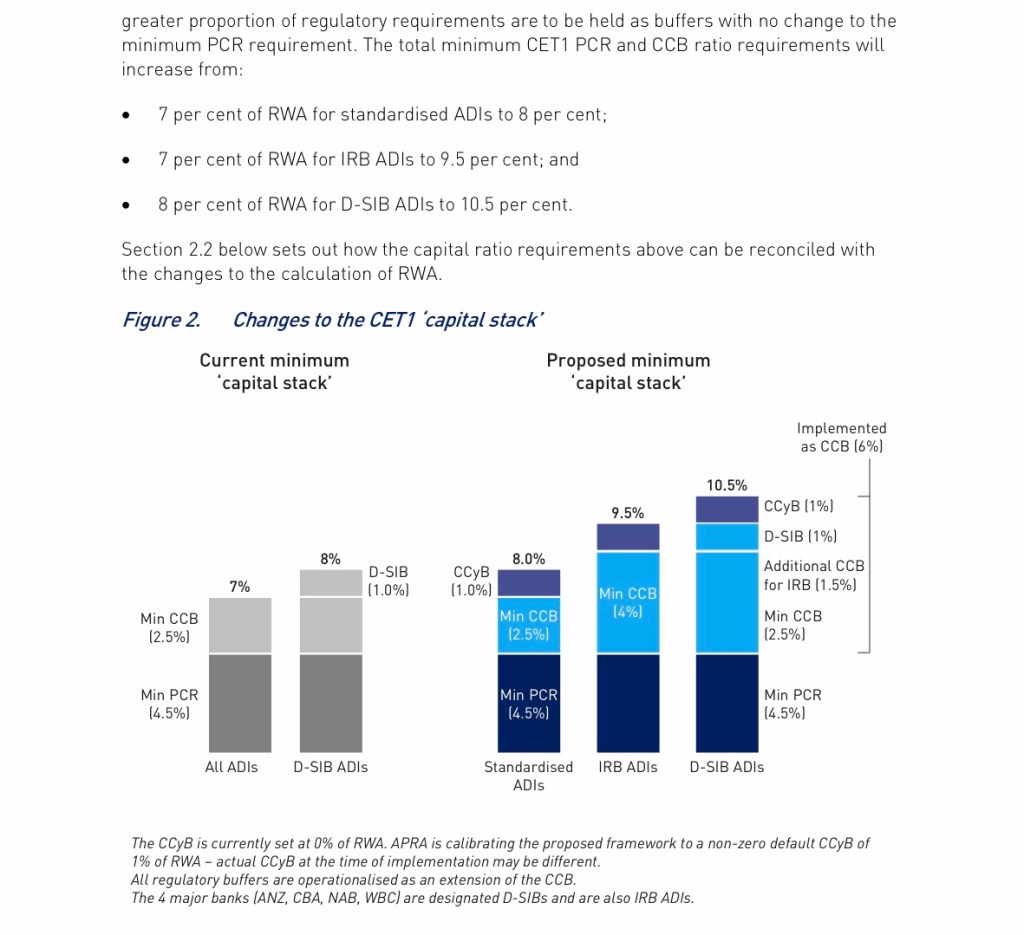
On one level, the answer is quite simple – Exhibit A from the Discussion Paper (page 17) …

APRA DP “A more flexible and resilient capital framework for ADIs” page 17
  • For systemically important ADI (D-SIB ADIs), the Unquestionably Strong 10.5% CET1 benchmark will be enshrined in a series of expanded capital buffers that will come into force on 1 January 2023 and add up to 10.5%.
  • However, we also know that APRA has at the same time outlined a range of enhancements to risk weights that are expected to have the effect of reducing aggregate Risk Weighted Assets and thereby result in higher capital adequacy ratios.
  • APRA has also emphasised that the net impact of the changes is intended to be capital neutral; i.e. any D-SIB ADI that meets the Unquestionably Strong benchmark now (i.e. that had a CET1 ratio of at least 10.5% under the current framework) will be Unquestionably Strong under the new framework
  • However this implies that the expected increase in reported CET1 under the new framework will not represent surplus capital so it looks like Unquestionably Strong will require a CET1 ratio higher than 10.5% once the new framework comes into place.

The only way I can reconcile this is to assume that APRA will be revisiting the calibration of the proposed increased capital buffers once it gets a better handle on how much capital ratios will increase in response to the changes it makes to bring Australian capital ratios closer to those calculated by international peers under the Basel minimum requirements. If this was spelled out in the Discussion Paper I missed it.

What about the impact of RBNZ requiring more capital to be held in New Zealand?

Running alongside the big picture issues summarised above (Unquestionably Strong, Transparency, Comparability, Flexibility, Resilience”, APRA has also been looking at how it should respond to the issues posed by the RBNZ policy applying substantial increases to the capital requirements for banks operating in NZ. I wrote two post on this issue (see here and here) that make the following points

  • To understand what is going on here you need to understand the difference between “Level 1” and Level 2” Capital Adequacy (part of the price of entry to this discussion is understanding more APRA jargon)
  • The increased share of the group capital resources required to be maintained in NZ will not have any impact on the Level 2 capital adequacy ratios that are the ones most commonly cited when discussing Australian ADI capital strength
  • In theory, maintaining the status quo share of group capital resources maintained in Australia would require some increase in the Level 2 CET1 ratio (i.e. the one that is used to express the Unquestionably Strong benchmark)
  • In practice, the extent to which the Level 2 benchmark is impacted depends on the maternity of the NZ business so it may be that there is nothing to see here
  • It is hard to tell however partly because there is not a lot of disclosure on the details of the Level 1 capital adequacy ratios (at least not a lot that I could find) and partly because the Level 1 capital measure is (to my mind) not an especially reliable (or indeed intuitive) measure of the capital strength
Summing up
  • There is I think a general consensus that the Australian D-SIB ADIs all currently exceed the requirements of what it means to be Unquestionably Strong under the current capital adequacy framework
  • This implies that they have surplus capital that may potentially be returned to shareholders
  • APRA has laid out what I believe to be pretty sensible and useful enhancements to that framework (the expanded and explicitly more flexible capital buffers in particular)
  • These changes have however (for me at least) made it less clear what it will mean for an ADI to be Unquestionably Strong post 1 January 2023 when the proposed changes to Risk Weighted Assets come into effect

Any and all contributions to reducing my ignorance and confusion will be gratefully accepted – let me know what I am missing

Tony – From the Outside

APRA reflects on “… a subtle but important shift in regulatory thinking”

Wayne Byres speech to the Risk Management Association covered a range of developments but, for me, the important part was the discussion of the distinction between strength and resilience referenced in the title of this post.

This extract from the speech sets out how Mr Byres frames the distinction …

… in the post-GFC period, the emphasis of the international reforms was on strengthening the global financial system. Now, the narrative is how to improve its resilience. A perusal of APRA speeches and announcements over time shows a much greater emphasis on resilience in more recent times as well.

What is behind this shift? Put simply, it is possible to be strong, but not resilient. Your car windscreen is a great example – without doubt it is a very strong piece of glass, but one small crack and it is irreparably damaged and ultimately needs to be replaced. That is obviously not the way we want the financial system to be. We want a system that is able to absorb shocks, even from so-called “black swan” events, and have the means to restore itself to full health.

In saying that, financially strong balance sheets undoubtedly help provide resilience, and safeguarding financial strength will certainly remain the cornerstone of prudential regulation and supervision. But it is not the full story. So with that in mind, let me offer some quick reflections on the past year, and what it has revealed about opportunities for the resilience of the financial system to be further improved.

APRA Chair Wayne Byres – Speech to the 2020 Forum of the Risk Management Association – 3 December 2020

To my mind, the introduction of an increased emphasis on resilience is absolutely the right way to go. We saw some indications of the direction APRA intend to pursue in the speech that Mr Byres gave to the AFR Banking and Wealth Summit last month and will get more detail next week (hopefully) when APRA releases a consultation paper setting out a package of bank capital reforms that is likely to include a redesign of the capital buffer framework.

This package of reforms is one to watch. To the extent that it delivers on the promise of increasing the resilience of the Australian banking system, it is potentially as significant as the introduction of the “unquestionably strong” benchmark in response to the Australian Financial System Inquiry.

Tony – From the Outside

Bank capital adequacy – APRA chooses Option 2

APRA released a discussion paper in August 2018 titled “Improving the transparency, comparability and flexibility of the ADI capital framework” which offered two alternative paths.

  • One (“Consistent Disclosure”) under which the status quo would be largely preserved but where APRA would get involved in the comparability process by adding its imprimatur to the “international harmonised ratios” that the large ADIs use to make the case for their strength compared to their international peers, and
  • A second (“Capital Ratio Adjustments”) under which APRA would align its formal capital adequacy measure more closely with the internationally harmonised approach.

I covered those proposals in some detail here and came out in favour of the second option. I don’t imagine APRA pay much attention to my blog but in a speech delivered to the AFR Banking and Wealth Summit Wayne Byres flagged that APRA do in fact intend to pursue the second option.

The speech does not get into too much detail but it listed the following features the proposed new capital regime will exhibit:

– more risk-based – by adjusting risk weights in a range of areas, some up (e.g. for higher risk housing) and some down (e.g. for small business);
 – more flexible – by changing the mix between minimum requirement and buffers, utilising more of the latter;
 – more transparent – by better aligning with international minimum standards, and making the underlying strength of the Australian framework more visible;
 – more comparable – by, in particular, making sure all banks disclose a capital ratio under the common, standardised approach; and
 – more proportionate – by providing a simpler framework suitable for small banks with simple business models.

while also making clear that

… probably the most fundamental change flowing from the proposals is that bank capital adequacy ratios will change. Specifically, they will tend to be higher. That is because the changes we are proposing will, in aggregate, reduce risk-weighted assets for the banking system. Given the amount of capital banks have will be unchanged, lower risk-weighted assets will produce higher capital ratios.

However, that does not mean banks will be able to hold less capital overall. I noted earlier that a key objective is to not increase capital requirements beyond the amount needed to meet the ‘unquestionably strong’ benchmarks. Nor is it our intention to reduce that amount. The balance will be maintained by requiring banks to hold larger buffers over their minimum requirements.

One observation at this stage …

It is hard to say too much at this stage given the level of detail released but I do want to make one observation. Wayne Byres listed four reasons for the changes proposed;

  1. To improve risk sensitivity
  2. To make the framework more flexible, especially in times of stress
  3. To make clearer the fundamental strength of our banking system vis-a-vis international peers
  4. To ensure that the unquestionably strong capital built up prior to the pandemic remains a lasting feature of the Australian banking system.

Pro-cyclicality remains an issue

With respect to increasing flexibility, Wayne Byres went on to state that “Holding a larger proportion of capital requirements in the form of capital buffers main that there is more buffer available to be utilised in times of crisis” (emphasis added).

It is true that the capital buffer will be larger in basis points terms by virtue of the RWA (denominator in the capital ratio) being reduced. However, it is also likely that the capital ratio will be much more sensitive to the impacts of a stress/crisis event.

This is mostly simple math.

  1. I assume that loan losses eating into capital are unchanged.
  2. It is less clear what happens to capital deductions (such as the CET1 deduction for Regulatory Expected Loss) but it is not obvious that they will be reduced.
  3. Risk Weights we are told will be lower and more risk sensitive.
  4. The lower starting value for RWA in any adverse scenario means that the losses (we assume unchanged) will translate into a larger decline in the capital ratio for any given level of stress.
  5. There is also the potential for the decline in capital ratios under stress to be accentuated (or amplified) to the extent the average risk weights increase in percentage terms more than they would under the current regime.

None of this is intended to suggest that APRA has made the wrong choice but I do believe that the statement that “more buffer” will be available is open to question. The glass is however most definitely half full. I am mostly flagging the fact that pro-cyclicality is a feature of any risk sensitive capital adequacy measure and I am unclear on whether the proposed regime will do anything to address this.

The direction that APRA has indicated it intends to take is the right one (I believe) but I think there is an opportunity to also address the problem of pro-cyclicality. I remain hopeful that the consultation paper to be released in a few weeks will shed more light on these issues.

Tony – From the Outside

p.s. the following posts on my blog touch on some of the issues that may need to be covered in the consultation

  1. The case for lower risk weights
  2. A non zero default for the counter cyclical capital buffer
  3. The interplay of proposed revisions to APS 111 and the RBNZ requirement that banks in NZ hold more CET1 capital
  4. Does expected loss loan provisioning reduce pro-cyclicality
  5. My thoughts on a cyclical capital buffer

Restructuring Basel’s capital buffers

Douglas Elliott at Oliver Wyman has written a short post which I think makes a useful contribution to the question of whether the capital buffers in the BCBS framework are serving their intended purpose.

The short version is that he argues the Countercyclical Capital Buffer (CCyB) has worked well while the Capital Conservation Buffer (CCB) has not. The solution he proposes is that the “the Basel Committee should seriously consider shrinking the CCB and transferring the difference into a target level of the CCyB in normal times”. Exactly how much is up for debate but he uses an example where the base rate for the CCyB is 1.0% and the CCB is reduced by the same amount to maintain the status quo.

The idea of having a non-zero CCyB as the default setting is not new. The Bank of England released a policy statement in April 2016 that had a non zero CCyB at its centre (I wrote about that approach in this post from April 2018). What distinguishes Elliott’s proposal is that he argues that the increased CCyB should be seeded by a transfer from the CCB. While I agree with many of his criticisms of the CCB (mostly that it is simply not usable in practice), my own view is that a sizeable CCB offers a margin of safety that offers a useful second line of defence against the risk that a bank breaches its minimum capital requirement. My perspective is heavily influenced by a concern that both bankers and supervisors are prone to underestimate the extent to which they face an uncertain world.

For anyone interested, this post sets out my views on how the cyclical capital buffer framework should be constructed and calibrated. This issue is especially relevant for Australian banks because APRA has an unresolved discussion paper which includes a proposal to increase the size of the capital buffers the Australian banks are expected to maintain. I covered that discussion paper here. A speech that APRA Chair Wayne Byres gave in May 2020 covering some of the things APRA had learned from dealing with the economic fallout of COVID-19 is also worth checking out (covered in this post).

Tony – From the Outside

RBNZ COVID 19 Stress Tests

The RBNZ just released the results of the stress testing conducted by itself and a selection of the larger NZ banks to test resilience to the risks posed by COVID 19.

The extract below summarises the process the RBNZ followed and its key conclusions:

COVID-19 stress test consisted of two parts. First, a desktop stress test where the Reserve Bank estimated the impact on profitability and capital for nine of New Zealand’s largest banks to the impact of two severe but plausible scenarios. Second, the Reserve Bank coordinated a process in which the five largest banks used their own models to estimate the effect on their banks for the same scenarios.

  The pessimistic baseline scenario can be characterised as a one-in-50 to one-in-75 year event with the unemployment rate rising to 13.4 percent and a 37 percent fall in property prices. In the very severe scenario, the unemployment rate reaches 17.7 percent and house prices fall 50 percent. It should be noted that these scenarios are hypothetical and are significantly more severe than the Reserve Banks’ baseline scenario.

  The overall conclusion from the Reserve Bank’s modelling is that banks could draw on their existing capital buffers and continue lending to support lending in the economy during a downturn of the severity of the pessimistic baseline scenario. However, in the more severe scenario, banks capital fell below the regulatory minimums and would require significant mitigating actions including capital injections to continue lending. This reinforces the need for strong capital buffers to provide resilience against severe but unlikely events.

  The results of this stress test supports decisions that were made as part of the Capital Review to increase bank capital levels. The findings will help to inform Reserve Bank decisions on the timing of the implementation of the Capital Review, and any changes to current dividend restrictions.

“Outcome from a COVID-19 stress test of New Zealand banks”, RBNZ Bulletin Vol 83, No 3 September 2020

I have only skimmed the paper thus far but there is one detail I think worth highlighting for anyone not familiar with the detail of how bank capital adequacy is measured – specifically the impact of Risk Weighted Assets on the decline in capital ratios.

The RBNZ includes two useful charts which decompose the aggregate changes in CET1 capital ratio by year two of the scenario.

In the “Pessimistic Baseline Scenario”(PBS), the aggregate CET1 ratio declines 3.7 percentage points to 7.7 percent. This is above both the regulatory minimum and the threshold for mandatory conversion of Additional Tier 1 Capital. What I found interesting was that RWA growth contributed 2.2 percentage points to the net decline.

The RBNZ quite reasonably points out that banks will amplify the downturn if they restrict the supply of credit to the economy but I think it is also reasonable to assume that the overall level of loan outstandings is not growing and may well be shrinking due to the decline in economic activity. So a substantial portion of the decline in the aggregate CET1 ratio is due to the increase in average risk weights as credit quality declines. The C ET1 ratio is being impacted not only by the increase in impairment expenses reducing the numerator, there is a substantial added decline due to the way that risk weighted assets are measured

In the “Very Severe Scenario”(VSS), the aggregate CET1 ratio declines 5.6 percentage points to 5.8 percent. The first point to note here is that CET1 only remains above the 4.5% prudential minimum by virtue of the conversion of 1.6 percentage points of Additional Tier 1 Capital. Assuming 100% of AT1 was converted, this also implies that the Tier 1 ratio is below the 6.0% prudential minimum.

These outcomes provide food for thought but I few points I think wroth considering further before accepting the headline results at face value:

  • The headline results are materially impacted by the pro cyclicality of the advanced forms of Risk Weighted Asset measurement – risk sensitive measures offer useful insights but we also need to understand they ways in which they can also amplify the impacts of adverse scenarios rather than just taking the numbers at face value
  • The headline numbers are all RBNZ Desktop results – it would be useful to get a sense of exactly how much the internal stress test modelling conducted by the banks varied from the RBNZ Desktop results – The RBNZ stated (page 12) that the bank results were similar to its for the PBS but less severe in the VSS.

As always, it is entirely possible that I am missing something but I feel that the answer to bank resilience is not just a higher capital ratio. A deeper understanding of the pro cyclicality embedded in the system will I think allow us to build a better capital adequacy framework. As yet I don’t see this topic getting the attention it deserves.

Tony – From the Outside

Banks Are Managing Their Stress – Bloomberg

The ever reliable Matt Levine discusses the latest stress test results for the US banks. In particular the disconnect between the severity of the assumptions in the hypothetical scenario and the actual results observed to date. He notes that it is still early and plenty of room for the actual outcomes to catch up with the hypothetical. However, one of the issues with stress testing is the way you model the way people (and governments) respond to stress.

As Matt puts it …

But another important answer is that, when a crisis actually happens, people do something about it. They react, and try to make it better. In the case of the coronavirus crisis, the Fed and the U.S. government tried to mitigate the effect of a real disaster on economic and financial conditions. Unemployment is really high, but some of the consequences are mitigated by stimulus payments and increased unemployment benefits. Asset prices fell sharply, but then rose sharply as the Fed backstopped markets. Financing markets seized up, and then the Fed fixed them.

The banks themselves also acted to make things better, at least for themselves. One thing that often happens in a financial crisis is that banks’ trading desks make a killing trading for clients in turbulent markets, which helps to make up for some of the money they lose on bad loans. And in fact many banks had blowout first quarters in their trading divisions: Clients wanted to trade and would pay a lot for liquidity, and banks took their money.

In a hypothetical stress test, you can’t really account for any of this. If you’re a bank, and the Fed asks you to model how you’d handle a huge financial crisis, you can’t really write down “I would simply make a ton of money trading derivatives.” It is too cute, too optimistic. But in reality, lots of banks just went and did that.

Similarly, you obviously can’t write down “I would simply rely on the Fed to backstop asset prices and liquidity.” That is super cheating. Much of the purpose of the stress tests is to make it so the Fed doesn’t have to bail out the banking system; the point is to demonstrate that the banks can survive a financial crisis on their own without government support. But in reality, having a functioning financial system is better than not having that, so the Fed did intervene; keeping people in their homes is better than foreclosing on them, so the government supported incomes. So the banks are doing much better than you might expect with 13.3% unemployment.

So it is likely that the Fed’s stress test is both not harsh enough, in its economic scenario, and too harsh, in its assumption about how that scenario will affect banks.

Notwithstanding the potential for people to respond to and mitigate stress, there is still plenty of room for reality to catch up with and exceed the hypothetical scenario. Back to Matt…

But the fact that the stress test imagines an economic crisis that is much nicer than reality is still a little embarrassing, and the Fed can’t really say “everything is fine even in the terrible downside case of 10% unemployment, the banks are doing great.” So it also produced some new stress-test results (well, not quite a full stress test but a “sensitivity analysis”) assuming various scenarios about the recovery from the Covid crisis (“a rapid V-shaped recovery,” “a slower, more U-shaped recovery,” and “a W-shaped double dip recession”). The banks are much less well capitalized in those scenarios than they are either (1) now or (2) in the original stress tests, though mostly still okay, and the Fed is asking the banks to reconsider stress and capital based on current reality. Also stop share buybacks:

Worth reading

Tony – From the Outside

Capital adequacy reform – what we have learned from the crisis

A speech by APRA Chair Wayne Byres released today had some useful remarks on the post 2008 capital adequacy reforms and what we have learned thus far. A few observations stood out for me. Firstly, a statement of the obvious is that the reforms are getting their first real test and we are likely to find areas for improvement

“… the post-2008 reforms will be properly tested, and inevitably we will find areas they can be improved.”

The speech clarifies that just how much, if any, change is required is not clear at this stage

“Before anyone misinterprets that comment, I am not advocating a watering down of the post-2008 reforms. It may in fact turn out they’re insufficient, and we need to do more. Maybe they just need to be reshaped a bit. I do not know. But inevitably there will be things we learn, and we should not allow a determination not to backtrack on reforms to deter us from improving them.”

Everyone is focused on fighting the COVID 19 fire at the moment but a discussion paper released in 2018 offered some insights into the kinds of reforms that APRA was contemplating before the crisis took priority. It will be interesting to see how the ideas floated in this discussion paper are refined or revised in the light of what we and APRA learn from this crisis. One of the options discussed in that 2018 paper involved “APRA modifying the calculation of regulatory capital ratios to utilise more internationally harmonised definitions of capital and RWA“. It was interesting therefore to note that the speech released today referred to the internationally comparable ratios rather than APRA’s local interpretation of Basel III.

“We had been working for some years to position our largest banks in the top quartile of international peers from a capital adequacy perspective, and fortuitously they had achieved that positioning before the crisis struck. On an internationally comparable basis, our largest banks are operating with CET1 ratios in the order of 15-16 per cent, and capital within the broader banking system is at a historical high – and about twice the level heading into the 2008 crisis.”

The speech makes a particular note of what we are learning about the capacity to use capital buffers.

“One area where I think we are learning a lot at present is the ability to use buffers. It is not as easy as hoped, despite them having been explicitly created for use during a crisis. One blockage does seem to be that markets, investors and rating agencies have all adjusted to contemporary capital adequacy ratios as (as the name implies) ‘adequate capital’. But in many jurisdictions, like Australia, ratios are at historical highs. We often hear concern about our major banks’ CET1 ratios falling below 10 per cent. This is even though, until a few years ago, their CET1 ratios had never been above 10 per cent and yet they were regarded as strong banks with AA ratings. So expectations seem to have shifted and created a new de facto minimum. We need to think about how to reset that expectation.”

I definitely agree that there is more to do on the use of capital buffers and have set out my own thoughts on the topic here. One thing not mentioned in the speech is the impact of procyclicality on the use of capital ratios.

This chart from a recent Macquarie Wealth Management report summarises the disclosure made by the big four Australian banks on the estimated impact of the deterioration in credit quality that banks inevitably experience under adverse economic conditions such as are playing out now. The estimated impacts collated here are a function of average risk weights calculated under the IRB approach increasing as average credit deteriorates. This is obviously related to the impact of increased loan loss provisioning on the capital adequacy numerator but a separate factor driving the capital ratios down via its impact on the denominator of the capital ratio.

There are almost certainly issues with the consistency and comparability of the disclosure but it does give a rough sense of the materiality of this factor which I think is not especially well understood. This is relevant to some some observations in Wayne Byres speech about the capital rebuilding process.

A second possible blockage is possibly that regulatory statements permitting banks to use their buffers are only providing half the story. Quite reasonably, what banks (and their investors) need to understand before they contemplate using buffers is the expectation as to their restoration. But we bank supervisors do not have a crystal ball – we cannot confidently predict the economic pathway, so we cannot provide a firm timetable. The best I can offer is that it should be as soon a circumstances reasonably allow, but no sooner. In Australia, I would point to the example of the way we allowed Australian banks to build up capital to meet their ‘unquestionably strong’ benchmarks in an orderly way over a number of years. We should not be complacent about the rebuild, but there are also risks from rushing it.”

Given that the estimated impacts summarised in the chart above are entirely due to “RWA inflation” as credit quality deteriorates, it seems reasonable to assume that part of the capital buffer rebuild will be generated by the expected decline in average risk weights as credit quality improves. The capital buffers will in a sense partly self repair independent of what is happening to the capital adequacy numerator.

I think we had an academic understanding of the capital ratio impact of this RWA inflation and deflation process pre COVID 19 but will have learned a lot more once the dust settles.

Tony – From the Outside