What does “proof of reserves” prove?

Frances Coppola argues in a recent post that proof of reserves as practised by the crypto finance community proves nothing. I would be interested to read any rebuttals, but the arguments she advances in support of this claim looks pretty sound to me.

Frances starts with the observation that the concept of “reserves” is not well understood even in conventional banking.

In the banking world, we have now, after many years of confusion, broadly reached agreement that the term “reserves” specifically means the liquidity that banks need to settle deposit withdrawals and make payments. This liquidity is narrowly defined as central bank deposits and physical currency – what is usually known as “base money” or M0, and we could perhaps also (though, strictly speaking, incorrectly) deem “cash”.

“Proof of reserves is proof of nothing” Coppola Comment 16 Feb 2023

This certainly rings true to me. I often see “reserves” confused with capital when reserves are really a liquidity tool. If you are still reading, I suspect you are ready to jump ship fearing a pedantic discussion of obscure banking terminology. Bear with me.

If you have even a glancing interested in crypto you will probably have encountered the complaint that traditional banks engage in the dubious (if not outrightly nefarious) practice of fractional reserve banking. A full discussion of the pros and cons of fractional reserve banking is a topic for another day. The key point for this post is that the crypto community will frequently claim that their crypto alternative for a TradFi activity like deposit taking is fully reserved and hence safer.

The published “proof of reserves” is intended therefore to demonstrate that the activity being measured (e.g. a stablecoin) is in fact fully reserved and hence much safer than bank deposits which are only fractionally reserved. Some of the cryptographic processes (e.g. Merkle trees) employed to allow customers to verify that their account balance is included in the proof are interesting but Frances’ post lists a number of big picture concerns with the crypto claim:

  1. The assets implicitly classified as reserves in the crypto proof do not meet the standards of risk and liquidity applied to reserves included in the banking measure; they are not really “reserves” at all as the concept is commonly understood in conventional banking
  2. As a result the crypto entity may in fact be engaging in fractional reserve banking just like a conventional bank but with riskier less liquid assets and much less liquidity and capital
  3. The crypto proof of “reserves” held against customer liabilities also says nothing about the extent to which the crypto entity has taken on other liabilities which may also have a claim on the assets that are claimed to be fully covering the customer deposits.

Crypto people complain that traditional banks don’t have 100% cash backing for their deposits, then claim stablecoins, exchanges and crypto lenders are “fully reserved” even if their assets consist largely of illiquid loans and securities. But this is actually what the asset base of traditional banks looks like. 

Let me know what I missing ….

Tony – From the Outside
Hollow promises

Frances Coppola regularly offers detailed and useful analysis on exactly what is wrong with some of the claims made by crypto banks. I flagged one of her posts published last November and her latest post “Hollow Promises”continues to offer useful insights into the way traditional banking concepts like deposits, liquidity and solvency get mangled.

Well worth reading.

Tony – From the Outside

“From the Outside” takes stock

This is possibly a bit self indulgent but “From The Outside” is fast approaching the 5th anniversary of its first post so I thought it was time to look back on the ground covered and more importantly what resonated with the people who read what I write.

The blog as originally conceived was intended to explore some big picture questions such as the ways in which banks are different from other companies and the implications this has for thinking about questions like their cost of equity, optimal capital structure, risk appetite, risk culture and the need for prudential regulation. The particular expertise (bias? perspective?) I brought to these questions was that of a bank capital manager, with some experience in the Internal Capital Adequacy Assessment Process (ICAAP) applicable to a large Australian bank and a familiarity with a range of associated issues such as risk measurement (credit, market, operational, interest rate etc), risk appetite, risk culture, funds transfer pricing and economic capital allocation.

Over the close to 5 years that the blog has been operational, something in excess of 200 posts have been published. The readership is pretty limited (196 followers in total) but hopefully that makes you feel special and part of a real in crowd of true believers in the importance of understanding the questions posed above. Page views have continued to grow year on year to reach 9,278 for 2022 with 5,531individual visits.

The most popular post was one titled “Milton Friedman’s doctrine of the social responsibility of business” in which I attempted to summarise Friedman’s famous essay “The Social Responsibility of Business is to Increase its Profits” first published in September 1970. I was of course familiar with Friedman’s doctrine but only second hand via reading what other people said he said and what they thought about their framing of his argument. You can judge for yourself, but my post attempts to simply summarise his doctrine with a minimum of my own commentary. It did not get as much attention but I also did a post flagging what I thought was a reasonably balanced assessment of the pros and cons of Friedman’s argument written by Luigi Zingales.

The second most popular post was one titled “How banks differ from other companies. This post built on an earlier one titled “Are banks a special kind of company …” which attempted to respond to some of the contra arguments made by Anat Admati and Martin Hellwig. Both posts were based around three distinctive features that I argued make banks different and perhaps “special” …

  • The way in which net new lending by banks can create new bank deposits which in turn are treated as a form of money in the financial system (i.e. one of the unique things banks do is create a form of money);
  • The reality that a large bank cannot be allowed to fail in the conventional way (i.e. bankruptcy followed by reorganisation or liquidation) that other companies and even countries can (and frequently do); and
  • The extent to which bank losses seem to follow a power law distribution and what this means for measuring the expected loss of a bank across the credit cycle.

The third most popular post was titled “What does the “economic perspective” add to can ICAAP and this to be frank this was a surprise. I honestly thought no one would read it but what do I know. The post was written in response to a report the European Central Bank (ECB) put out in August 2020 on ICAAP practices it had observed amongst the banks it supervised. What I found surprising in the ECB report was what seemed to me to be an over reliance on what economic capital models could contribute to the ICAAP.

It was not the ECB’s expectation that economic capital should play a role that bothered me but more a seeming lack of awareness of the limitations of these models in providing the kinds of insights the ECB was expecting to see more of and a lack of focus on the broader topic of radical uncertainty and how an ICAAP should respond to a world populated by unknown unknowns. It was pleasing that a related post I did on John Kay and Mervyn King’s book “Radical Uncertainty : Decision Making for an Unknowable Future” also figured highly in reader interest.

Over the past year I have strayed from my area of expertise to explore what is happening in the crypto world. None of my posts have achieved wide readership but that is perfectly OK because I am not a crypto expert. I have been fascinated however by the claims that crypto can and will disrupt the traditional banking model. I have attempted to remain open to the possibility that I am missing something but remain sceptical about the more radical claims the crypto true believers assert. There are a lot of fellow sceptics that I read but if I was going to recommend one article that offers a good overview of the crypto story to date it would be the one by Matt Levine published in the 31 October 2022 edition of Bloomberg Businessweek.

I am hoping to return to my bank capital roots in 2023 to explore the latest instalment of what it means for an Australian bank to be “Unquestionably Strong” but I fear that crypto will continue to feature as well.

Thank you to all who find the blog of interest – as always let me know what I missing.

Tony – From the Outside

After FTX: Explaining the Difference Between Liquidity and Insolvency

Sam Bankman-Fried continues to argue that FTX was solvent. No one is buying this of course but Frances Coppola offers a useful reminder on the difference between illiquidity and insolvency. If you take only one thing away from her article it is to understand the way in which the accounting definition of insolvency can contribute to the confusion.

The confusion between liquidity and solvency is partly caused by the generally accepted definition of “insolvency,” which is “unable to meet obligations as they fall due.” This sounds very much like shortage of cash, i.e., a liquidity crisis. But shortage of cash isn’t necessarily insolvency.

When Frances uses the term “generally accepted) I think she is alluding to Generally Accepted Accounting Principles. I have had the liquidity versus solvency debate more times than I can count and this issue was often the core source of confusion when trying to explain the concepts to people without a Treasury or markets background.

If you want to dig deeper into the solvency versus liquidity question I had a go at the issue here. Matt Levine also had a good column on the topic.

Tony – From the Outside

Impact of oligopoly on bank margins

Intuitively you might expect a more open market to yield lower net interest margins. This post by JP Koning comparing Canada and America suggests that is not always the case.

His post is not long but the short extract below captures the main observation…

It’s true that we have an incredibly concentrated banking sector up here in Canada, with the big 5 controlling an outsized chunk of the market. Paradoxically, this “oligopoly” doesn’t translate into higher net interest margins for Canadian banks. Margins are actually more elevated in the the hotbed of capitalism, the U.S., even though its banks are far more diffused. This margin difference suggests that competition among banks is more strident north of the border than south of it.

Are U.S. banks more competitive than Canadian banks? Moneyness JP Koning, 13 December 2022

Would be interested to read any insights on why this is so. For what it is worth …

  • I wonder how much differences in business mix explain the difference in margin. I am not an expert on Canadian banks but my guess is that they have a lot more housing loan exposure than their American counterparts.
  • It would also be interesting to see how much of the margin difference translated into a higher or lower return on equity.

Tony – From the Outside

A short history of credit card design choices

One for the banking and payment nerds I suspect but I at least found this discussion of some of the design choices associated with our card payment system to be well worth reading for a perspective on how the choices baked into the system were made and how cards adapted to the proliferation of increasingly online business models

bam.kalzumeus.com/archive/credit-cards-as-a-legacy-system/

Tony – From The Outside

Bank risk culture

APRA today released the results of a survey of how Australian ADI’s (i.e. “banks” for anyone reading outside Australia) believe they are doing on the question of risk culture.

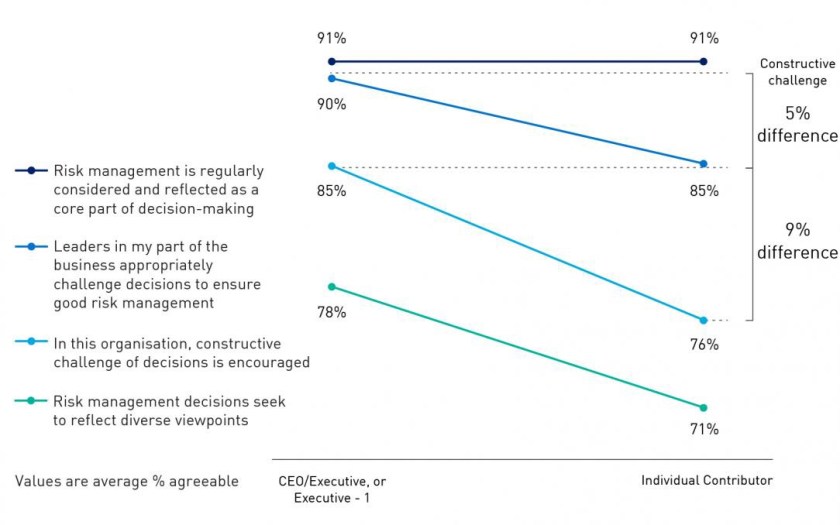
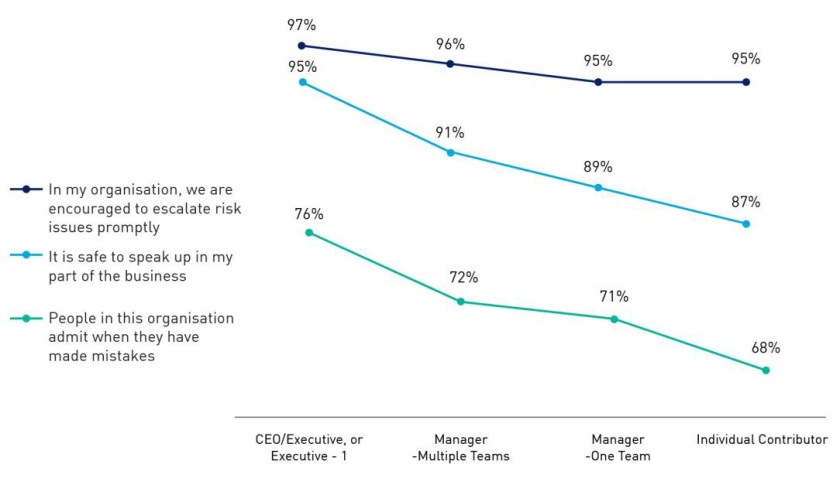
What I found most interesting was the gap between what the executives believe and what the people on the front line believe as reflected in these two charts

Figure 5. Psychological safety – Management vs Individual Contributors
Figure 8: Decision-making effectiveness – Executives vs Individual Contributors

Creating an environment in which people truely feel safe to speak up is hard but it does appear that there is a lot more work to do. The first book that comes to mind when I read about risk culture is Creativity, Inc which explores (amongst other things) how Pixar institutionalised “Candour” into the business. Michael Mauboussin’s “The Success Equation” and Greg Ip’s “Foolproof” are also useful guides for avoiding hubris and general overconfidence in your risk management process.

I have to say that the challenge of speaking up is one that resonates with me from my time in the front line and it appears that there is still more to do. Personally I quite liked Pixar’s “brains trust” solution.

Tony – From the Outside

Bronte Capital: An old story in modern times. Duncan Mavin’s pretty darn good book on Greensill

The story of people in finance doing dumb things never gets old for me. I will probably shut my blog down when I figure out why the same old mistakes keep getting repeated. I look forward to reading Duncan Mavin’s book but in the interim John Hempton’s review offers a quick recap.
— Read on brontecapital.blogspot.com/2022/10/an-old-story-in-modern-times-duncan.html

Tony – From the Outside

Margin calls …

… seem to be on the increase.

This post by Marc Rubinstein offers a short but detailed summary of what has been going on, why and what it means for markets. Read the whole post but one of the key issues for me is increased procyclicality…

The drawback of a heavily collateralized market, though, is its tendency to inject procyclicality into the system. Periods of market turbulence can drive sharply higher collateral requirements, which can prompt more turbulence if that leads to forced selling – such as we saw in the UK last week.

Marc Rubinstein, “Net Interest” Blog – 8 October 2022

Tony – From the Outside

The empire strikes back?

There is a lot written about how bad the US payment system is and why crypto solutions are the future. Against that background, Tom Noyes recently published an interesting post setting out his thoughts on a project JPM Chase is running to reengineer their payment system. Tom’s posts are normally restricted to subscribers but he has unlocked the first in a 5 part series exploring what JPM Chase is doing.

His post is definitely worth reading if you are interested in the future of banking. The short version is that the traditional banking system is not sitting still while crypto and fintech attempt to eat its lunch.

Tony – From the Outside