Bank funding costs and capital structure

Here is another paper for anyone interested in the optimal bank capital structure debate. It is a Bank of England Staff Working Paper titled “Bank funding costs and capital structure” by Andrew Gimber and Aniruddha Rajan.

The authors summarise their paper as follows:

“If bail-in is credible, risk premia on bank securities should decrease as funding sources junior to and alongside them in the creditor hierarchy increase. Other things equal, we find that when banks have more equity and less subordinated debt they have lower risk premia on both. When banks have more subordinated and less senior unsecured debt, senior unsecured risk premia are lower. For percentage point changes to an average balance sheet, these reductions would offset about two thirds of the higher cost of equity relative to subordinated debt and one third of the spread between subordinated and senior unsecured debt.”

Abstract

The paper adds support to the argument that the cost of higher capital requirements will be mitigated by a reduction in leverage risk which translates into lower borrowing costs and a decline in the required return on equity. In the jargon of the corporate finance wonks, the paper supports a Modigliani Miller (MM) offset.

I need to dig a bit deeper into the results but I am struggling with the finding that increasing the level of subordinated debt at the expense of senior debt results in a reduction in the cost of senior debt. In the interests of full disclosure, I recognise that this may simply reflect the fact that my experience and knowledge base is mostly limited to the Australian and New Zealand banking systems but here goes. As always, it is also possible that I am simply missing something.

The problem for me in these results

We are not debating here the principle that risk (and hence required return) increases as you move through the loss hierarchy. This is a common challenge thrown out at anyone who questions the thesis that risk should decline as you reduce leverage. My concern is that MM did not anticipate a financing structure in which the risk of certain liabilities is mitigated by the existence of an assumption that the public sector will support any bank that is deemed Too Big To Fail (TBTF).

I am not seeking to defend the right of banks to benefit from this implied subsidy. I fully support the efforts being made to eliminate this market distortion. However, so far as I can determine, the reality is that increasing the level of subordinated debt and/or equity may reduce the value of the implied TBTF assumption but senior debt itself does not seem to be any less risky so far as senior debt investors are concerned. So why should they adjust their required return?

This seems to be what we are observing in the response of the debt ratings of the major Australian banks to proposals that they be required to maintain increased levels of subordinated debt to comply with Basel III’s Total Loss Absorbing Capital (TLAC) requirement.

My second concern is not specific to the Bank of England paper but worth mentioning since we are on the topic. One of the MM predictions tested in this study is that “the risk premium on a funding source should fall as that funding source expands at the expense of a more senior one” with the study finding evidence that this is true. This proposition (now supported by another study with empirical data) is often used to argue that it really does not matter how much equity a bank is required to hold because the cost of equity will decline to compensate (the “Big Equity” argument).

What is missing, I think, is any consideration of what is the lower boundary for the return that an equity investor requires to even consider taking the junior position in the financing structure in what is ultimately one of the most cyclically exposed areas of an economy. My last post looked at a study of the returns on both risky and safe assets over a period of 145 years which suggested that risky assets have on average generated a real return of circa 7% p.a.. When you factor in an allowance for inflation you are looking at something in the range of 9%-10% p.a. In addition, there are a range of factors that suggest a bank should be looking to target a Return on Equity of at least 2%-3% over the average “through the cycle” expected return. This includes the way that loan losses are accounted for in the benign part of the cycle and I don’t think that IFRS9 is going to change this.

This is a topic I plan to explore in greater detail in a future post. For the moment, the main point is that there has to be a lower boundary to how much the cost of equity can decline to in response to changes in capital structure but this seems to be largely absent from the Big Equity debate.

I have added a bit of background below for anyone who is not familiar with the detail of how a bank financing structure tends to be more complicated than that of a typical non-financial company.

Tell me what I am missing …

Tony

Appendix: A bit of background for those new to this debate

The extent of this MM offset is one of the more contentious issues in finance that has generated a long and heated debate stretching back over more than half a century. Both sides of the debate agree that there is a hierarchy of risk in a company financing structure. Common equity is unambiguously at the high end of this risk hierarchy and hence should expect to earn the highest return. Layers in the hierarchy, and hence the relative protection from solvency risk, are introduced by creating levels of seniority/subordination amongst the various funding sources.

An industrial company could just have debt and equity in which case the MM offset is much easier to analyse (though still contentious). Bank financing structures, in contrast, introduce a variety of issues that render the debate even more complicated and contentious:

  • Prudential capital requirements introduce at least three layers of subordination/seniority via the distinction between minimum capital requirements for Common Equity Tier 1, Additional Tier 1 and Tier 2 capital
  • The transition to a “bail-in” regime potentially introduces another level of subordination/seniority in the form of an additional requirement for certain (typically large and systemically important) banks to hold Non-Preferred Senior debt (or something functionally equivalent)
  • Next comes senior unsecured debt that is one of the workhorses of the bank financing structure (which in turn may be short or long term)
  • In certain cases a bank may also issue covered bonds which are secured against a pool of assets (to keep things simple, I will skip over securitisation financing)
  • Banks are also distinguished by their capacity to borrow money in the form of bank deposits which also serve as a means of payment in the economy (and hence as a form of money)
  • Bank deposits often have the benefit of deposit insurance and/or a preferred super senior claim on the assets of the bank

Apart from the formal protections afforded by the seniority of their claim, certain liabilities (typically the senior unsecured) can also benefit from an implied assumption that the government will likely bail a bank out because it is Too Big To Fail (TBTF). Eliminating this implied subsidy is a key objective of the changes to bank capital requirements being progressively implemented under Basel III.

Until this process is complete, and the implied balance sheet value of being considered TBTF is eliminated, the response of bank funding costs to changes in leverage will not always follow the simple script defined by the MM capital irrelevancy thesis.

“The rate of return on everything”

This is the focus of a paper titled “The Rate of Return on Everything, 1870-2015 that seeks to address some fundamental questions that underpin, not only economic theory, but also investment strategy.

To quote the abstract:

This paper answers fundamental questions that have preoccupied modern economic thought since the 18th century. What is the aggregate real rate of return in the economy? Is it higher than the growth rate of the economy and, if so, by how much? Is there a tendency for returns to fall in the long-run? Which particular assets have the highest long-run returns? We answer these questions on the basis of a new and comprehensive dataset for all major asset classes, including—for the first time—total returns to the largest, but oft ignored, component of household wealth, housing. The annual data on total returns for equity, housing, bonds, and bills cover 16 advanced economies from1870 to 2015, and our new evidence reveals many new insights and puzzles.ets.

“The Rate of Return on Everything” Òscar Jordà, Katharina Knoll, Dmitry Kuvshinov, Moritz Schularick, Alan M. Taylor – December 2017

The paper is roughly 50 pages long (excluding appendices) but the 5 page introduction summarises the four main findings which I have further summarised below:

  1. Risky Returns: The study finds that “… residential real estate and equities have shown very similar and high real total gains, on average about 7% per year. Housing outperformed equity before WW2. Since WW2, equities have outperformed housing on average, but only at the cost of much higher volatility and higher synchronicity with the business cycle”.
  2. Safe Returns: The study finds that “Safe returns have been low on average, falling in the 1%–3% range for most countries and peacetime periods“. However, “the real safe asset return has been very volatile over the long-run, more so than one might expect, and oftentimes even more volatile than real risky returns.” This offers a long-run perspective on the current low level of the safe returns with the authors observing that “… it may be fair to characterize the real safe rate as normally fluctuating around the levels that we see today, so that today’s level is not so unusual. Which begs the question “… why was the safe rate so high in the mid-1980s rather than why has it declined ever since.”
  3. The Risk Premium: The study finds that the risk premium has been very volatile over the long run. The risk premium has tended to revert to about 4%-5% but there have been periods in which it has been higher. The study finds that the increases in the risk premium “… were mostly a phenomenon of collapsing safe rates rather than dramatic spikes in risky rates. In fact, the risky rate has often been smoother and more stable than safe rates, averaging about 6%–8% across all eras” . This for me was one of the more interesting pieces of data to emerge from the study and has implications for the question of what should be happening to target return on equity in a low interest rate environment such as we are currently experiencing. In the Authors’ words “Whether due to shifts in risk aversion or other phenomena, the fact that safe rates seem to absorb almost all of these adjustments seems like a puzzle in need of further exploration and explanation
  4. On Returns Minus Growth: This is the question that Thomas Piketty explored in his book “Capital in the Twenty-First Century”. Piketty argued that, if the return to capital exceeded the rate of economic growth, rentiers would accumulate wealth at a faster rate and thus worsen wealth inequality. The study finds that, “for more countries and more years, the rate of return on risk assets does in fact materially exceed the rate of growth in GDP… In fact, the only exceptions to that rule happen in very special periods: the years in or right around wartime. In peacetime, r has always been much greater than g. In the pre-WW2 period, this gap was on average 5% per annum (excluding WW1). As of today, this gap is still quite large, in the range of 3%–4%, and it narrowed to 2% during the 1970s oil crises before widening in the years leading up to the Global Financial Crisis.

So why does this matter?

There is a lot to think about in this paper depending on your particular areas of interest.

The finding that the long run return on residential housing is on par with equity but lower volatility is intriguing though I must confess that I want to have a closer look at the data and methodology before I take the conclusion as a fact. In particular, I think it is worth paying close attention to the way that the study deals with taxation. Fortunately, the paper offers a great deal of detail on the way that residential property is taxed (Appendix M in the December 2017 version of the paper) in different countries which is useful in its own right. I have been looking for a source that collates this information for some time and this is the best I have seen so far.

For me at least, the data on how the Equity Risk Premium (ERP) expands and contracts to offset changes in the return unsafe assets was especially interesting. This observation about the relationship is not new of itself but it was useful to find more data in support of it. I have been thinking a lot about Cost of Equity in a low interest rate environment and this seems to support the thesis that the target Return on Equity (ROE) should not necessarily be based on simply adding a fixed measure of the ERP (say 4%-5%) to whatever the current long run risk free rate is. It is at least worth having the question in mind when considering the question of whether Australian bank ROE is excessive at this point of the cycle.

If you are interested in the issues covered above then it is also worth having a look at an RBA Research Discussion Paper titled “A History of Australian Equities” by Thomas Matthews that was published this month.

From The Outside

The “skin in the game” argument for more common equity

One of the traditional arguments for higher common equity requirements is that it increases the shareholders’ “skin in the game” and thereby creates an incentive to be more diligent and conservative in managing risk.

This principle is true up to a point but I believe more common equity mostly generates this desirable risk management incentive when the extra skin in the game (aka capital) is addressing a problem of too little capital. It is much less obvious that more capital promotes more conservative risk appetite for a bank that already has a strong capital position.

In the “too little” capital scenarios, shareholders confronted with a material risk of failure, but limited downside (because they have only a small amount of capital invested), have an incentive to take large risks with uncertain payoffs. That is clearly undesirable but it is not a fair description of the risk reward payoff confronting bank shareholders who have already committed substantial increased common equity in response to the new benchmarks of what it takes to be deemed a strong bank.

The European Systemic Risk Board published some interesting research on this question in a paper titled “Has regulatory capital made banks safer? Skin in the game vs moral hazard” . I have copied the abstract below which summarises the key conclusions.

Abstract: The paper evaluates the impact of macroprudential capital regulation on bank capital, risk taking behaviour, and solvency. The identification relies on the policy change in bank-level capital requirements across systemically important banks in Europe. A one percentage point hike in capital requirements leads to an average CET1 capital increase of 13 percent and no evidence of reduction in assets. The increase in capital comes at a cost. The paper documents robust evidence on the existence of substitution effects toward riskier assets. The risk taking behavior is predominantly driven by large and less profitable banks: large wholesale funded banks show less risk taking, and large banks relying on internal ratings based approach successfully disguise their risk taking. In terms of overall impact on solvency, the higher risk taking crowds-out the positive effect of increased capital.

I have only skimmed the paper thus far and have reservations regarding how they measure increased risk. As I understand it, the increased riskiness the analysis measures is based on increases in average risk weights. It was not clear how the analysis distinguished changes in portfolio riskiness from changes in the risk weight measure. That said, the overall conclusions seem intuitively right.

Tony

Australian government support for banks

The impending transition to an increased level of Loss Absorbing Capital has prompted speculation on whether this means that the assumption of government support embedded in the senior debt rating of the large Australian banks remains appropriate. This speculation is fuelled in part by precedents established in the European Union and United States where the implementation of increased loss absorption requirements has resulted in the assessment of government supportiveness being downgraded.

Standard and Poor’s addressed this question in the Australian context and the short answer is that continued high government support is the probable outcome.

“In our view, this framework does not propose–nor have the authorities more broadly taken–any concrete actions that would suggest reduced government support despite the stated intent to reduce the implicit government guarantee and the perception that some banks are too big to fail”

“Australian Government Support For Banks: Will There Be More Twists In The Tale?, 8 April 2019 – S&P Global RatingsDirect

APRA’s proposed framework for increased loss absorption

Before digging into the detail of why S&P continue to believe the Australian Government will most likely remain “highly supportive” of systemically important banks, it will be useful to quickly revisit the discussion paper APRA published in November 2018 setting out its proposed response to the Financial System Inquiry recommendation that the Government “Implement a framework for minimum loss absorbing and recapitalization capacity in line with emerging international practice, sufficient to facilitate the orderly resolution of Australian authorised deposit-taking institutions (ADIs) and minimize taxpayer support”.

APRA proposed that selected Australian banks (mostly D-SIBs) be required to hold more loss absorbing capital via an increase in the minimum Prudential Capital Requirement (PCR) applied the Total Capital Ratio (TCR) they are required to maintain under Para 23 of APS 110.

“The minimum PCRs that an ADI must maintain at all times are:
(a) a Common Equity Tier 1 Capital ratio of 4.5 per cent;
(b) a Tier 1 Capital ratio of 6.0 per cent; and
(c) a Total Capital ratio of 8.0 per cent.
APRA may determine higher PCRs for an ADI and may change an ADI’s PCRs at any time.”

APS 110 Paragraph 23

This means that banks have discretion over what form of capital they use but it is assumed they will choose Tier 2 capital as the lowest cost way to meet the requirement.

A post I did on APRA’s discussion paper, identified 5 issues posed by APRA’s proposed response including the question “To what extent would the public sector continue to stand behind the banking system once the proposed level of self insurance is in place?”. My assessment at that time was that …

“… the solution that APRA has proposed seems to me to give the official family much greater options for dealing with future banking crises without having to call on the taxpayer to underwrite the risk of recapitalising failed or otherwise non-viable banks.

It does not, however, eliminate the need for liquidity support. ... The reality is that banking systems built on mostly illiquid assets will likely face future crises of confidence where the support of the central bank will be necessary to keep the financial wheels of the economy turning. ….

… the current system requires the central bank to be the lender of last resort. That support is extremely valuable and is another design feature that sets banks apart from other companies. It is not the same however, as bailing out a bank via a recapitalisation.

“Does more loss absorption and “orderly resolution” eliminate the TBTF subsidy”, posted on From The Outside (November 2018)

I noted that the proposed increase in loss absorbing capital would give APRA and the RBA much greater options for dealing with the solvency aspect of any future crisis but my main point in that initial response to the policy proposal was that the need for a liquidity support backstop remained. In my experience, solvency and liquidity are frequently conflated in the public discussion of bail-outs and my point was that recognising that they are not the same facilitates a more sensible discussion of the role of bail-in and government support. The steps APRA is proposing to take to reduce the implied level of government support do not change the fact that the central bank standing ready to act as the Lender of Last Resort (“LOLR”) will remain a design feature of the financial system we have, not a bug.

The distinction between solvency an liquidity is important but, with the benefit of hindsight, I should have paid equal attention to the extent to which the Australian government might still be expected to go beyond liquidity support if required and the way in which the Australian approach to bail-in differs from that being developed in the U.S. and the E.U.

Standard and Poors continues to rate the Australian government as “highly supportive”

Notwithstanding some ambiguity introduced by the government’s response to the FSI recommendation, S&P continue to believe that the Australian government will remain “highly supportive” towards the systemically important private sector banks. They clarify that support in this context means “… the propensity of a government to provide extraordinary support (typically a capital injection) …”.

The factors underpinning S&P’s (admittedly subjective) assessment are:

  • The Australian economy’s dependence on continued access to offshore funding via the Australian banks
  • The potential risk of contagion across the four major banks due to their interconnectedness
  • No evidence of in-principle political or social opposition to government support should it prove necessary
  • APRA’s proposed framework for increased loss absorption does not hinder government support (in contrast to the resolution frameworks adopted in the European Union and the United States where bail-in is a pre-requisite for a government funded bail-out)
  • Notwithstanding the broad range of powers that APRA has for dealing with a stressed financial institution, S&P do not see any clearly laid out framework that would allow senior creditors to be captured by a bail-in
  • A track record of prompt and decisive action to support banks where required.

The ambiguity referenced above stems from the Government’s response to the FSI in which it stated that it “… agrees that steps should be taken to reduce any implicit government guarantee and the perception that some banks are too big to fail”.

My prior post referred to APRA’s proposed solution giving “… the official family much greater options for dealing with future banking crises without having to call on the taxpayer…”. The fact that the government will have the option to use pre-positioned capital instruments to recapitalise failing banks in the future does not necessarily mean that they have forgone the option of using public funds, if that is deemed to be a better (or least worst) option. It is also worth noting that the Government’s response itself does not contemplate eliminating the implicit guarantee and the perception that some banks are too big to fail, simply to reducing them.

What would stop the Government using bail-in to recapitalise a bank?

The interesting question here is what would preclude the government from using the bail-in option, choosing instead to use public funds to recapitalise one or more non-viable banks. So long as investors in these instruments bought them with full knowledge of the downside, there is no obvious reason why they should be protected. The bigger issue seems to be whether the banking system can cope with this particular class of investor temporarily choosing to withdraw from funding Australian banks.

Here I think it is important to distinguish between a constraint on access to senior funding and a constraint on access to the kinds of contingent debt/capital instruments used to meet the Total Loss Absorption Requirement. The history of bond defaults suggests that investors eventually forgive or forget but it is also safer to assume that any banking system subject to bail-in might be temporarily excluded from access to the kinds of contingent convertible debt instruments that were used to recapitalise it.

That I suspect is a manageable scenario provided the recapitalisation of the banking system is sufficient to address any concerns that the senior bond holders may have regarding the solvency and/or viability of the banks impacted. Some degree of over-capitalisation of the banks may be necessary to achieve this and the cost of funding can be expected to increase also. This is part of the price of failure. There is however no in principle reason why bail-in of Additional Tier 1, Tier 2 and Tier 3 capital should impact the senior debt so long as it is clear that senior debt is not subject to the same risk of bail-in.

In the absence of access to Additional Tier 1, Tier 2 or Tier 3 capital, these banks will probably be required to temporarily rely on a greater share of common equity to meet their Total Capital Requirement but that can be regenerated through profit retention. I don’t see the capital rebuilding task being materially different to what would have applied if the bank was initially required to meet its TLAC requirement entirely via CET1 capital (as the RBNZ proposes). This is also where the official family can provide liquidity support with minimal risk of the taxpayer facing a loss. Once the bank has regained the trust of the investors, the option of increasing the share of non CET1 capital in the TLAC mix can be re-established.

The importance of the assumption of government support should not be underestimated

This is a complex topic and one where reasonable people can form different interpretations of the facts so let me know if I am missing something …

Table 1 from the S&P report illustrates that an improvement in the Stand Alone Credit Profile (SACP) of one of the Australian majors is not enough on its own to offset a downgrade in S&P’s assessment of government supportiveness. The SACP of the Australian majors is currently assessed at “a-” with government support translating to a 2 notch improvement in the Issuer Credit Rating (ICR) to “AA-“. If the government support assessment is downgraded, the ICR declines 1 notch to “A+” and is not improved even if the SACP is enhanced to “a”.

Tony (From the Outside)

What is the value of information in the money market?

“Debt and institutions dealing with debt have two faces: a quiet one and a tumultuous one …. The shift from an information-insensitive state where liquidity and trust prevails because few questions need to be asked, to an information-sensitive state where there is a loss of confidence and a panic may break out is part of the overall system: the calamity is a consequence of the quiet. This does not mean that one should give up on improving the system. But in making changes, it is important not to let the recent crisis dominate the new designs. The quiet, liquid state is hugely valuable.”

Bengt Holmstrom (2015)

The quote above comes from an interesting paper by Bengt Holmstrom that explores the ways in which the role money markets play in the financial system is fundamentally different from that played by stock markets. That may seem like a statement of the obvious but Holmstrom argues that some reforms of credit markets which based on the importance of transparency and detailed disclosure are misconceived because they do not reflect these fundamental differences in function and mode of operation.

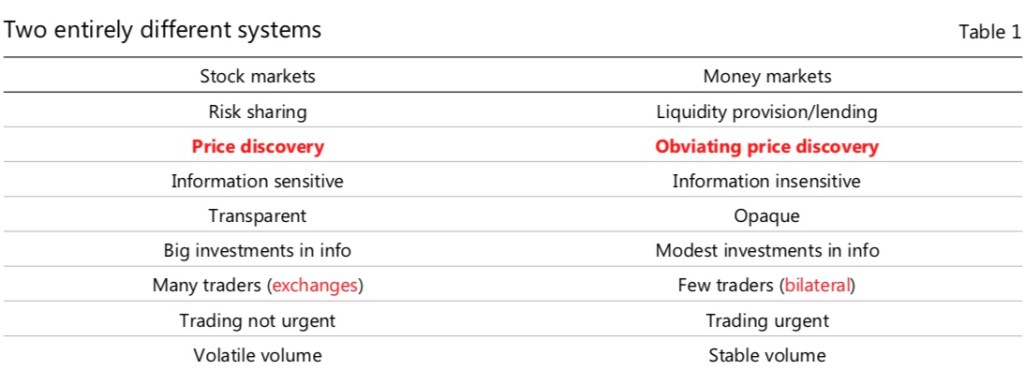
Holmstrom argues that the focus and purpose of stock markets is price discovery for the purpose of allocating risk efficiently. Money markets, in contrast are about obviating the need for price discovery in order to enhance the liquidity of the market. Over-collateralisation is one of the features of the money market that enable deep, liquid trading to occur without the need to understand the underlying risk of the assets that are being funded .

 “The design of money market policies and regulations should recognise that money markets are very different from stock markets. Lessons from the latter rarely apply to the former, because markets for risk-sharing and markets for funding have their own separate logic. The result is two coherent systems with practices that are in almost every respect polar opposites.”

From “Understanding the role of debt in the financial system” Bengt Holmstrom (BIS Working Papers No 479 – January 2015)

Holmstrom appears to have written the paper in response to what he believes are misconceived attempts to reform credit markets in the wake of the recent financial crisis. These reforms have often drawn on insights grounded in our understanding of stock markets where information and transparency are key requirements for efficient price discovery and risk management. His paper presents a perspective on the logic of credit markets and the structure of debt contracts that highlights the information insensitivity of debt. This perspective explains among other things why he believes that information insensitivity is the natural and desired state of the money markets.

Holmstrom notes that one of the puzzles of the GFC was how people traded so many opaque instruments with a seeming ignorance of their real risk. There is a tendency to see this as a conspiracy by bankers to confuse and defraud customers which in turn has prompted calls to make money market instruments more transparent. While transparency and disclosure is essential for risk pricing and allocation, Holmstrom argues that this is not the answer for money markets because they operate on different principles and serve a different function.

 “I will argue that a state of “no questions asked” is the hallmark of money market liquidity; that this is the way money markets are supposed to look when they are functioning well.”

“Among economists, the mistake is to apply to money markets the lessons and logic of stock markets.”

“The key point I want to communicate today is that these two markets are built on two entirely different, one could say diametrically opposite, logics. Ultimately, this is because they serve two very different purposes. Stock markets are in the first instance aimed at sharing and allocating aggregate risk. To do that effectively requires a market that is good at price discovery.

 “But the logic behind transparency in stock markets does not apply to money markets. The purpose of money markets is to provide liquidity for individuals and firms. The cheapest way to do so is by using over-collateralised debt that obviates the need for price discovery. Without the need for price discovery the need for public transparency is much less. Opacity is a natural feature of money markets and can in some instances enhance liquidity, as I will argue later.”

“Why does this matter? It matters because a wrong diagnosis of a problem is a bad starting point for remedies. We have learned quite a bit from this crisis and we will learn more. There are things that need to be fixed. But to minimise the chance of new, perhaps worse mistakes, we need to analyse remedies based on the purpose of liquidity provision. In particular, the very old logic of collateralised debt and the natural, but sometimes surprising implications this has for how information and risk are handled in money markets, need to be properly appreciated.”

There is a section of the paper titled “purposeful opacity” which, if I understood him correctly, seemed to extend his thesis on the value of being able to trade on an “information insensitive” basis to argue that “opacity” in the debt market is something to be embraced rather than eliminated. I struggled with embracing opacity in this way but that in no way diminishes the validity of the distinction he draws between debt and equity markets.

The other useful insight was the way in which over-collateralistion (whether explicit or implicit) anchors the liquidity of the money market. His discussion of why the sudden transition from a state in which the creditworthiness of a money market counter-party is taken for granted to one in which doubt emerges also rings true.

The remainder of this post mostly comprises extracts from the paper that offer more detail on the point I have summarised above. The paper is a technical one but worth the effort for anyone interested in the question of how banks should finance themselves and the role of debt in the financial system.

Money markets versus stock markets

Holmstrom argues that each system displays a coherent internal logic that reflects its purpose but these purposes are in many respects polar opposites.

Stock markets are primarily about risk sharing and price discovery. As a consequence, these markets are sensitive to information and value transparency. Traders are willing to make substantial investments to obtain this information. Liquidity is valuable but equity investors will tend to trade less often and in lower volumes than debt markets.

Money markets, in contrast, Holmstrom argues are primarily about liquidity provision and lending. The price discovery process is much simpler but trading is much higher volume and more urgent.

“The purpose of money markets is to provide liquidity. Money markets trade in debt claims that are backed, explicitly or implicitly, by collateral.

 “People often assume that liquidity requires transparency, but this is a misunderstanding. What is required for liquidity is symmetric information about the payoff of the security that is being traded so that adverse selection does not impair the market. Without symmetric information adverse selection may prevent trade from taking place or in other ways impair the market (Akerlof (1970)).”

“Trading in debt that is sufficiently over-collateralised is a cheap way to avoid adverse selection. When both parties know that there is enough collateral, more precise private information about the collateral becomes irrelevant and will not impair liquidity.”

The main purpose of stock markets is to share and allocate risk … Over time, stock markets have come to serve other objectives too, most notably governance objectives, but the pricing of shares is still firmly based on the cost of systemic risk (or a larger number of factors that cannot be diversified). Discovering the price of systemic risk requires markets to be transparent so that they can aggregate information efficiently.     

Purposeful opacity

“Because debt is information-insensitive … traders have muted incentives to invest in information about debt. This helps to explain why few questions were asked about highly rated debt: the likelihood of default was perceived to be low and the value of private information correspondingly small.”

 Panics: The ill consequences of debt and opacity

“Over-collateralised debt, short debt maturities, reference pricing, coarse ratings, opacity and “symmetric ignorance” all make sense in good times and contribute to the liquidity of money markets. But there is a downside. Everything that adds to liquidity in good times pushes risk into the tail. If the underlying collateral gets impaired and the prevailing trust is broken, the consequences may be cataclysmic”

“The occurrence of panics supports the informational thesis that is being put forward here. Panics always involve debt. Panics happen when information-insensitive debt (or banks) turns into information-sensitive debt … A regime shift occurs from a state where no one feels the need to ask detailed questions, to a state where there is enough uncertainty that some of the investors begin to ask questions about the underlying collateral and others get concerned about the possibility”

These events are cataclysmic precisely because the liquidity of debt rested on over-collateralisation and trust rather than a precise evaluation of values. Investors are suddenly in the position of equity holders looking for information, but without a market for price discovery. Private information becomes relevant, shattering the shared understanding and beliefs on which liquidity rested (see Morris and Shin (2012) for the general mechanism and Goldstein and Pauzner (2005) for an application to bank runs).

Would transparency have helped contain the contagion?

“A strong believer in the informational efficiency of markets would argue that, once trading in credit default swaps (CDS) and then the ABX index began, there was a liquid market in which bets could be made both ways. The market would find the price of systemic risk based on the best available evidence and that would serve as a warning of an imminent crisis. Pricing of specific default swaps might even impose market discipline on the issuers of the underlying debt instruments”

 Shadow banking

 “The rapid growth of shadow banking and the use of complex structured products have been seen as one of the main causes of the financial crisis. It is true that the problems started in the shadow banking system. But before we jump to the conclusion that shadow banking was based on unsound, even shady business practices, it is important to try to understand its remarkable expansion. Wall Street has a hard time surviving on products that provide little economic value. So what drove the demand for the new products?”

 “It is widely believed that the global savings glut played a key role. Money from less developed countries, especially Asia, flowed into the United States, because the US financial system was perceived to be safe … More importantly, the United States had a sophisticated securitisation technology that could activate and make better use of collateral … Unlike the traditional banking system, which kept mortgages on the banks’ books until maturity, funding them with deposits that grew slowly, the shadow banking system was highly scalable. It was designed to manufacture, aggregate and move large amounts of high-quality collateral long distances to reach distant, sizable pools of funds, including funds from abroad.”

“Looking at it in reverse, the shadow banking system had the means to create a lot of “parking space” for foreign money. Securitisation can manufacture large amounts of AAA-rated securities provided there is readily available raw material, that is, assets that one can pool and tranche”

“I am suggesting that it was an efficient transportation network for collateral that was instrumental in meeting the global demand for safe parking space.”

 “The distribution of debt tranches throughout the system, sliced and diced along the way, allowing contingent use of collateral”

“Collateral has been called the cash of shadow banking (European repo council (2014)). It is used to secure large deposits as well as a host of derivative transactions such as credit and interest rate swaps.”  

There is a relatively recent, but rapidly growing, body of theoretical research on financial markets where the role of collateral is explicitly modelled and where the distinction between local and global collateral is important

“Viewed through this theoretical lens, the rise of shadow banking makes perfectly good sense. It expanded in response to the global demand for safe assets. It improved on traditional banking by making collateral contingent on need and allowing it to circulate faster and attract more distant capital. In addition, securitisation created collateral of higher quality (until the crisis, that is) making it more widely acceptable. When the crisis hit, bailouts by the government, which many decry, were inevitable. But as just discussed, the theory supports the view that bailouts were efficient even as an ex ante policy (if one ignores potential moral hazard problems). Exchanging impaired collateral for high-quality government collateral, as has happened in the current crisis (as well as historically with clearing houses), can be rationalised on these grounds.”

 Some policy implications

 A crisis ends only when confidence returns. This requires getting back to the no-questions-asked state ….

Transparency would likely have made the situation worse

“By now, the methods out of a crisis appear relatively well understood. Government funds need to be committed in force (Geithner (2014)). Recapitalisation is the only sensible way out of a crisis. But it is much less clear how the banking system, and especially shadow banking, should be regulated to reduce the chance of crisis in the first place.  The evidence from the past panic suggests that greater transparency may not be that helpful.”

“The logic of over-capitalisation in money markets leads me to believe that higher capital requirements and regular stress tests is the best road for now.”

“Transparency can provide some market discipline and give early warning of trouble for individual banks. But it may also lead to strategic behaviour by management. The question of market discipline is thorny. In good times market discipline is likely to work well. The chance that a bank that is deemed risky would trigger a panic is non-existent and so the bank should pay the price for its imprudence. In bad times the situation is different. The failure of a bank could trigger a panic. In bad times it would seem prudent to be less transparent with the stress tests (for some evidence in support of this dichotomy, see Machiavelli (1532)).”

“On money, debt, trust and central banking”

Is the title of an interesting paper by Claudio Borio (Head of the Monetary and Economic Department at the BIS). This link will take you to the paper but my post offers a short summary of what I took away from it.

Overview of the paper

Borio’s examination of the properties of a well functioning monetary system:

  • stresses the importance of the role trust plays in this system and of the institutions needed to secure that trust.
  • explores in detail the ways in which these institutions help to ensure the price and financial stability that is critical to nurturing and maintaining that trust.
  • focuses not just on money but also the transfer mechanisms to execute payments (i.e. the “monetary system”)

“My focus will be the on the monetary system, defined technically as money plus the transfer mechanisms to execute payments. Logically, it makes little sense to talk about one without the other. But payments have too often been taken for granted in the academic literature, old and new. In the process, we have lost some valuable insights.”

Borio: Page 1

In the process, he addresses several related questions, such as

  • the relationship between money and debt,
  • the viability of cryptocurrencies as money,
  • money neutrality, and
  • the nexus between monetary and financial stability.

Borio highlights three key points he wants you to take away from his paper

First, is the fundamental way in which the monetary system relies on trust and equally importantly the role that institutions, the central bank in particular, play in ensuring there is trust in the system. At the technical level, people need to trust that the object functioning as money will be generally accepted and that payments will be executed but it also requires trust that the system will deliver price and financial stability in the long run.

Second, he draws attention to the “elasticity of credit” (i.e. the extent to which the system allows credit to expand) as a key concept for understanding how the monetary system works. It is well understood that allowing too much credit expansion can cause serious economic damage in the long run but elasticity of credit, he argues, is essential for the day to day operations of the payment system.

Third, the need to understand the ways in which price and financial stability are different but inexorably linked. As concepts, they are joined at the hip: both embody the trust that sustains the monetary system. But the underlying processes required to achieve these outcomes differ, so that there can be material tensions in the short run.

These are not necessarily new insights to anyone who has being paying attention to the questions Borio poses above, but the paper does offer a good, relatively short, overview of the issues.

I particularly liked the way Borio

  • presented the role elasticity of credit plays in both the short and long term functioning of the economy and how the tension between the short and long term is managed,
  • covered the relationship between money, debt and trust (“we can think of money as an especially trustworthy type of debt”), and
  • outlined how and why the monetary system should be seen, not as an “outer facade” but rather as a “cornerstone of an economy”

The rest of this post contains more detailed notes on some, but not all, of the issues covered in the paper.

Elements of a well functioning monetary system

The standard definition of money is based on its functions as
1) Unit of account
2) Means of payment
3) Store of value

Borio expands the focus to encompass the “monetary system”as a whole, introducing two additional elements. Firstly the need to consider the mechanisms the system uses to transfer the means of payment and settle transactions. Secondly, the ways in which the integrity of the chosen form of money as a store of value is protected.

” In addition, compared with the traditional focus on money as an object, the definition crucially extends the analysis to the payment mechanisms. In the literature, there has been a tendency to abstract from them and assume they operate smoothly in the background. I believe this is one reason why money is often said to be a convention …. But money is much more than a convention; it is a social institution (eg Giannini (2011)). It is far from self-sustaining. Society needs an institutional infrastructure to ensure that money is widely accepted, transactions take place, contracts are fulfilled and, above all, agents can count on that happening”

Borio: Page 3

The day to day operation of the monetary system

Borio highlights two aspects of the day to day operations of the monetary system.

  1. The need for an elastic supply of the means of payment
  2. The need for an elastic supply of bank money more generally

In highlighting the importance of the elasticity of credit, he also draws attention to “the risk of overestimating the distinction between credit (debt) and money”.

The central banks’ elastic supply of the means of payment is essential to ensure that (i) transactions are settled in the interbank market and (ii) the interest rate is controlled.

“To smooth out interbank settlement, the provision of central bank credit is key. The need for an elastic supply to settle transactions is most visible in the huge amounts of intraday credit central banks supply to support real-time gross settlement systems – a key way of managing risks in those systems (Borio (1995)).”

Borio: Page 5
“…we can think of money as an especially trustworthy type of debt”

Put differently, we can think of money as an especially trustworthy type of debt. In the case of bank deposits, trust is supported by central bank liquidity, including as lender of last resort, by the regulatory and supervisory framework and varieties of deposit insurance; in that of central bank reserves and cash, by the sovereign’s power to tax; and in both cases, by legal arrangements, way beyond legal tender laws, and enshrined in market practice.

Borio: Page 9

Once you understand the extent to which our system of money depends on credit relationship you understand the extent to which trust is a core feature which should not be taken for granted. The users of the monetary system are relying on some implied promises that underpin their trust in it.

“Price and financial instability amount to broken promises.”

Borio: Page 11

While the elasticity of money creation oils the wheels of the payment system on a day to day basis, it can be problematic over long run scenarios where too much elasticity can lead to financial instability. Some degree of elasticity is important to keep the wheels of the economy turning but too much can be a problem because the marginal credit growth starts to be used for less productive or outright speculative investment.

The relationship between price and financial stability

While, as concepts, price and financial stability are joined at the hip, the processes behind the two differ. Let’s look at this issue more closely


The process underpinning financial instability hinges on how “elastic” the monetary system is over longer horizons, way beyond its day-to-day operation. Inside credit creation is critical. At the heart of the process is the nexus between credit creation, risk-taking and asset prices, which interact in a self-reinforcing fashion generating possibly disruptive financial cycles (eg Borio (2014)). The challenge is to ensure that the system is not excessively elastic drawing on two monetary system anchors. One operates on prices – the interest rate and the central bank’s reaction function … The other operates on quantities: bank regulatory requirements, such as those on capital or liquidity, and the supervisory apparatus that enforces them.

Borio: Page 12

Given that the processes underlying price and financial stability differ, it is not surprising that there may be material tensions between the two objectives, at least in the near term. Indeed, since the early 1980s changes in the monetary system have arguably exacerbated such tensions by increasing the monetary system’s elasticity (eg Borio (2014)). This is so despite the undoubted benefits of these changes for the world economy. On the one hand, absent a sufficiently strong regulatory and supervisory apparatus – one of the two anchors – financial liberalisation, notably for banks, has provided more scope for outsize financial cycles. On the other hand, the establishment of successful monetary policy frameworks focused on near-term inflation control has meant that there was little reason to raise interest rates – the second anchor – since financial booms took hold as long as inflation remained subdued. And in the background, with the globalisation of the real side of the economy putting persistent downward pressure on inflation while at the same time raising growth expectations, there was fertile ground for financial imbalances to take root in.

Borio: Page 16

Borio concludes that the monetary system we have is far from perfect but it is better than the alternatives

Borio concludes that the status quo, while far from perfect, is worth persisting with. He rejects the cryptocurrency path but does not explicitly discuss other radical options such as the one proposed by Mervyn King, in his book “The End of Alchemy”. The fact that he believes “… the distinction between money and debt is often overplayed” could be interpreted as an indirect rejection of the variations on the Chicago Plan that have recently reentered public debate. It would have been interesting to see him address these alternative monetary system models more directly.

In Borio’s own words ….

The monetary system is the cornerstone of an economy. Not an outer facade, but its very foundation. The system hinges on trust. It cannot survive without it, just as we cannot survive without the oxygen we breathe. Building trust to ensure the system functions well is a daunting challenge. It requires sound and robust institutions. Lasting price and financial stability are the ultimate prize. The two concepts are inextricably linked, but because the underlying processes differ, in practice price and financial stability have often been more like uncomfortable bedfellows than perfect partners. The history of our monetary system is the history of the quest for that elusive prize. It is a journey with an uncertain destination. It takes time to gain trust, but a mere instant to lose it. The present system has central banks and a regulatory/supervisory apparatus at its core. It is by no means perfect. It can and must be improved.55 But cryptocurrencies, with their promise of fully decentralised trust, are not the answer.

Paraphrasing Churchill’s famous line about democracy, “the current monetary system is the worst, except for all those others that have been tried from time to time”.

Page 18

The topic is not for everyone, but I found the paper well worth reading.

Tony

Why banks are different

A previous post explored the question of whether banks are just like other companies or somehow unique. The post listed three distinctive features I believe make banks different and perhaps “special”:

  • The way in which net new lending by banks can create new bank deposits which in turn are treated as a form of money in the financial system (i.e. one of the unique things banks do is create a form of money);
  • The reality that a large bank cannot be allowed to fail in the conventional way (i.e. bankruptcy followed by reorganisation or liquidation) that other companies and even countries can (and frequently do); and
  • The extent to which bank losses seem to follow a power law distribution and what this means for measuring the expected loss of a bank across the credit cycle.

This post will focus on the first two features which I think are related. As a rule, I am a fan of the principle of “strong views, lightly held”. I feel pretty strongly that my arguments for why banks are different are robust but acknowledge that there are contrary views on the question. My earlier post used a paper by Anat Admati and Martin Hellwig (frequently cited as authorities on the issues of bank capital discussed in this post) “The Parade of the Bankers’ New Clothes Continues: 31 Flawed Claims Debunked” as an example of the alternative perspective.

It is up to the reader to determine the validity of my rebuttal of Admati and Hellwig’s arguments but I recently read an interesting paper by Joseph Sommer that I think supports the position I was making for why banks are different. Sommer wrote the paper, titled “ Why Bail-In? And How!”, while working as an assistant vice president and counsel at the Federal Reserve Bank of New York. Central to his analysis is the concept of “financial liabilities”

Financial Liabilities

Sommer argues that one of the features that distinguishes a bank is that they create a special type of liability which he labels “financial liabilities”. He defines a financial liability as one whose value is impaired by the insolvency process. That may sound like a statement of the obvious. Insolvency naturally threatens the value of liabilities via shortfalls in the liquidation value of assets but Sommer is making a different point. He is talking about something more than credit risk impairing the value of these liabilities.

The reason is that “financial liabilities” are also distinguished by the extent to which the function of the financial instrument is to provide liquidity or shift risk; i.e. by the extent to which the liability is a “product” not just a form of finance. Bankruptcy disrupts the ability of these financial liabilities to perform these economic functions.

The customers who own these financial liabilities have a creditor relationship with the bank, just like other liability holders do. However, they do not buy these instruments as “investments”, they are customers buying a product.

“The creditor in such contracts is not primarily an investor: paying money now to get more later. Instead, it wants liquidity, or insurance, or other kind of risk shifting”

Insolvency destroys the value of financial liabilities

“The central policy implication of this article is that Financial liabilities deserve priority treatment in insolvency law but the standard bankruptcy process cannot do this.”

The bankruptcy process seeks to protect the value of the business by protecting the value of business assets. To protect the value of business assets, the process will typically seek to temporarily suspend the rights of liability holders to be repaid.

For non-financial companies, the value of business liabilities in the bankruptcy process is defined by their contractual claim (e.g. the promised payment of principal and interest) and their priority in the loss hierarchy. In theory, that value is not impacted beyond any shortfall in assets versus the priority of the claim the liability has, and the time value of delayed payment.

However, the value of a bank is also embedded in its financial liabilities not just its assets. Consequently, suspending the rights of these financial liabilities impairs the value of the liability in ways that harm the business.

“This notion of a financial liability as a product has implications for insolvency law, apart from priorities. Insolvency law assumes that firms often need a breathing spell from their creditors, so that they can pick themselves up, continue operating, and start reorganizing. It therefore places all claims in a collective procedure and places a moratorium on efforts to collect assets. However, financial products are operations of the financial firm. Freezing performance on a financial product, whether by automatic stay or treatment as a claim, is akin to prohibiting a carmaker in Chapter 11 from making and selling cars, or an airline from selling tickets, buying jet fuel, and flying planes”

Adapting to the challenges of the bank balance sheet

Ideally, insolvency law would preserve the liquidity or risk shifting functions of financial liabilities but the standard bankruptcy process is not designed to deal with this feature of the bank balance sheet. Sommer favours bail-in as a way to overcome the problems of applying the traditional insolvency process to a bank balance sheet. An alternative is to simply require banks to be capitalised with a much higher level of common equity.

Higher common equity is the solution advocated by Admati and Hellwig and most recently by the RBNZ.  I side with Sommer on this question, favouring a combination of:

  • common equity calibrated to make a sound, well managed, well supervised bank Unquestionably Strong,
  • supplemented with sufficient additional loss absorbing “capital” calibrated to what would be required if the bank were high risk, poorly managed and possibly poorly supervised

The distinction I am drawing between the capital requirements of “good” and “bad” banks might be dismissed as splitting hairs but it strikes me as a frequent source of confusion in the debate about how much capital and what type. Good banks don’t actually seem to need much capital whereas bad banks need a lot. Obviously, we don’t know ex ante which banks are good and which are bad. We do know that common equity is the foundation of any capital structure and we could just capitalise all banks with common equity on the basis that they might be bad banks. While not expressed so bluntly, this I think is effectively the solution recently proposed by the RBNZ.

Which solution is better lies outside the scope of this post. I have touched on this question previously in a few posts (see here, here, here, and here) but am yet to bring my thoughts together in one place. The main purpose in this post was simply to introduce readers to an interesting paper that I think adds some useful insights to the question of what makes banks different from non-financial companies.

Conclusion

There are various ways to make the argument that banks are different to non-financial firms. My earlier post highlighted the way in which net new lending by banks can create new bank deposits which in turn are treated as a form of money in the financial system (i.e. one of the unique things banks do is create a form of money). This in turn helps explain why bank supervisors are reluctant to allow large banks to fail in the conventional way that other companies and even countries can (and frequently do).

The argument I developed in the earlier post is a subset of a broader theme in Sommer’s paper. I focussed on the need to protect the value of deposits if they are to function as money. Deposits in Sommer’s argument are part of a broader class of what he labels “financial liabilities”. The conclusion however is the same, bankruptcy can protect the value of non-financial firms but it almost certainly destroys value in banks by impairing the value of financial liabilities. It is not the optimal solution for dealing with a failing bank.

It is also worth reading a paper by Gary Gorton and George Pannacchi titled “Financial Intermediaries and Liquidity Creation” which offers another angle on these issues. They note that credit intermediation between savers and borrowers has traditionally been identified as the key economic role of banks. Banks clearly do intermediation, but they argue that the really critical function of banks is to provide a liquid asset in the form of bank deposits that serve as a form of money (arguably the primary form of money).

The problem is that the capacity of a bank deposit to function as money depends on the ability of uninformed agents to use it without fear of loss; i.e. the extent to which the value of the instrument is insulated from any adverse information about the counterparty (aka bank). There are a variety of ways to make bank deposits liquid in the sense that Gorton/Pennacchi define it (i.e. insensitive to adverse information about the bank) but they argue for solutions where depositors have a sufficiently deep and senior claim on the banks assets that any volatility in their value is of no concern to them. This earlier post offers more detail on Gorton and Pennacchi’s paper.

I intend to try and consolidate these thoughts in a future post that will set out my take on the case for bail-in. In the interim, I can recommend the two papers referenced in this post to anyone seeking to understand bank balance sheets.

Tony

What should count as bank capital?

My last post looked at a RBNZ consultation paper which addressed the question “How much capital is enough?”. The overall quantum of capital the RBNZ arrived at (16% of RWA plus) seemed reasonable but it was less obvious that relying almost entirely on CET1 was the right solution. That prompted me to revisit an earlier consultation paper in which the RBNZ set out its case for why it did not want contingent capital instruments to play a significant role in the capital structure of the banks it supervises. This post explores the arguments the RBNZ marshals to support its position as part of a broader exploration of the debate over what counts as capital.

The traditional approach to this question assumes that common equity is unquestionably the best form of capital from the perspective of loss absorption. Consequently, the extent to which alternative forms of funding count as capital is judged by common equity benchmarks; e.g. the extent to which the funding is a permanent commitment (i.e. no maturity date) and the returns paid to investors depend on the profitability or capacity of the company to pay (failure to pay is not an event of default).

There is no dispute that tangible common equity unquestionably absorbs loss and is the foundation of any company’s capital structure but I believe contingent convertible capital instruments do potentially add something useful to the bank capital management toolkit. I will attempt to make the case that a foundation of common equity, supplemented with some debt that converts to common equity if required, is better than a capital structure comprised solely or largely of common equity.

The essence of my argument is that there is a point in the capital structure where adding contingent convertible instruments enhances market discipline relative to just adding more common equity. The RBNZ discusses the potential value of these structures in their consultation paper:

49. The theoretical literature on contingent debt explores how these instruments might reduce risk (i.e. lower the probability of insolvency) for an individual bank.  

50. Two effects have been identified. Firstly, adding contingent debt to a bank’s balance sheet directly increases the loss absorbing potential of the bank, relative to issuing pure debt (but not relative to acquiring more common equity). This follows directly from the fact that removing the debt is an essential part of every contingent debt instrument. Secondly, depending on the terms, contingent capital may cause bank management to target a lower level of risk (incentive effects). In other words, in theory, a contingent debt instrument both reduces the probability a bank will incur losses and absorbs losses that do eventuate. Because of both these factors, contingent debt is expected, in theory, to reduce the risk of bank failure.  

51. Focusing on the second of these effects, management incentives, it matters whether, when the debt is written off, holders are compensated in the form of newly issued shares (“conversion”). If conversion is on such a scale as to threaten existing shareholders with a loss of control of the bank, it will be optimal for bank management to target a lower level of risk exposure for a given set of circumstances than would have been the case otherwise. For example, bank management may be less tolerant of asset volatility, and more likely to issue new equity to existing shareholders, when capital is low rather than risk triggering conversion.”

RBNZ Capital Review Paper 2: What should qualify as bank capital? Issues and Options (para 49 – 51) – Emphasis added

So the RBNZ does recognise the potential value of contingent debt instruments which convert into common equity but chose to downplay the benefits while placing much greater weight on a series of concerns it identified.

What’s in a name – The RBNZ Taxonomy of Capital

Before digging into the detail of the RBNZ concerns, it will be helpful to first clarify terminology. I am using the term Contingent Convertible Instruments for my preferred form of supplementary capital whereas much of the RBNZ paper focuses on what it refers to as “Contingent debt instruments“, which it defines in part as “debt that absorbs loss via write-off, which may or may not be followed by conversion”.

I had not picked this up on my first read of the RBNZ paper but came to realise we are talking slightly at cross purposes. The key words to note are “contingent” and “convertible”.

  • The “contingent” part of these instruments is non-negotiable if they are to be accepted as bank regulatory capital. The contingency is either a “non-viability event” (e.g. the supervisor determines that the bank must increase common equity to remain viable) or a CET1 ratio of 5.125% or less (what APRA terms a “loss absorption trigger” and the RBNZ refers to as a “going-concern trigger”)
  • “Conversion” however is optional. Loss absorption is non-negotiable for bank regulatory capital but it can be achieved in two ways. I have argued that loss absorption is best achieved by converting these capital instruments into common equity but prudential regulation is satisfied so long as the instruments are written-off.

I had taken it as given that these instruments would be convertible but the RBNZ places more emphasis on the possibility that conversion “may or may not” follow write-off. Small point but worth noting when evaluating the arguments.

Why does conversion matter?

The RBNZ understandably focuses on the write-off part of the loss absorption process whereas I focus on conversion because it is essential to preserving a loss hierarchy that allocates losses to common equity in the first instance. If we ignore for a moment the impact of bail-in (either by conversion or write-off), the order in which losses are applied to the various sources of funding employed by a bank follows this loss hierarchy:

  • Going Concern:
    • Common Equity Tier 1 (CET1)
    • Additional Tier 1 (AT1)
  • Insolvency – Liquidation or restructuring:
    • Tier 2 (T2)
    • Senior unsecured
    • Super senior
      • Covered bonds
      • Deposits
      • Insured deposits

Under bail-in, writing off a contingent capital instrument generates an increase in common equity that accrues to the existing ordinary shareholders thereby negating the traditional loss hierarchy that requires common equity to be exhausted before more senior instruments can be required to absorb loss.

Conversion is a far better way to effect loss absorption because ordinary shareholders still bear the brunt of any loss, albeit indirectly via the dilution of their shareholding (and associated share price losses). In theory, conversion shields the AT1 investors from loss absorption because they receive common equity equivalent in value to the book value of their claim on the issuer. In practice, it is less clear that the AT1 investors will be able to sell the shares received at the conversion price or better but they are still better off than if they had simply seen the value of their investment written-off. If you are interested in digging deeper, this post looks at how loss absorption works under bail-in.

The RBNZ does recognise this dynamic but still chose to reject these advantages so it is time to look at their concerns.

RBNZ concerns with contingent capital

The RBNZ identified six concerns to justify its in principle decision to exclude the use of contingent capital instruments in the NZ capital adequacy framework.

  1. Possible under-estimation of the tax effects of contingent debt
  2. Reliance on parent entities as purchasers of AT1 contingent debt
  3. Not suitable for retail investors
  4. Banks structured as mutual societies cannot offer contingent debt that includes conversion into common equity
  5. Potential for regulatory arbitrage arising from the tension between tax and capital regulation
  6. Difficulties with exercising regulatory oversight of contingent debt

I don’t imagine the RBNZ is much concerned with my opinion but I don’t find the first three concerns to be compelling. I set out my reasons later in the post but will focus for the moment on three issues that I think do bear deeper consideration. You do not necessarily have to agree with the RBNZ assessment, or the weight they assign to them, but I believe these concerns must be addressed if we are to make the case for contingent debt.

Stronger arguments against contingent debt

1) Contingent debt gives the larger, listed banks a competitive advantage over mutual societies that are unable to issue ordinary shares

The RBNZ notes that all New Zealand banks are able to issue a version of contingent debt that qualifies as capital, but that some types of banks may have access to a broader – and cheaper – range of capital opportunities than others. The current definition of capital is thus in part responsible for a somewhat uneven playing field.

The primary concern seems to be banks structured as mutual societies which are unable to issue ordinary shares. They cannot offer contingent debt that includes conversion and must rely on the relatively more expensive option of writing-off of the debt to effect loss absorption.

I think this is a reasonable concern but I also believe there may be ways to deal with it. One option is for these banks to issue Mutual Equity Interests as has been proposed in Australia. Another option (also based on an Australian proposal) is that the increased requirements for loss absorbing capital be confined to the banks which cannot credibly be allowed to fail or be resolved in any other way. I recognise that this option benefits from the existence of deposit insurance which NZ has thus far rejected.

I need to do bit more research on this topic so I plan to revisit the way we deal with small banks, and mutuals in particular, in a future post.

2) Economic welfare losses due to regulatory arbitrage opportunities in the context of contingent debt

The tax treatment of payments to security holders is one of the basic tests for determining if the security is debt or equity but contingent debt instruments don’t fall neatly into either box. The conversion terms tied to PONV triggers make the instruments equity like when the issuer is under financial stress while the contractual nature of the payments to security holders makes them appear more debt like under normal operating conditions.

I can see a valid prudential concern but only to the extent the debt like features the tax authority relied on in making its determination regarding tax-deductibility somehow undermined the ability of the instrument to absorb loss when required.

There have been instances where securities have been mis-sold to unsophisticated investors (the Monte dei Paschi di Sienna example cited by the RBNZ is a case in point) but it is less obvious that retail investment by itself is sufficient cause to rule out this form of capital.

The only real difference I see over conventional forms of debt is the line where their equity like features come into play. Conventional debt is only ever at risk of loss absorption in the event of bankruptcy where its seniority in the loss hierarchy will determine the extent to which the debt is repaid in full. These new forms of bank capital bring forward the point at which a bank balance sheet can be restructured to address the risk that the restructuring undermines confidence in the bank. The economics of the restructuring are analogous so long as losses are allocated by conversion rather than by write-off alone.

3) Difficulties experienced with the regulatory oversight of contingent debt

Possibly their core concern is that overseeing instrument compliance is a complex and resource-intensive process that the RBNZ believes does not fit well with its regulatory model that emphasises self-discipline and market discipline. The RBNZ highlights two concerns in particular.

  • Firstly the RBNZ has chosen to respond to the challenge of vetting these instruments by instituting a “non-objection process” that places the onus on issuers to confirm that their instruments comply with the capital adequacy requirements.
  • Secondly, notwithstanding the non objection process, the added complexity of the instruments relative to common equity, still requires significant call on prudential resources.

This I think, is the strongest objection the RBNZ raises against contingent debt. Contingent debt securities are clearly more complex than common equity so the RBNZ quite reasonably argues that they need to bring something extra to the table to justify the time, effort and risk associated with them. There is virtually no justification for them if they do, as the RBNZ asserts, work against the principles of self and market discipline that underpin its regulatory philosophy.

Three not so compelling reasons for restricting the use of contingent capital instruments (“in my humble opinion’)

1) Possible under-estimation of the tax effects of contingent debt

The first concern relates to the RBNZ requirement that banks must acknowledge any potential tax implications arising from contingent debt and reflect these potential “tax offsets” in the reported value of capital. Banks are required to obtain a binding ruling from the NZ tax authority (or voluntarily take a tax ”haircut”). The RBNZ acknowledges that a binding ruling can provide comfort that tax is fully accounted for under prudential requirements, but quite reasonably argues that this will only be the case if the ruling that is sought is appropriately specified so as to capture all relevant circumstances.

The RBNZ’s specific concern seems to be what happens when no shares are issued in the event of the contingent loss absorption feature being triggered and hence no consideration is paid to investors in exchange for writing off their debt claim. The bank has made a gain that in principle would create a tax lability but it also seems reasonable to assume that the write off could only occur if the bank was incurring material losses. It follows then that the contingent tax liability created by the write off is highly likely to be set off against the tax losses such that there is no tax to pay.

I am not a tax expert so I may well be missing something but I can’t see a practical risk here. Even in the seemingly unlikely event that there is a tax payment, the money represents a windfall gain for the public purse. That said, I recognise that the reader must still accept my argument regarding the value of having the conversion option to consider it worth dealing with the added complexity.

2) A reliance on parent entities as purchasers of AT1 contingent debt

I and the RBNZ both agree that one of the key planks in the case for accepting contingent debt as bank capital is the beneficial impact on bank risk taking generated by the risk of dilution but the RBNZ argues this beneficial impact is less than it could be when the instrument is issued by a NZ subsidiary to its publicly listed parent.

I may be missing something here but the parent is exposed to dilution if the Non-Viability or Going Concern triggers are hit so I can’t see how that reduces the incentive to control risk unless the suggestion is that NZ management will somehow have the freedom to pursue risky business strategies with no input from their ultimate owners.

3) Retail investors have acquired contingent debt

The RBNZ cites some statistical evidence that suggests that, in contrast to the experience overseas, there appears to be limited uptake by wholesale investors of contingent debt issued by the big four banks. This prompts them to question whether the terms being offered on instruments issued outside the parent group are not sufficiently attractive for sophisticated investors. This concern seems to be predicated on the view that retail will always be the least sophisticated investors so banks will seek to take advantage of their relative lack of knowledge.

It is arguably true that retail investors will tend be less sophisticated than wholesale investors but that should not in itself lead to the conclusion that any issue targeted at retail is a cynical attempt at exploitation or that retail might legitimately value something differently to the way other investors do. The extent that the structures issued by the Australian parents have thus far concentrated on retail, for example, might equally be explained by the payment of franking credit that was more highly valued by the retail segment. Offshore institutions might also have been negative on the Australian market therefore pushing Australian banks to focus their efforts in the domestic market.

I retain an open mind on this question and need to dig a bit deeper but I don’t see how the fact that retail investment dominates the demand for these structures at a point in time can be construed to be proof that they are being mis-sold.

The RBNZ’s answer ultimately lies in their regulatory philosophy

The reason that the RBNZ rejects the use of these forms of supplementary capital ultimately appears to lie in its regulatory philosophy which is based on the following principles

  • Self discipline on the part of the financial institutions they supervise
  • Market discipline
  • Deliberately conservative
  • Simplicity

The RBNZ also acknowledges the value of adopting BCBS consistent standards but this is not a guiding principle. It reserves the right to adapt them to local needs and, in particular, to be more conservative. It should also be noted that the RBNZ has quite deliberately rejected adopting deposit insurance on the grounds (as I understand it) that this encourages moral hazard. They take this a step further by foregoing any depositor preference in the loss hierarchy and by a unique policy of Open Bank Resolution (OBR) under which deposits are explicitly included in the liabilities which can be written down in need to assist in the recapitalisation of an insolvent bank.

In theory, the RBNZ might have embraced contingent convertible instruments on the basis of their consistency with the principles of self and market discipline. The threat of dilution via conversion of the instrument into common equity creates powerful incentives not just for management to limit excessive risk taking but also for the investors to exert market discipline where they perceive that management is not exercising self-discipline.

In practice, the RBNZ seems to have discounted this benefit on the grounds that that there is too much risk, either by design or by some operational failure, that these instruments might not convert to common equity. They also seem quite concerned with structures that eschew conversion (i.e. loss absorption effected by write-off alone) but they could have just excluded these instruments rather than a blanket ban. Having largely discounted or disregarded the potential benefit, the principles of deliberate conservatism and simplicity dictate their proposed policy position, common equity rules.

Summing up

This post only scratches the surface of this topic. My key point is that contingent convertible capital instruments potentially add something useful to the bank capital management toolkit compared to relying entirely on common equity. The RBNZ acknowledge the potential upside but ultimately argue that the concerns they identify outweigh the potential benefits. I have reviewed their six concerns in this post but need to do a bit more work to gain comfort that I am not missing something and that my belief in the value of bail-in based capital instruments is justified.

Tony

Revisiting the mortgage risk weight fact check

The ACCC’s Final Report on its “Residential Mortgage Price Inquiry” (Section 4.3) listed four challenges faced by the smaller banks in making decisions about their residential mortgage product offering; specifically 1) APRA’s prudential benchmarks, 2) APRA’s regulatory capital requirements, 3) service levels to brokers and aggregators, and 4) customer loyalty to the big four banks and customer inertia.

The smaller banks undoubtedly face a number of challenges in competing with the bigger banks but I have argued previously that the difference in regulatory capital requirements is overstated.

The ACCC describe the challenge with APRA’s regulatory capital requirements as follows:

For otherwise identical ADIs, the advantage of a 25% average risk weight (APRA’s minimum for IRB banks) compared to the 39% average risk weight of standardised ADIs is a reduction of approximately 0.14 percentage points in the cost of funding the loan portfolio. This difference translates into an annual funding cost advantage of almost $750 on a residential mortgage of $500 000, or about $15 000 over the 30 year life of a residential mortgage (assuming an average interest rate of 7% over that period).

The report does offer some caveats on the size of the difference in risk weights …

This estimate is indicative only. No allowance has been made for the cost to IRB-accredited ADIs of achieving or maintaining their IRB accreditation, or for other differences between IRB and standardised ADIs in funding their residential mortgage portfolios, such as differences in wholesale funding costs and other aspects of APRA’s capital adequacy regime which impose additional capital costs on IRB-accredited banks.

But the commentary I read in the financial press just focussed on the nominal difference in the risk weights (i.e. 25% versus 39%) without any of the qualifications. My early post on this question identified 5 problems with the simplistic comparison cited by the ACCC:

  • Problem 1 – Capital adequacy ratios differ
  • Problem 2 – You have to include capital deductions
  • Problem 3 – The standardised risk weights for residential mortgages seems set to change
  • Problem 4 – The risk of a mortgage depends on the portfolio not the individual loan
  • Problem 5 – You have to include the capital required for Interest Rate Risk in the Banking Book? 

Summing up

My aim in this and the original post was not to defend the big banks but rather to try to contribute some of the knowledge I have acquired working in this area to what I think is an important but misunderstood question. In the interests of full disclosure, I have worked for one of the large Australian banks and may continue to do work for them in the future.

On a pure risk basis, it seems to me that the loan portfolio of a large bank will tend to be more diversified, and hence lower risk, than that of a smaller bank. It is not a “gift” for risk weights to reflect this.

There is a legitimate debate to be had regarding whether small banks should be given (gifted?) an advantage that helps them compete against the big banks. That debate however should start with a proper understanding of the facts about how much advantage the large banks really have and the extent to which their lower risk weights reflect lower risk.

If you disagree tell me what I am missing …

Modelling bank capital requirements – The Zone of Validity

Even casual students of bank capital will be familiar with the view that advanced modelling of capital requirements is a waste of time – offering no useful insights at all and indeed dangerous to the extent these “advanced” or “sophisticated” approaches create a false sense of safety that results in excessive leverage and or credit growth.

The more technical critiques of modelling focus on the fact that a capital requirement, by definition, seeks to measure the unexpected. Mervyn King (“The End of Alchemy“), for example, argues that there is a core element of what he labels “radical uncertainty” (aka Knightian uncertainty) that cannot be modelled in the probabilistic sense that underpins the advanced approaches to capital risk measurements.

“… no amount of sophisticated statistical analysis is a match for the historical experience that “stuff happens”.  At the heart of modern macroeconomics is the same illusion that uncertainty can be confined to the mathematical manipulation of known probabilities.”

There are I think substantial elements of truth in this view. The high confidence level employed in the regulatory capital requirement was intended to bring a healthy margin of safety to the measure but the idea that a model derived answer made bank insolvency a 1: 1000 year event was never very robust once you started to look at the detail.

To be fair, the architects of Basel II were well aware of the restrictive assumptions they had made (e.g. well diversified risk, portfolio invariant) expecting that both banks and regulators would make suitable allowances for the extent to which real banks did not conform to the ideal model assumptions. In practice though, these caveats tended to get lost in the enthusiasm for a seemingly precise and robust number. Disclosure and market discipline also proved much less robust controls on bank leverage than seemed logical in the 1980’s when the Efficient Market Hypothesis reigned supreme.

There is however a “zone of validity” in which I believe that models do offer useful insight and guidance. I want to focus here on the models employed in the Internal Ratings Based (IRB) approach to credit risk; the dominant risk class for many banking systems.

I encountered the term “zone of validity” in Wilmott and Orrell’s book (The Money Formula) but I am sure the idea is not new; it is also fairly intuitive

“The key then is to keep with simple models, but make sure that the model is capturing the key dynamics of the system, and only use it within its zone of validity. Models should be seen as imperfect patches, rather than as accurate representations of the complete system. Instead of attempting … a better, more complete “theory of everything”, the aim is to find models that are useful for a particular purpose, and know when they break down”.

“The Money Formula”, Wilmott and Orrell, Chapter 8

Applying the “zone of validity” filter to IRB models

The first thing to do is distinguish the different types of models employed in the IRB framework (Yes Virginia, there is not just one monolithic IRB model). One of the people I go to when I want to understand credit risk has proposed the following taxonomy of IRB models which can be ranked in terms of robustness and empirical evidence for their effectiveness.

  • Relative Risk (Rank Ordering) Models – that measure relative risk (aka rank ordering) at an obligor level – e.g. Probability of Default (PD) rating models, Exposure at Default (EAD) segmentation models, Loss Given Default (LGD) segmentation models.
  • Point in Time (Econometric) Models – that capture the relationship between external systemic (economic) drivers and point in time default rates or loss rates – e.g. point in time PD
  • Highly Extrapolated, Point in Time, Models – Essentially the same form of model as above but applied to highly stressed or rare scenarios – e.g. stress testing models targeting a 1 in 25 year or higher scenario consistent with a severe recession
  • VAR models –  which attempt to describe the entirety of the credit loss distribution and correlation effects, usually with the goal to quantify the size of low probability tail loss events such as a 1 in 100 or 1 in 1000 year loss – e.g. capital models

Relative Risk models arguably have the widest zone of validity. We may not be able to predict precisely when individual exposures will default but models tend to do a pretty reasonable job of rank ordering the risk of default. We also have a pretty good handle on the kinds of factors that increase the severity of loss in the event of default, at least in relative terms.

From there on, the zone of validity progressively shrinks along with the degree of precision that the models are capable of offering. That said, the models can still offer useful insights so long as we understand the limitations of what they are saying.

  • Point in time models will help anchor loan loss provisioning; like any model, there will be a degree of error, but the structured approach makes it much easier to deconstruct the overall loan loss estimate and figure out where you agree or disagree with the output.
  • Highly extrapolated models such as you might see in a stress testing model clearly expand the range of error but again they offer a way of peering under the hood and seeing what part of the output looks wrong;
  • VAR models arguably do operate outside their zone of validity (at a minimum they are not a reliable measure of the 1 in 1000  year risk the bank’s capital will be sufficient) so the answers they provide need to be used with that weakness in mind.

The fixes and the potential unintended consequences

A very common response to the modelling problems discussed above is to apply more conservative values to the risk parameters (i.e PD, LGD, EAD and Correlation) employed in the IRB capital calculation. This is relatively easy to do, feels intuitively right and gives a higher capital requirement but this approach also has costs. The cost may be justified but should be recognised.

One of the issues with arbitrarily increasing risk estimates is that you start to distort the model outputs that do lie within their zone of validity. Modelling (estimating) Regulatory Expected Loss (REL), in particular, should be quite simple – just multiply PD by LGD by EAD and “voila”, we have a 1 year measure of what we expect the credit portfolio to lose at this point in the credit cycle. In principle, we can also be reasonably confident that our stressed loss estimate is useful provided we are honest about the quality of our credit portfolio and don’t get too ambitious on the level of severity. It seems to me that these applications are mostly within the zone of validity of the models we use to measure these things; and we hold capital to cover the risk that something unexpected happens.

However, in practice, we start the REL estimate by using a “downturn” measure of LGD that reflects what we expect to lose during a part of the credit cycle that may or may not coincide with where we actually are at this point in time. Next we increase PD to be conservative; again that choice of a conservative measure may or may not reflect were we actually are in the credit cycle at this point in time. The same goes for EAD. Exactly what we are measuring starts to become unclear and it is hard to see how deliberately introducing reduced clarity can ever be desirable.

My purpose here is not oppose the idea of bank capital needing to be a conservative measure (and I know that there are reasons deeply embedded in the IRB model’s history for why we use a downturn measure of LGD). My point is simply that the way that you pursue that conservatism has consequences and I have used Regulatory Expected Loss as an example. If the aim is simply to require a bank to hold more capital then there are alternatives (increase the correlation assumptions or increase the capital buffer ratio requirements) that achieve that outcome without distorting the REL measure.

Tell me what I am missing …

Tony