My Adventures in CryptoLand – Net Interest

Marc Rubinstein lays out a detailed account of his initial explorations of decentralised finance. His professional background (like mine) is grounded in the conventional financial system so I found this very useful. Even better it is a short read with some hard numbers (time and cost) on the user experience.

My only quibble is that he calls these decentralised financial enties “banks”. Call me pedantic but none of the institutions discussed are banks and I think the distinction still matters if we want to understand how much of conventional banking will remain as this new chapter in financial innovation plays out.
Link to Marc’s blog here – www.netinterest.co/p/my-adventures-in-cryptoland

Tony – From the Outside

ECB Targeted Review of Internal Models

The European Central Bank recently (April 2021) released a report documenting what had been identified in a “Targeted Review of Internal Models”(TRIM). The TRIM Report has lots of interesting information for subject matter experts working on risk models.

It also has one item of broader interest for anyone interested in understanding what it means for an Australian Authorised Deposit Taking Institution (ADI) to be “Unquestionably Strong” per the recommendation handed down by the Australian Financial System Inquiry in 2014 and progressively being enshrined in capital regulation by the Australian Prudential Regulation Authority (APRA).

The Report disclosed that the TRIM has resulted in 253 supervisory decisions that are expected to result in a 12% increase in the aggregate RWAs of the models covered by the review. European banks may not be especially interested in the capital adequacy of their Australian peers but international peer comparisons have become one of the core lens through which Australian capital adequacy is assessed as a result of the FSI recommendation.

There are various ways in which the Unquestionably Strong benchmark is interpreted but one is the requirement that the Australian ADIs maintain a CET1 ratio that lies in the top quartile of international peer banks. A chart showing how Australian ADIs compare to their international peer group is a regular feature of the capital adequacy data they disclose. The changes being implemented by the ECB in response to the TRIM are likely (all other things being equal) to make the Australian ADIs look even better in relative terms in the future.

More detail …

The ECB report documents work that was initiated in 2016 covering 200 on-site model investigations (credit, market and counterparty credit risk) across 65 Significant Institutions (SI) supervised by ECB under what is known as the Single Supervisory Mechanism and extends to 129 pages. I must confess I have only read the Executive Summary (7 pages) thus far but I think students of the dark art of bank capital adequacy will find some useful nuggets of information.

Firstly, the Report confirms that there has been, as suspected, areas in which the outputs of the Internal Models used by these SI varied due to inconsistent interpretations of the BCBS and ECB guidance on how the models should be used to generate consistent and comparable risk measures. This was not however simply due to evil banks seeking to game the system. The ECB identified a variety of areas in which their requirements were not well specified or where national authorities had pursued inconsistent interpretations of the BCBS/ECB requirements. So one of the key outcomes of the TRIM is enhanced guidance from the ECB which it believes will reduce the instances of variation in RWA due to differences in interpretation of what is required.

Secondly the ECB also identified instances in which the models were likely to be unreliable due to a lack of data. As you would expect, this was an issue for Low Default Portfolios in general and Loss Given Default models in particular. As a result, the ECB is applying “limitations” on some models to ensure that the outputs are sufficient to cover the risk of the relevant portfolios.

Thirdly the Report disclosed that the TRIM has resulted in 253 supervisory decisions that are expected to result in a 12% increase in the aggregate RWAs of the models covered by the review.

As a follow-up to the TRIM investigations, 253 supervisory decisions have been issued or are in the process of being issued. Out of this total, 74% contain at least one limitation and 30% contain an approval of a material model change. It is estimated that the aggregated impact of TRIM limitations and model changes approved as part of TRIM investigations will lead to a 12% increase in the aggregated RWA covered by the models assessed in the respective TRIM investigations. This corresponds to an overall absolute increase in RWA of about €275 billion as a consequence of TRIM and to a median impact of -51 basis points and an average impact of -71 basis points on the CET1 ratios of the in-scope institutions.

European Central Bank, “Targeted Review of Internal Models – Project Report”, April 2021, (page 7)
Summing up

Interest in this report is obviously likely to be confined for the most part to the technical experts that labour in the bowels of the risk management machines operated by the large sophisticated banks that are accredited to measure their capital requirements using internal models. There is however one item of general interest to an Australian audience and that is the news that the RWA of their European peer banks is likely to increase by a material amount due to modelling changes.

It might not be obvious why that is so for readers located outside Australia. The reason lies in the requirement that our banks (or Authorised Deposit-Taking Institutions to use the Australian jargon) be capitalised to an “Unquestionably Strong” level.

There are various ways in which this benchmark is interpreted but one is the requirement that the Australian ADIs maintain a CET1 ratio that lies in the top quartile of international peer banks. A chart showing how Australian ADIs compare to this international peer group is a regular feature of the capital adequacy data disclosed by the ADIs and the changes being implemented by the ECB are likely (all other things being equal) to make the Australian ADIs look even better in relative terms in the future.

Tony – From the Outside
JP Koning’s “over consumptionist” theory of Bitcoin and decentralisation

Interesting post by JP Koning exploring the current debate about the value of Bitcoin and its energy demand.

There are two extreme theories about cryptocurrency energy consumption, both of them bitterly opposed to each other. The first I’ll call the big waste theory. Cryptocurrencies such as Bitcoin and Ethereum serve no useful purpose. Yet they are sucking up huge amounts of useful electricity. Let’s ban them.

The second theory is the vital cog theory. Cryptocurrencies are a useful bit of global financial infrastructure. And so the huge amounts of energy that they are consuming is beneficial. Let’s not impede them.

“The overconsumption theory of bitcoin (and decentralization in general)”, JP Koning, May 2021

Koning offers an alternative “overconsumptionist theory” – worth reading

Tony – From the Outside

Australian bank capital adequacy – building out the Unquestionably Strong framework

In this post, I lay out some problems that I have encountered in attempting to reconcile what it will mean for a D-SIB ADI to be “Unquestionably Strong” under the proposed new framework that APRA outlined in its December 2020 Discussion Paper (“A more flexible and resilient capital framework for ADIs”). Spoiler alert – I think the capital buffers adding up to a 10.5% CET1 prudential requirement may need to be recalibrated once all of the proposed changes to risk weights are tied down. I also include some questions regarding the impact of the RBNZ’s requirement for substantially higher capital requirements for NZ domiciled banks.

The backstory

The idea that Australian Authorised Deposit Taking Institutions (“ADIs” but more commonly referred to as “banks”) needed to be “Unquestionably Strong” originated in a recommendation of the Australian Financial System Inquiry (2014) based on the rationale that Australian ADIs should both be and, equally importantly, be perceived to be more resilient than the international peers with which they compete for funding in the international capital markets.In July 2017, APRA translated the FSI recommendation into practical guidance in an announcementsupported by a longer information paper.

For most people, this all condensed into a very simple message, the systemically important Australian ADIs needed to maintain a Common Equity Tier 1 (CET1) ratio of at least 10.5%. The smaller ADIs have their own Unquestionably Strong benchmark but most of the public scrutiny seems to have focussed on the larger systemically important ADIs.

In the background, an equally important discussion has been playing out regarding the extent to which the Unquestionably Strong framework should take account of the “comparability” and “transparency” of that measure of strength and the ways in which “flexibility” and “resilience” could be added to the mix. This discussion kicked off in earnest with a March 2018 APRA discussion paper (which I covered here) and has come to a conclusion with the December 2020 release of the APRA Discussion Paper explored in the post above.

December 2020 – “Unquestionably Strong” meets “A more flexible and resilient capital framework for ADIs”

I have written a couple of posts on APRA’s December 2020 Discussion Paper but have thus far focussed on the details of the proposed changes to risk weights and capital buffers (here, here and here). This was partly because there was a lot to digest in these proposals but also because I simply found the discussion of how the proposed new framework reconciled to the Unquestionably Strong benchmark to be a bit confusing.

What follows is my current understanding of what the DP says and where we are headed.

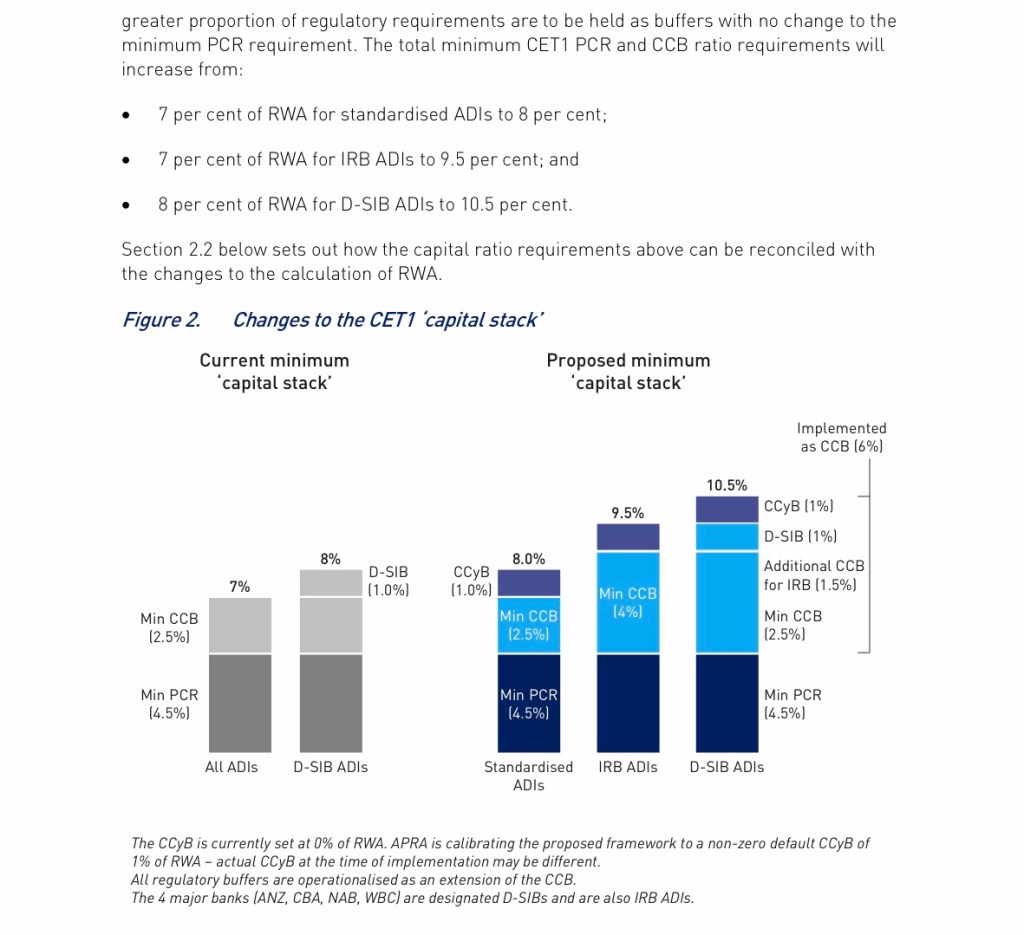
On one level, the answer is quite simple – Exhibit A from the Discussion Paper (page 17) …

APRA DP “A more flexible and resilient capital framework for ADIs” page 17
  • For systemically important ADI (D-SIB ADIs), the Unquestionably Strong 10.5% CET1 benchmark will be enshrined in a series of expanded capital buffers that will come into force on 1 January 2023 and add up to 10.5%.
  • However, we also know that APRA has at the same time outlined a range of enhancements to risk weights that are expected to have the effect of reducing aggregate Risk Weighted Assets and thereby result in higher capital adequacy ratios.
  • APRA has also emphasised that the net impact of the changes is intended to be capital neutral; i.e. any D-SIB ADI that meets the Unquestionably Strong benchmark now (i.e. that had a CET1 ratio of at least 10.5% under the current framework) will be Unquestionably Strong under the new framework
  • However this implies that the expected increase in reported CET1 under the new framework will not represent surplus capital so it looks like Unquestionably Strong will require a CET1 ratio higher than 10.5% once the new framework comes into place.

The only way I can reconcile this is to assume that APRA will be revisiting the calibration of the proposed increased capital buffers once it gets a better handle on how much capital ratios will increase in response to the changes it makes to bring Australian capital ratios closer to those calculated by international peers under the Basel minimum requirements. If this was spelled out in the Discussion Paper I missed it.

What about the impact of RBNZ requiring more capital to be held in New Zealand?

Running alongside the big picture issues summarised above (Unquestionably Strong, Transparency, Comparability, Flexibility, Resilience”, APRA has also been looking at how it should respond to the issues posed by the RBNZ policy applying substantial increases to the capital requirements for banks operating in NZ. I wrote two post on this issue (see here and here) that make the following points

  • To understand what is going on here you need to understand the difference between “Level 1” and Level 2” Capital Adequacy (part of the price of entry to this discussion is understanding more APRA jargon)
  • The increased share of the group capital resources required to be maintained in NZ will not have any impact on the Level 2 capital adequacy ratios that are the ones most commonly cited when discussing Australian ADI capital strength
  • In theory, maintaining the status quo share of group capital resources maintained in Australia would require some increase in the Level 2 CET1 ratio (i.e. the one that is used to express the Unquestionably Strong benchmark)
  • In practice, the extent to which the Level 2 benchmark is impacted depends on the maternity of the NZ business so it may be that there is nothing to see here
  • It is hard to tell however partly because there is not a lot of disclosure on the details of the Level 1 capital adequacy ratios (at least not a lot that I could find) and partly because the Level 1 capital measure is (to my mind) not an especially reliable (or indeed intuitive) measure of the capital strength
Summing up
  • There is I think a general consensus that the Australian D-SIB ADIs all currently exceed the requirements of what it means to be Unquestionably Strong under the current capital adequacy framework
  • This implies that they have surplus capital that may potentially be returned to shareholders
  • APRA has laid out what I believe to be pretty sensible and useful enhancements to that framework (the expanded and explicitly more flexible capital buffers in particular)
  • These changes have however (for me at least) made it less clear what it will mean for an ADI to be Unquestionably Strong post 1 January 2023 when the proposed changes to Risk Weighted Assets come into effect

Any and all contributions to reducing my ignorance and confusion will be gratefully accepted – let me know what I am missing

Tony – From the Outside

Mortgage Mayhem – Net Interest

Marc Rubinstein has written another really interesting post on the economics of the American mortgage market which you can find here. The post is useful not only for his account of the mechanics of why the American mortgage market is prone to boom and bust but also for reminding us of some of the ways in which the American approach is very different from that employed in other markets. 

Lending to finance home ownership is an increasingly big part of most modern financial systems but the ways in which the process is done differ a lot more than you might think from casual inspection. I have previously flagged a post that Marc did on financing the American home. Read that in conjunction with a post I did on financing the Danish home. Marc also did an interesting post looking at the tension between competition and financial stability.

Tony – From the Outside

Tether offers a bit more detail on the composition of its reserves

… but Jemima Kelly at FT Alphaville remains a sceptic. I think the FT headline is a bit harsh (“Tether says its reserves are  backed by cash to the tune of . . .  2.9%”). Real banks don’t hold a lot of “cash” either but the securities they hold in their liquid asset portfolios will tend to be a lot better quality than the securities that Tether disclosed.

The role of real banks in the financial system may well be shrinking but the lesson I take from this FT opinion piece is that understanding the difference between these financial innovations and real banks remains a useful insight as we navigate the evolving new financial system.

Let me know what I am missing …

Tony – From the Outside

Explaining the value of Dogecoin

I don’t profess to be able to explain the value of Dogecoin but Matt Levine offers an interesting perspective curtesy of a research report published by Galaxy Digital Research. Apart from the left field explanation of what underpins Dogecoin’s value, the relatively short report (22 pages) offers a useful recap of the story of how this variation of digital money came to be.

Here is a short extract from the report

“When we set out to write this report, we expected to find what we’ve always known: Dogecoin is a joke, but it’s also a joke… not credible, resilient, or adopted. But as we reviewed the data, we found that, despite its deficiencies, Dogecoin has remarkably strong fundamentals and powerful forces supporting its rise: a genuine origin story, longevity, and a growing community of users who appear determined to meme a Shiba Inu-themed global currency into existence. We don’t expect Dogecoin to become the world’s most valuable cryptocurrency any time soon, but DOGE should not be ignored.”

“Dogecoin: The Most Honest Sh*tcoin” by Alex Thorn, Head of Firmwide Research and Karim Helmy, Research Associate, Galaxy Digital Research, 4 May 2021

Matt’s column has a link to the report itself which is worth a read if you are interested in Dogecoin in particular or the broader topic of digital money.

Tony – From the Outside

Central bank digital currency

Izabella Kaminska (FT Alphaville) offers another perspective on what the development of a Central Bank Digital Currency CBDC) by the People’s Bank of China means for China itself, the rest of the world and the USD in particular.

Her column is titled “Is the central bank panic about the PBOC coin justified?”. It is not clear that central banks are actually panicking at this stage (equally I am not sure that Isabella has 100% control over the titles her sub-editors apply to her articles). The article does however offer some balance to the narrative that sees China’s moves in this space forcing other central banks to follow suite.

I am yet to fully come to terms with the questions posed in her article but this (for me at least) is definitely an area to watch and seek to understand.

Izabella has been a reliable source of insight on this and the broader questions associated with the increased role of fintech in our payment systems. I can also recommend a column she wrote in July 2019 titled “Why dealing with fin techs is a bit like dealing with pirates”. A paper by Tobias Adrian and Tommaso Mancini-Griffoli titled “The Rise of Digital Money” is also worth reading if you are interested in this topic (one of my posts offers a short overview of the paper and a link to the original).

Tony – From the Outside

Andrew Haldane

Claire Jones writing for the Financial Times Alphaville column confesses a fondness for the speeches of Andrew Haldane (departing chief economist at the Bank of England) . She offered a selection of favourites (you can access her column by signing up to Alphaville if you are not an FT subscriber).

I also rate pretty much everything he writes as worth reading often more than once to reflect on the issues he raises. To her top three Haldane speeches, I will add one he did in 2016 titled “The Great Divide” which explored the gap between the way banks perceive themselves and how they are perceived by the community.

Tony – From the Outside

The Conversation: “Hostage to fortune: why Westpac could struggle to find the right buyer for its NZ subsidiary”

Another useful contribution to the question of how the Australian banks deal with changes in the capital requirements impacting their NZ subsidiaries.

Their conclusion is that Westpac will struggle to find a buyer at an acceptable price

The Conversation: “Hostage to fortune: why Westpac could struggle to find the right buyer for its NZ subsidiary”