Mortgage risk weights fact check revisited – again

The somewhat arcane topic of mortgage risk weights is back in the news. It gets popular attention to the extent they impact the ability of small banks subject to standardised risk weights to compete with bigger banks which are endorsed to use the more risk sensitive version based on the Internal Ratings Based (IRB) approach. APRA released a Discussion Paper (DP) in February 2018 titled “Revisions to the capital framework for authorised deposit-taking institutions”. There are reports that APRA is close to finalising these revisions and that this will address the competitive disadvantage that small banks suffer under the current regulation.

This sounds like a pretty simple good news story – a victory for borrowers and the smaller banks – and my response to the discussion paper when it was released was that there was a lot to like in what APRA proposed to do. I suspect however that it is a bit more complicated than the story you read in the press.

The difference in capital requirements is overstated

Let’s start with the claimed extent of the competitive disadvantage under current rules. The ACCC’s Final Report on its “Residential Mortgage Price Inquiry” described the challenge with APRA’s current regulatory capital requirements as follows:

“For otherwise identical ADIs, the advantage of a 25% average risk weight (APRA’s minimum for IRB banks) compared to the 39% average risk weight of standardised ADIs is a reduction of approximately 0.14 percentage points in the cost of funding the loan portfolio. This difference translates into an annual funding cost advantage of almost $750 on a residential mortgage of $500 000, or about $15 000 over the 30 year life of a residential mortgage (assuming an average interest rate of 7% over that period).”

You could be forgiven for concluding that this differential (small banks apparently required to hold 56% more capital for the same risk) is outrageous and unfair.

Just comparing risk weights is less than half the story

I am very much in favour of a level playing field and, as stated above, I am mostly in favour of the changes to mortgage risk weights APRA outlined in its discussion paper but I also like fact based debates.

While the risk weights for big banks are certainly lower on average than those required of small banks, the difference in capital requirements is not as large as the comparison of risk weights suggests. To understand why the simple comparison of risk weights is misleading, it will be helpful to start with a quick primer on bank capital requirements.

The topic can be hugely complex but, reduced to its essence, there are three elements that drive the amount of capital a bank holds:

  1. The risk weights applied to its assets
  2. The target capital ratio applied to those risk weighted assets
  3. Any capital deductions required when calculating the capital ratio

I have looked at this question a couple of times (most recently here) and identified a number of problems with the story that the higher risk weights applied to residential mortgages originated by small bank places them at a severe competitive disadvantage:

Target capital ratios – The target capital adequacy ratios applied to their higher standardised risk weighted assets are in some cases lower than the IRB banks and higher in others (i.e. risk weights alone do not determine how much capital a bank is required to hold).

Portfolio risk – The risk of a mortgage depends on the portfolio not the individual loan. The statement that a loan is the same risk irrespective of whether it is written by a big bank or small bank sounds intuitively logical but is not correct. The risk of a loan can only be understood when it is considered as part of the portfolio the bank holds. All other things being equal, small banks will typically be less diversified and hence riskier than a big bank.

Capital deductions – You also have to include capital deductions and the big banks are required to hold capital for a capital deduction linked to the difference between their loan loss provisions and a regulatory capital value called “Regulatory Expected Loss”. The exact amount varies from bank to bank but I believe it increases the effective capital requirement by 10-12% (i.e. an effective RW closer to 28% for the IRB banks).

IRRBB capital requirement – IRB banks must hold capital for Interest Rate Risk in the Banking Book (IRRBB) while the small standardised banks do not face an explicit requirement for this risk. I don’t have sufficient data to assess how significant this is, but intuitively I would expect that the capital that the major banks are required to hold for IRRBB will further narrow the effective difference between the risk weights applied to residential mortgages.

How much does reducing the risk weight differential impact competition in the residential mortgage market?

None of the above is meant to suggest that the small banks operating under the standardised approach don’t have a case for getting a lower risk weight for their higher quality lower risk loans. If the news reports are right then it seems that this is being addressed and that the gap will be narrower. However, it is important to remember that:

  • The capital requirement that the IRB banks are required to maintain is materially higher than a simplistic application of the 25% average risk weight (i.e. the IRB bank advantage is not as large as it is claimed to be).
  • The standardised risk weight does not seem to be the binding constraint so reducing it may not help the small banks much if the market looks through the change in regulatory risk measurement and concludes that nothing has changed in substance.

One way to change the portfolio quality status quo is for small banks to increase their share of low LVR loans with a 20% RW. Residential mortgages do not, for the most part, get originated at LVR of sub 50% but there is an opportunity for small banks to try to refinance seasoned loans where the dynamic LVR has declined. This brings us to the argument that IRB banks are taking the “cream” of the high quality low risk lending opportunities.

The “cream skimming” argument

A report commissioned by COBA argued that:

“While average risk weights for the major banks initially rose following the imposition of average risk weight on IRB banks by APRA, two of the major banks have since dramatically reduced their risk weights on residential mortgages with the lowest risk of default. The average risk weights on such loans is now currently on average less than 6 per cent across the major banks.”

“Despite the imposition of an average risk weight on residential home loans, it appears some of the major banks have decided to engage in cream skimming by targeting home loans with the lowest risk of default. Cream skimming occurs when the competitive pressure focuses on the high-demand customers (the cream) and not on low- demand ones (the skimmed milk) (Laffont & Tirole, 1990, p. 1042). Cream skimming has adverse consequences as it skews the level of risk in house lending away from the major banks and towards other ADIs who have to deal with an adversely selected and far riskier group of home loan applicants.”

“Reconciling Prudential Regulation with Competition” prepared by Pegasus Economics May 2019 (page 43)

It is entirely possible that I am missing something here but, from a pure capital requirement perspective, it is not clear that IRB banks have a material advantage in writing these low risk loans relative to the small bank competition. The overall IRB portfolio must still meet the 25% risk weight floor so any loans with 6% risk weights must be offset by risk weights (and hence riskier loans) that are materially higher than the 25% average requirement. I suspect that the focus on higher quality low risk borrowers by the IRB banks was more a response to the constraints on capacity to lend than something that was driven by the low risk weights themselves.

Under the proposed revised requirements, small banks in fact will probably have the advantage in writing sub 50% LVR loans given that they can do this at a 20% risk weight without the 25% floor on their average risk weights and without the additional capital requirements the IRB banks face.

I recognise there are not many loans originated at this LVR band but there is an opportunity in refinancing seasoned loans where the combined impact of principal reduction and increased property value reduces the LVR. In practice the capacity of small banks to do this profitably will be constrained by their relative expense and funding cost disadvantage. That looks to me to be a bigger issue impacting the ability of small banks to compete but that lies outside the domain of regulatory capital requirements.

Maybe this potential arbitrage does not matter in practice but APRA could quite reasonably impose a similar minimum average RW on Standardised Banks if the level playing field argument works both ways. This should be at least 25% but arguably higher once you factor in the fact that the small banks do not face the other capital requirements that IRB banks do. Even if APRA did not do this, I would expect the market to start looking more closely at the target CET1 for any small bank that accumulated a material share of these lower risk weight loans.

Implications

Nothing in this post is meant to suggest that increasing the risk sensitivity of the standardised risk weights is a bad idea. It seems doubtful however that this change alone will see small banks aggressively under cutting large bank competition. It is possible that small bank shareholders may benefit from improved returns on equity but even that depends on the extent to which the wholesale markets do not simply look through the change and require smaller banks to maintain the status quo capital commitment to residential mortgage lending.

What am I missing …
How much capital is enough? – The NZ perspective

The RBNZ has delivered the 4th instalment in a Capital Review process that was initiated in March 2017 and has a way to run yet. The latest consultation paper addresses the question “How much capital is enough?”.  The banking industry has until 29 March 2019 to respond with their views but the RBNZ proposed answer is:

  • A Tier 1 capital requirement of 16% of RWA for systemically important banks and 15% of RWA for all other banks
  • The Tier 1 minimum requirement to remain unchanged at 6% (with AT1 capital continuing to be eligible to contribute a maximum of 1.5 percentage points)
  • The proposed increased capital requirement to be implemented via an overall prudential capital buffer of 9-10% of RWA comprised entirely of CET1 capital;
    • Capital Conservation Buffer 7.5% (currently 2.5%)
    • D-SIB Buffer 1.0% (no change)
    • Counter-cyclical buffer 1.5% (currently 0%)

The increase in the capital ratio requirement is proposed to be supplemented with a series of initiatives that will increase the RWA of IRB banks:

  • The RBNZ proposes to 1) remove the option to apply IRB RW to sovereign and bank exposures,  2) increase the IRB scalar (from 1.06 to 1.20) and 3) to introduce an output floor set at 85% of the Standardised RWA on an aggregate portfolio basis
  • As at March 2018, RWA’s produced by the IRB approach averaged 76% of the Standardised Approach and the RBNZ estimate that the overall impact will be to increase the aggregate RWA to 90% of the outcome generated by the Standardised approach (i.e. the IRB changes, not the output floor, drive the increase in RWA)
  • Aggregate RWA across the four IRB banks therefore increases by approximately 16%, or $39bn, compared to March 2018 but the exact impact will depend on how IRB banks respond to the higher capital requirements

The RBNZ has also posed the question whether a Tier 2 capital requirement continues to be relevant given the substantial increase in Tier 1 capital.

Some preliminary thoughts …

There is a lot to unpack in this paper so this post will only scratch the surface of the issues it raises …

  • The overall number that the RBNZ proposes (16%) is not surprising.It looks to be at the lower end of what other prudential regulators are proposing in nominal terms
  • But is in the same ball park once you allow for the substantial increase in IRB RWA and the fact that it is pretty much entirely CET1 capital
  • What is really interesting is the fundamentally different approach that the RBNZ has adopted to Tier 2 capital and bail-in versus what APRA (and arguably the rest of the world) has adopted
    • The RBNZ proposal that the increased capital requirement take the form of CET1 capital reflects its belief that “contingent convertible instruments” should be excluded from what counts as capital
    • Exactly why the RBNZ has adopted this position is a complex post in itself (their paper on the topic can be found here) but the short version (as I understand it) is that they think bail-in capital instruments triggered by non-viability are too complex and probably won’t work anyway.
    • Their suggestion that Tier 2 probably does not have a role in the capital structure they have proposed is logical if you accept their premise that Point of Non-Viability (PONV) triggers and bail-in do not work.
  • The RBNZ highlight a significantly enhanced role for prudential capital buffersI am generally in favour of bigger, more dynamic, capital buffers rather than higher fixed minimum requirements and I have argued previously in favour of the base rate for the counter-cyclical being a positive value (the RBNZ propose 1.5%)
    • But the overall size of the total CET1 capital buffer requirement requires some more considered thought about 1) the role of bail-in  structures and PONV triggers in the capital regulation toolkit (as noted above) and 2) whether the impacts of the higher common equity requirement will be as benign as the RBNZ analysis suggests
  • I am also not sure that the indicative capital conservation responses they have outlined (i.e. discretionary distributions limited to 60% of net earnings in the first 250bp of the buffer, falling to 30% in the next 250bp and no distributions thereafter) make sense in practice.
    • This is because I doubt there will be any net earnings to distribute if losses are sufficient to reduce CET1 capital by 250bp so the increasing capital conservation requirement is irrelevant.
  • Last, but possibly most importantly, we need to consider the impact on the Australian parents of the NZ D-SIB banks and how APRA responds. The increase in CET1 capital proposed for the NZ subsidiaries implies that, for any given amount of CET1 capital held by the Level 2 Banking Group, the increased strength of the NZ subsidiaries will be achieved at the expense of the Australian banking entities
    • Note however that the impact of the higher capital requirement in NZ will tend to be masked by the technicalities of how bank capital ratios are calculated.
      • It probably won’t impact the Level 2 capital ratios at all since these are a consolidated view of the combined banking group operations of the Group as a whole
      • The Level 1 capital ratios for the Australian banks also treat investments in bank subsidiaries relatively generously (capital invested in unlisted subsidiaries is treated as a 400% risk weighted asset rather than a capital deduction).

Conclusion

Overall, I believe that the RBNZ is well within its rights to expect the banks it supervises to maintain a total level of loss absorbing capital of 16% or more. The enhanced role for capital buffers is also a welcome move.

The issue is whether relying almost entirely on CET1 capital is the right way to achieve this objective. This is however an issue that has been debated for many decades with no clear resolution. It will take some time to fully unpack the RBNZ argument and figure out how best to articulate why I disagree. In the interim, any feedback on the issues I have outlined above would be most welcome.

Tony

Does more loss absorption and “orderly resolution” eliminate the TBTF subsidy?

The Australian Government’s 2014 Financial System Inquiry (FSI) recommended that APRA implement a framework for minimum loss-absorbing and recapitalisation capacity in line with emerging international practice, sufficient to facilitate the orderly resolution of Australian authorised deposit-taking institutions (ADIs) and minimise taxpayer support (Recommendation 3).

In early November, APRA released a discussion paper titled “Increasing the loss absorption capacity of ADIs to support orderly resolution” setting out its response to this recommendation. The paper proposes that selected Australian banks be required to hold more loss absorbing capital. Domestic Systemically Important Banks (DSIBs) are the primary target but, depending partially on how their Recovery and Resolution Planning addresses the concerns APRA has flagged, some other banks will be captured as well.

The primary objectives are to improve financial safety and stability but APRA’s assessment is that competition would also be “Marginally improved” on the basis that “requiring larger ADIs to maintain additional loss absorbency may help mitigate potential funding advantages that flow to larger ADIs“. This assessment may be shaped by the relatively modest impact (5bp) on aggregate funding costs that APRA has estimated or simple regulatory conservatism. I suspect however that APRA is under selling the extent to which the TBTF advantage would be mitigated if not completely eliminated by the added layer of loss absorption proposed. If I am correct, then this proposal would in fact, not only minimise the risk to taxpayers of future banking crises, but also represent an important step forward in placing Australian ADIs on a more level playing field.

Why does the banking system need more loss absorption capacity?

APRA offers two reasons:

  1. The critical role financial institutions play in the economy means that they cannot be allowed to fail in a disorderly manner that would have adverse systemic consequences for the economy as a whole.
  2. The government should not be placed in a position where it believes it has no option but to bail out one or more banks

The need for extra capital might seem counter-intuitive, given that ADI’s are already “unquestionably strong”, but being unquestionably strong is not just about capital, the unstated assumption is that the balance sheet and business model are also sound. The examples that APRA has used to calibrate the degree of total loss absorption capacity could be argued to reflect scenarios in which failures of management and/or regulation have resulted in losses much higher than would be expected in a well-managed banking system dealing with the normal ups and downs of the business cycle.

At the risk of over simplifying, we might think of the first layers of the capital stack (primarily CET1 capital but also Additional Tier 1) being calibrated to the needs of a “good bank” (i.e. well-managed, well-regulated) while the more senior components (Tier 2 capital) represent a reserve to absorb the risk that the good bank turns out to be a “bad bank”.

What form will this extra capital take?

APRA concludes that ADI’s should be required to hold “private resources” to cope with this contingency. I doubt that conclusion would be contentious but the issue is the form this self-insurance should take. APRA proposes that the additional loss absorption requirement be implemented via an increase in the minimum Prudential Capital Requirement (PCR) applied to the Total Capital Ratio (TCR) that Authorised Deposit-Taking Institutions (ADIs) are required to maintain under Para 23 of APS 110.

“The minimum PCRs that an ADI must maintain at all times are:
(a) a Common Equity Tier 1 Capital ratio of 4.5 per cent;
(b) a Tier 1 Capital ratio of 6.0 per cent; and
(c) a Total Capital ratio of 8.0 per cent.
APRA may determine higher PCRs for an ADI and may change an ADI’s PCRs at any time.”

APS 110 Paragraph 23

This means that banks have discretion over what form of capital they use, but APRA expect that banks will use Tier 2 capital that counts towards the Total Capital Ratio as the lowest cost way to meet the requirement. Advocates of the capital structure irrelevance thesis would likely take issue with this part of the proposal. I believe APRA is making the right call (broadly speaking) in supporting more Tier 2 rather than more CET1 capital, but the pros and cons of this debate are a whole post in themselves. The views of both sides are also pretty entrenched so I doubt I will contribute much to that 50 year old debate in this post.

How much extra loss absorbing capital is required?

APRA looked at three things when calibrating the size of the additional capital requirement

  • Losses experienced in past failures of systemically important banks
  • What formal requirements other jurisdictions have applied to their banks
  • The levels of total loss absorption observed being held in an international peer group (i.e. what banks choose to hold independent of prudential minimums)

Based on these inputs, APRA concluded that requiring DSIBs to maintain additional loss absorbing capital of between 4-5 percentage points of RWA would be an appropriate baseline setting to support orderly resolution outcomes. The calibration will be finalised following the conclusion of the consultation on the discussion paper but this baseline requirement looks sufficient to me based on what I learned from being involved in stress testing (for a large Australian bank).

Is more loss absorption a good idea?

The short answer, I think, is yes. The government needs a robust way to recapitalise banks which does not involve risk to the taxpayer and the only real alternative is to require banks to hold more common equity.

The devil, however, is in the detail. There are a number of practical hurdles to consider in making it operational and these really need to be figured out (to the best of out ability) before the fact rather than being made up on the fly under crisis conditions.  The proposal also indirectly raises some conceptual issues with capital structure that are worth understanding.

How would it work in practice?

The discussion paper sets out “A hypothetical outcome from resolution action” to explain how an orderly resolution could play out.

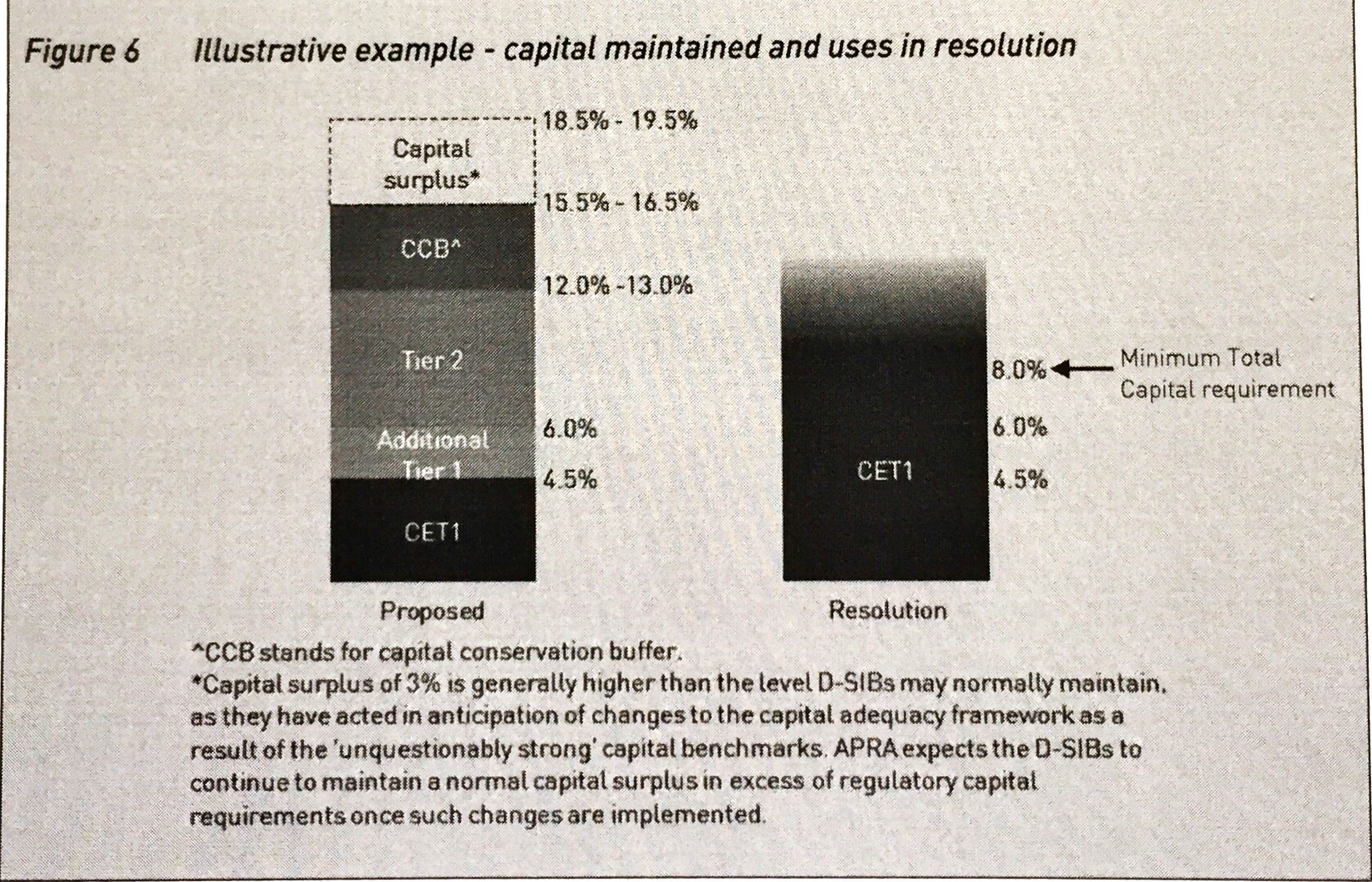
“The approximate capital levels the D-SIBs would be expected to maintain following an increase to Total Capital requirements, and a potential outcome following the use of the additional loss absorbency in resolution, are presented in Figure 6. Ultimately, the outcome would depend on the extent of losses.

If the stress event involved losses consistent with the largest of the FSB study (see Figure 2), AT1 and Tier 2 capital instruments would be converted to ordinary shares or written off. After losses have been considered, the remaining capital position would be wholly comprised of CET1 capital. This conversion mechanism is designed to allow for the ADI to be stabilised in resolution and provide scope to continue to operate, and particularly to continue to provide critical functions.”

IMG_5866.JPG

Source – APRA Discussion Paper (page 24)

What I have set out below draws from APRA’s example while adding detail that hopefully adds some clarity on what should be expected if these scenarios ever play out.

  • In a stress event, losses first impact any surplus CET1 held in excess of the Capital Conservation Buffer (CCB) requirement, and then the CCB itself (the first two layers of loss absorption in Figure 6 above)
  • As the CCB is used up, the ADI is subject to progressive constraints on discretionary distributions on CET1 and AT1 capital instruments
  • In the normal course of events, the CCB should be sufficient to cope with most stresses and the buffer is progressively rebuilt through profit retention and through new issuance, if the ADI wants to accelerate the pace of the recapitalisation process
  • The Unquestionably Strong capital established to date is designed to be sufficient to allow ADIs to withstand quite severe expected cyclical losses (as evidenced by the kinds of severe recession stress scenarios typically used to calibrate capital buffers)
  • In more extreme scenarios, however, the CCB is overwhelmed by the scale of losses and APRA starts to think about whether the ADI has reached a Point of Non-Viability (PONV) where ADI’s find themselves unable to fund themselves or to raise new equity; this is where the proposals in the Discussion Paper come into play
  • The discussion paper does not consider why such extreme events might occur but I have suggested above that one reason is that the scale of losses reflects endogenous weakness in the ADI (i.e. failures of risk management, financial control, business strategy) which compound the losses that would be a normal consequence of downturns in the business cycle
  • APRA requires that AT1 capital instruments, classified as liabilities under Australian Accounting Standards, must include a provision for conversion into ordinary shares or write off when the CET1 capital ratio falls to, or below 5.125 per cent
  • In addition, AT1 and Tier 2 capital instruments must contain a provision, triggered on the occurrence of a non-viability trigger event, to immediately convert to ordinary shares or be written off
  • APRA’s simple example show both AT1 and Tier 2 being converted to CET1 (or write-off) such that the Post Resolution capital structure is composed entirely of CET1 capital

Note that conversion of the AT1 and Tier 2 instruments does not in itself allocate losses to these instruments. The holders receive common equity equivalent to the book value of their instrument which they can sell or hold. The ordinary shareholders effectively bear the loss via the forced dilution of their shareholdings. The main risk to the ATI and Tier 2 holders is that, when they sell the ordinary shares received on conversion, they may not get the same price that which was used to convert their instrument. APRA also imposes a floor on the share price that is used for conversion which may mean that the value of ordinary shares received is less than the face value of the instrument being converted. The reason why ordinary shareholders should be protected in this way under a resolution scenario is not clear.

The devil is in the detail – A short (probably incomplete) list of issues I see with the proposal:

  1. Market capacity to supply the required quantum of additional Tier 2 capital required
  2. Conversion versus write-off
  3. The impact of conversion on the “loss hierarchy”
  4. Why not just issue more common equity?
  5. To what extent would the public sector continue to stand behind the banking system once the proposed level of self insurance is in place?

Market capacity to supply the required level of additional loss absorption

APRA has requested industry feedback on whether market appetite for Tier 2 capital will be a problem but its preliminary assessment is that:

” … individual ADIs and the industry will have the capacity to implement the changes necessary to comply with the proposals without resulting in unnecessary cost for ADIs or the broader financial system.

Preliminary estimates suggest the total funding cost impact from increasing the D-SIBs’Total Capital requirements would not be greater than five basis points in aggregate based on current spreads. Assuming the D-SIBs meet the increased requirement by increasing the issuance of Tier 2 capital instruments and reducing the issuance of senior unsecured debt, the impact is estimated by observing the relative pricing of the different instruments. The spread difference between senior unsecured debt and Tier 2 capital instruments issued by D- SIBs is around 90 to 140 basis points.”

I have no expert insights on this question beyond a gut feel that the required level of Tier 2 capital cannot be raised without impacting the current spread between Tier 2 capital and senior debt, if at all. The best (only?) commentary I have seen to date is by Chris Joye writing in the AFR (see here and here). The key points I took from his opinion pieces are:

  • The extra capital requirement translates to $60-$80 billion of extra bonds over the next four years (on top of rolling over existing maturities)
  • There is no way the major banks can achieve this volume
  • Issuing a new class of higher ranking (Tier 3) bonds is one option, though APRA also retains the option of scaling back the additional Tier 2 requirement and relying on its existing ability to bail-in senior debt

Chris Joye know a lot more about the debt markets than I do, but I don’t think relying on the ability to bail-in senior debt really works. The Discussion Paper refers to APRA’s intention that the “… proposed approach is … designed with the distinctive features of the Australian financial system in mind, recognising the role of the banking system in channelling foreign savings into the economy “ (Page 4). I may be reading too much into the tea leaves, but this could be interpreted as a reference to the desirability of designing a loss absorbing solution which does not adversely impact the senior debt rating that helps anchor the ability of the large banks to borrow foreign savings. My rationale is that the senior debt rating impacts, not only the cost of borrowing, but also the volume of money that foreign savers are willing to entrust with the Australian banking system and APRA specifically cites this factor as shaping their thinking. Although not explicitly stated, it seems to me that APRA is trying to engineer a solution in which the D-SIBs retain the capacity to raise senior funding with a “double A” rating.

Equally importantly, the creation of a new class of Tier 3 instruments seems like a very workable alternative to senior bail-in that would allow the increased loss absorption target to be achieved without impacting the senior debt rating. This will be a key issue to monitor when ADI’s lodge their response to the discussion paper. It also seems likely that the incremental cost of the proposal on overall ADI borrowing costs will be higher than the 5bp that APRA included in the discussion paper. That is not a problem in itself to the extent this reflects the true cost of self insurance against the risk of failure, just something to note when considering the proposal.

Conversion versus write-off

APRA has the power to effect increased loss absorption in two ways. One is to convert the more senior elements of the capital stack into common equity but APRA also has the power to write these instruments off. Writing off AT1 and/or T2 capital, effectively represents a transfer of value from the holders of these instruments to ordinary shareholders. That is hard to reconcile with the traditional loss hierarchy that sees common equity take all first losses, with each of the more senior tranches progressively stepping up as the capacity of more junior tranches is exhausted.

Consequently I assume that the default option would always favour conversion over write-off. The only place that I can find any guidance on this question is Attachment J to APS 111 (Capital Adequacy) which states

Para 11. “Where, following a trigger event, conversion of a capital instrument:

(a)  is not capable of being undertaken;

(b)  is not irrevocable; or

(c) will not result in an immediate and unequivocal increase in Common Equity Tier 1 Capital of the ADI,

the amount of the instrument must immediately and irrevocably be written off in the accounts of the ADI and result in an unequivocal addition to Common Equity Tier 1 Capital.”

That seems to offer AT1 and Tier 2 holders comfort that they won’t be asked to take losses ahead of common shareholders but the drafting of the prudential standard could be clearer if there are other reasons why APRA believe a write-off might be the better resolution strategy. The holders need to understand the risks they are underwriting but ambiguity and uncertainty are to helpful when the banking system is in, or a risk of, a crisis.

The impact of conversion on the “loss hierarchy”

The concept of a loss hierarchy describes the sequence under which losses are first absorbed by common equity and then by Additional Tier 1 and Tier 2 capital, if the more junior elements prove insufficient. Understanding the loss hierarchy is I think fundamental to understanding capital structure in general and this proposal in particular:

  • In a traditional liquidation process, the more senior elements should only absorb loss when the junior components of the capital stack are exhausted
  • In practice, post Basel III, the more senior elements will be required to participate in recapitalising the bank even though there is still some book equity and the ADI technically solvent (though not necessarily liquid)
  • This is partly because the distributions on AT1 instruments are subject to progressively higher capital conservation restrictions as the CCB shrinks but mostly because of the potential for conversion to common equity (I will ignore the write-off option to keep things simple)

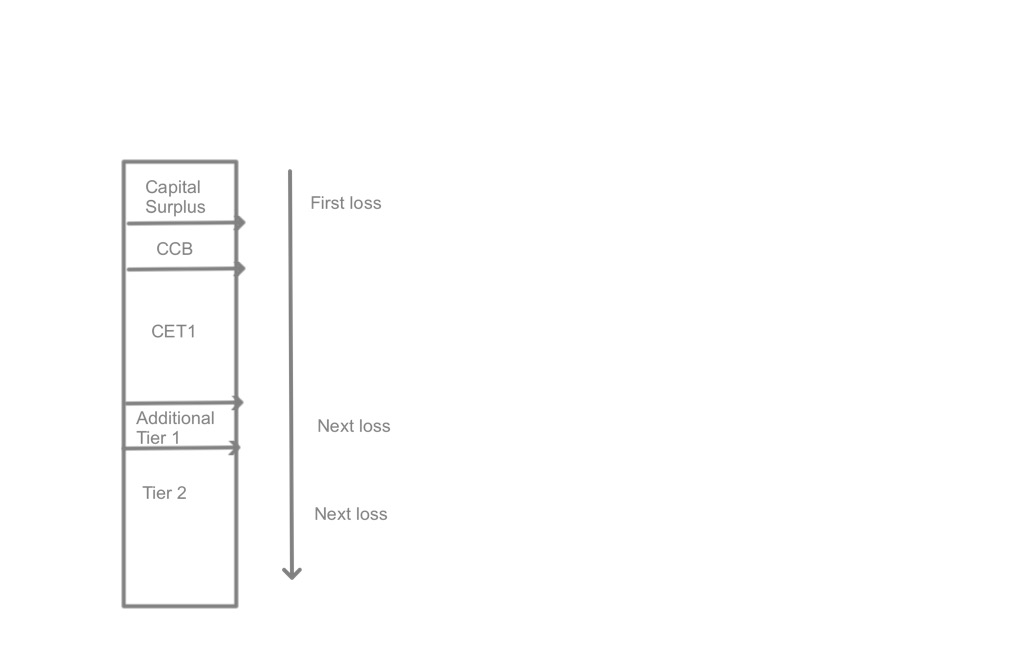
I recognise that APRA probably tried to simplify this explanation but the graphic example they used (see Figure 6 above) to explain the process shows the Capital Surplus and the CCB (both CET1 capital) sitting on top of the capital stack followed by Tier 2, Additional Tier 1 and finally the minimum CET1 capital. The figure below sets out what I think is a more logical illustration of the capital stack and loss .

IMG_2739

Losses initially impact CET1 directly by reducing net tangible assets per share. At the point of a non-viability based conversion event, the losses impact ordinary shareholders via the dilution of their shareholding. AT1 and Tier 2 holders only share in these losses to the extent that they sell the ordinary shares they receive for less than the conversion price (or if the conversion price floor results in them receiving less than the book value of their holding).

Why not just issue more common equity?

Capital irrelevancy M&M purists will no doubt roll their eyes and say surely APRA knows that the overall cost of equity is not impacted by capital structure tricks. The theory being that any saving in the cost of using lower cost instruments, will be offset by increases in the costs (or required return) of more subordinated capital instruments (including equity).

So this school argues you should just hold more CET1 and the cost of the more senior instruments will decline. The practical problem I think is that, the cost of senior debt already reflects the value of the implied support of being too big, or otherwise systemically important, to be allowed to fail. The risk that deposits might be exposed to loss is even more remote partly due to deposit insurance but, possibly more importantly, because they are deeply insulated from risk by the substantial layers of equity and junior ranking liabilities that must be exhausted before assets are insufficient to cover deposit liabilities.

To what extent would the public sector continue to stand behind the banking system once the proposed level of self insurance is in place?

Assuming the market capacity constraint question could be addressed (which I think it can), the solution that APRA has proposed seems to me to give the official family much greater options for dealing with future banking crises without having to call on the taxpayer to underwrite the risk of recapitalising failed or otherwise non-viable banks.

It does not, however, eliminate the need for liquidity support. I know some people argue that this is a distinction without a difference but I disagree. The reality is that banking systems built on mostly illiquid assets will likely face future crises of confidence where the support of the central bank will be necessary to keep the financial wheels of the economy turning.

There are alternative ways to construct a banking system. Mervyn King, for example, has advocated a version of the Chicago Plan under which all bank deposits must be 100% backed by liquid reserves that would be limited to safe assets such as government securities or reserves held with the central bank. Until we decide to go down that path, or something similar, the current system requires the central bank to be the lender of last resort. That support is extremely valuable and is another design feature that sets banks apart from other companies. It is not the same however, as bailing out a bank via a recapitalisation.

Conclusion

I have been sitting on this post for a few weeks while trying to consider the pros and cons. As always, the risk remains that I am missing something. That said, this looks to me like a necessary (and I would argue desirable) enhancement to the Australian financial system that not only underpins its safety and stability but also takes us much closer to a level playing field. Big banks will always have the advantage of sophistication, scale and efficiency that comes with size but any funding cost advantage associated with being too big to fail now looks to be priced into the cost of the additional layers of loss absorption this proposal would require them to put in place.

Tony

Capital adequacy – an option to add transparency and flexibility into the “Unquestionably Strong” mix

Two of my earlier posts (here and here) discussed the potential to improve the capital adequacy framework by revisiting the calibration and operation of regulatory capital buffers. Some of the issues discussed in those posts are touched on in a discussion paper APRA has released titled “Improving the transparency, comparability and flexibility of the ADI capital framework“.

APRA is open to alternatives but sets out two options for discussion

In APRA’s words, the DP outlines

“… options to modify the ADI capital framework to improve transparency and comparability of reported capital ratios. The main conceptual approaches APRA is considering and seeking feedback on are:

  • developing more consistent disclosures without modifying the underlying capital framework; and

  • modifying the capital framework by adjusting the methodology for calculating capital ratios.”

The First Approach– “Consistent disclosure” – seems to be a beefed up version of the status quo in which APRA gets more directly involved in the comparability process by adding its imprimatur to the internationally harmonised ratios some Australian banks currently choose to disclose as an additional informal measure of capital strength.

“Under this approach, ADIs would continue to determine regulatory capital ratios using APRA’s definitions of capital and RWA. However, APRA would also specify a methodology for ADIs to determine certain adjustments to capital and RWA that could be used for disclosure (Pillar 3) purposes. As noted above, the methodology would focus on aspects of relative conservatism that are material in size and able to be calculated simply and objectively.”

APRA argues that “The supplementary disclosure would allow all stakeholders to better assess the capital strength of an ADI on a more comparable basis. However, it would result in two APRA-endorsed capital ratios: an APRA regulatory capital ratio to be compared against minimum requirements, and an additional disclosure-only capital ratio for, in particular, international comparison.”

A Second Approach – “Capital ratio adjustments” would involve APRA modifying the calculation of regulatory capital ratios to utilise more internationally harmonised definitions of capital and RWA.

The DP explains that this “… alternative approach would involve APRA modifying the calculation of regulatory capital ratios to utilise more internationally harmonised definitions of capital and RWA. This would involve removing certain aspects of relative conservatism from ADIs’ capital ratio calculations and lifting minimum regulatory capital ratio requirements in tandem. This increase in regulatory capital ratio requirements could be in the form of a transparent adjustment to minimum capital ratio requirements—for the purposes of this paper, such an adjustment is termed the ‘APRA Overlay Adjustment’.”

“To maintain overall capital adequacy, the APRA Overlay Adjustment would need to be calculated such that the total dollar amount of Prudential Capital Requirement (PCR) and Capital Conservation Buffer (CCB) would be the same as that required if these measures were not adopted. In other words, the risk-based capital requirements of ADIs would be unchanged in absolute dollar terms, maintaining financial safety, but adjustments to the numerator and the denominator of the capital ratio to be more internationally comparable would increase reported capital ratios.”

APRA clarify that

“These options are not mutually exclusive, and there is potential for both approaches to be adopted and applied in different areas.”

Approach 2 has some clear advantages …

It would make the “unquestionably strong” capital ratios more directly comparable with international peers, thereby reducing the potential for the perception of this strength to be obscured or misunderstood.

“Perception” is the key word here. It matters that the strength of Australian banks is simple, transparent and evident rather than being something where the perceivers must understand a sequence of relatively obscure and complex adjustments to fully appreciate the strength of a bank’s capital. More importantly perception matters most when the system is under stress and people do not have the time, or the inclination, to look beyond the reported numbers.

The adjusted capital ratio approach also provides opportunity to increase the flexibility of the ADI capital framework in times of stress but only to the extent to which the Overlay Adjustment is applied to the capital buffer, rather than increasing the minimum capital requirements. Higher minimum requirements would do nothing to enhance flexibility and may even be a backward step.

I believe a non zero baseline for the CCyB would also enhance the flexibility of the capital framework by virtue of the fact that it improves the odds that the banks (and APRA) have a flexible buffer in place before it is needed. This opportunity for enhanced flexibility is an option under both approaches so long as the Unquestionably Strong Benchmark maintains a material surplus over the Capital Conservation Buffer as it currently does.

But also some challenges …

APRA notes that the Adjusted Capital Ratio approach:

  • May significantly increase operational complexity for ADIs by virtue of the fact that the application of the APRA Overlay Adjustment would result in variable capital ratio requirements,

• Potentially results in variable minimum capital requirements which introduces complexity in analysing capital buffers and may undermine the desired transparency, and

• Reduces the dollar value of the 5.125 per cent (of RWA) loss absorption trigger point.

Do the advantages of the Adjusted Capital Ratio approach outweigh the challenges?

The short answer, I think, is yes … albeit with some qualifications.

So far as I can see, the added complexity only enters the discussion to the extent that some of the APRA Overlay Adjustment is applied to increase the minimum capital requirement. Most, if not all, of the operational complexity is avoided if the “Overlay Adjustment” is confined to increasing the size of the capital buffer.

Conversely, the benefits of increased responsiveness (or risk sensitivity) and flexibility lie in an increased capital buffer.

It follows then that the best way to pursue this approach is for any harmonised adjustments to the reported capital ratio to be confined to a higher CCB. This begs the question whether all the Overlay Adjustment should be applied to the capital buffer. I address that question in my responses below to some of the questions APRA has posed to solicit industry feedback.

One issue not covered in the Discussion Paper in any detail is that the capital ratios under Approach 2 will be more sensitive to any changes in the numerator. This is a simple mathematical consequence of RWA being lower if more harmonised measures are adopted. I do not see this as a problem but the heightened risk sensitivity of the framework needs to be clearly understood beforehand to minimise the potential for larger changes in capital ratios to be misunderstood. A more risk sensitive capital ratio may even be an advantage. This may not be obvious but there is a body of research which suggests a more responsive, more volatile, measure of capital adequacy can be beneficial to the extent that it prompts greater risk awareness on the part of bank management and external stakeholders. Greg Ip’s book “Foolproof” offers an introduction to some of this research but a simple example illustrating the point is the way that the benefits of improved braking in modern cars is offset to some extent by people driving faster.

APRA concludes its discussion paper with some direct questions.

There are 8 questions in all but in the context of this post I will have a go at addressing 3 of them, questions 2, 7 and 8.

Question 2: If APRA were to apply a combination of Approach 1 and Approach 2, which aspects of relative conservatism are best suited to be treated under Approach 2?

If you accept the argument that the minimum capital requirement should continue to be a set value (i.e. not subject to periodic adjustment), then the aspects of relative conservatism best suited to Approach 2 are those which can reasonably be assigned to an increase in, and regular adjustment of, one or more of the capital buffers.

Running through the list of adjustments currently applied to generate the internationally harmonised capital ratios, we can distinguish three broad categories of APRA conservatism:

  1. The extra credit risk related losses a bank might expect to experience under a very severe recession or financial crisis style scenario but not necessarily a gone concern where losses extend into the tail of the loss distribution
  2. Assets whose value depends on the ADI being a going concern and consequently are less certain to be realisable if the bank is in liquidation or has otherwise reached a point of non-viability
  3. Capital deduction intended to avoid “double counting” capital invested outside the ADI include

There are very few areas of black and white in the response to this question, but the first group are the items of APRA conservatism that I think have the clearest claim to be included in the capital buffer. These reflect potential loss scenarios that are conservative but still within the domain of plausibly severe downturns in the business cycle; this would encompass the following capital ratio adjustments:

  • the 20 per cent loss given default (LGD) portfolio constraint required for residential mortgage exposures;
  • the LGD parameter for unsecured non-retail exposures;
  • credit conversion factors (CCFs) for undrawn non-retail commitments;
  • use of supervisory slotting and the scaling factor for specialised lending;
  • risk weights for other retail exposures covered by the standardised approach to credit risk; and
  • the exchange rate used to convert Euro-denominated thresholds in the Basel capital framework into Australian dollars.

The second category are assets which have a value if the bank is a going concern but cannot necessarily be relied upon in non viability scenarios; I.e.

  • deferred tax assets arising from timing differences;
  • capitalised expenses and transaction costs
  • the capital requirement applied by APRA for IRRBB (I am open to arguments that I am being too harsh on IRRBB)

The third category captures capital that is committed to risks where the bank is taking a first loss exposure including

  • investments in other financial institutions;
  • holdings of subordinated tranches of securitisations.
  • investments in commercial entities;

Another way to explore this question is to map these three categories to the traditional graphic expression of a bank loss distribution and establish whether they are expected to lie:

  • closer to the middle of the loss distribution (sometimes framed as a 1 in 25 year downturn or the kinds of losses we expect in a severe downturn)
  • Or closer to the “tail” of the loss distribution (typically expressed as a 1 in 1000 year loss in regulatory capital terms).

To be clear, I am not seeking to ascribe any level of precision to these statistical probabilities; simply to distinguish between the relative likelihood of the items of conservatism that APRA has embedded in its current measure of capital adequacy. These three items tend to be treated as equivalent under the current approach and enhanced disclosure per Approach 1 will do nothing to address this conflation of risks.

Question 7: Would increasing the size of capital buffers (either by increasing the CCB or by setting a non-zero baseline CCyB) relative to PCR appropriately balance capital strength with financial stability through the cycle?

I have advocated the benefits of a non zero baseline CCYB in previous posts. One of these posts focused on the approach adopted by the Bank of England where I identified two advantages.

Firstly, it directly addresses the problem of failing to detect/predict when systemic risk in the banking system requires prudential intervention. A lot of progress has been made in dealing with this challenge, not the least of which has been to dispense with the idea that central banks had tamed the business cycle. The financial system however retains its capacity to surprise even its most expert and informed observers so I believe it is better to have the foundations of a usable counter cyclical capital buffer in place as soon as possible after the post crisis repair phase is concluded rather than trying to predict when it might be required.

The BOE approach still monitors a range of core indicators for the CCyB grouped into three categories.

• The first category includes measures of ‘non-bank balance sheet stretch’, capturing leverage in the broader economy and in the private non-financial (ie household and corporate) sector specifically.

• The second category includes measures of ‘conditions and terms in markets’, which capture borrowing terms on new lending and investor risk appetite more broadly.

• The third category includes measures of ‘bank balance sheet stretch’, which capture leverage and maturity/liquidity transformation in the banking system.

However the BOE implicitly accepts that it can’t predict the future so it substitutes a simple, pragmatic and error resilient strategy (put the default CCyB buffer in place ASAP) for the harder problem of trying to predict when it will be needed. This strategy retains the option of increasing the CCyB, is simpler to administer and less prone to error than the standard BCBS approach. The BOE might still miss the turning point but it has a head start on the problem if it does.

The BOE also integrates its CCyB strategy with its approach to stress testing. Each year the stress tests include a scenario:

“intended to assess the risks to the banking system emanating from the financial cycle – the “annual cyclical scenario”

The severity of this scenario will increase as risks build and decrease after those risks crystallise or abate. The scenario might therefore be most severe during a period of exuberance — for example, when credit and asset prices are growing rapidly and risk premia are compressed. That might well be the point when markets and financial institutions consider risks to be lowest. And severity will be lower when exuberance has corrected — often the time at which markets assess risks to be largest. In leaning against these tendencies, the stress-testing framework will lean against the cyclicality of risk taking: it will be countercyclical.”

The Bank of England’s approach to stress testing the UK banking system – October 2015 (page 5)

I have discussed the BOE approach at length but the Canadian supervisor has also introduced some interesting innovations in the way that it uses a capital buffer to address the systemic risk of large banks that are worth considering as part of this review.

The second reason I favour a non zero baseline is because I believe it is likely to result in a more “usable” buffer once risk crystallizes (not just systemic risk) and losses start to escalate.

In theory, the standard capital conservation buffer (CCB) introduced under Basel III can absorb any unexpected increase in losses and allow banks the time to progressively rebuild the buffer when economic conditions improve

In practice, the upper boundary of the CCB acts as a de facto minimum requirement such that banks face strong market pressure to immediately rebuild the buffer potentially at material cost to shareholders

There are no guarantees for what happens to banking systems under stress, but a flexible buffer that is sensitive to the state of the credit cycle is I think far more fit for purpose.

It is important to note that a non zero CCYB is an option under both approaches. There is potentially enough surplus capital in the Unquestionably Strong calibration for a non-zero CCYB to be introduced without requiring banks to raise any more capital. This would be so under either of the approaches that APRA has outlined.

So a larger buffer would be desirable from the perspective of increased comparability and transparency but the advantages of a non zero CCYB could also be pursued under the Unquestionably Strong status quo or Approach 1.

Question 8: What may be some of the potential impacts if APRA increases the prescribed loss absorption trigger point above 5.125 per cent of RWA?

The rationale for increasing the PONV Trigger is that APRA believes it is important to preserve the value of the trigger in dollar terms.

I can see that it is important to have a PONV trigger well before a bank reaches the point of insolvency (I.e. where liabilities exceed assets).

It is less clear that the reduction in the dollar value of the trigger point is sufficiently material to matter.

What really matters is the amount of contingent capital available to be converted into common equity if the PONV conversion trigger is pulled.

In the absence of this source of new capital, the fact that a bank has X billion dollars more or less of book equity (according to the financial accounts) at the point of deemed non-viability is arguably irrelevant to whether it remains a going concern.

I am also pretty sure that we do not want the operational complexity associated with a PONV trigger that moves around over time as a result of seeking to compensate for the impact of the Overlay Adjustment on capital deductions and RWA.

Canada innovates in the capital buffer space

The Canadian prudential regulator (OFSI) has made an interesting contribution to the capital buffer space via its introduction of a Domestic Stability Buffer (DSB).

Key features of the Domestic Stability Buffer:

  • Applies only to Domestic Systemically Important Banks (D-SIB) and intended to cover a range of systemic vulnerabilities not captured by the Pillar 1 requirement
  • Vulnerabilities currently included in the buffer include (i) Canadian consumer indebtedness; (ii) asset imbalances in the Canadian market and (iii) Canadian institutional indebtedness
  • Replaces a previously undisclosed Pillar 2 loading associated with this class of risks (individual banks may still be required to hold a Pillar 2 buffer for idiosyncratic risks)
  • Initially set at 1.5% of Total RWA and will be in the range of 0 to 2.5%
  • Reviewed semi annually (June and December); with the option to change more frequently in exceptional circumstances
  • Increases phased in while decreases take effect immediately

Implications for capital planning:

  • DSB supplements the Pillar 1 buffers (Capital Conservation Buffer, D-SIB surcharge and the Countercyclical Buffer)
  • Consequently, the DSB will not result in banks being subject to the automatic constraints on capital distributions that are applied by the Pillar 1 buffers
  • Banks will be required to disclose that the buffer has been breached and the OFSI will require a remediation plan to restore the buffer

What is interesting:

  • The OFSI argues that translating the existing Pillar 2 requirement into an explicit buffer offers greater transparency which in turn “… will support banks’ ability to use this capital buffer in times of stress by increasing the market’s understanding of the purpose of the buffer and how it should be used”
  • I buy the OFSI rationale for why an explicit buffer with a clear narrative is a more usable capital tool than an undisclosed Pillar 2 requirement with the same underlying rationale
  • The OFSI retains a separate Countercyclical Buffer but this Domestic Stability Buffer seems similar but not identical in its over-riding purpose (to me at least) to the approach that the Bank of England (BoE) has adopted for managing the Countercyclical Buffer.
  • A distinguishing feature of both the BoE and OFSI approaches is linking the buffer to a simple, coherent narrative that makes the buffer more usable by virtue of creating clear expectations of the conditions under which the buffer can be used.

Bottom line is that I see useful features in both the BoE and OFSI approach to dealing with the inherent cyclicality of banking.  I don’t see  either of the proposals doing much to mitigate the cyclicality of banking but I do see them offering more potential for managing the consequences of that cyclicality. Both approaches seem to me to offer material improvements over the Countercyclical Buffer as originally conceived by the BCBS.

It will be interesting to see if APRA chooses to adapt elements of this counter cyclical approach to bank capital requirements.

If I am missing something, please let me know …

From the Outside

APRA’s proposed revisions to capital requirements for residential mortgages

… there is a lot to like in what APRA have proposed but also some issues that would benefit from further thought

Many readers will be aware that APRA released a Discussion Paper (DP) last week titled “Revisions to the capital framework for authorised deposit-taking institutions”.   The paper sets out APRA’s proposed changes to ADI capital requirements defined by the Internal Ratings Based Approach (IRB) and Standardised Approach to Credit Risk, Interest Rate Risk in the Banking Book (IRRBB) and Operational Risk. The focus of this post will be the proposals impacting credit risk capital requirements for residential mortgage lending. This post presupposes that the reader is familiar with the detail of what APRA has proposed. For those of you who have not yet got around to reading the whole paper I have added a short summary of the proposals below (see “APRA’s proposals – in more detail”).

My gut reaction is that there is a lot to like in what APRA have proposed but there are also issues that deserve further consideration in order to address the risk of unintended consequence and to better deliver on the objectives of consistency, transparency and competitive neutrality.

Proposals which make sense to me:

  • The increased risk sensitivity of the proposed standardised RWs for residential mortgages is, I believe, a material enhancement of the capital adequacy framework
  • There are arguments (and indeed evidence) for why investor property loans can be as low risk as owner occupier loans (most of the  time) but APRA’s desire to address the systemic tail risk of this form of lending is I think an understandable policy objective for a prudential regulator to pursue
  • Continuing to pursue higher IRB RW via changes to the correlation factor also looks to be a better approach than the 20% floor on LGD currently applied and thankfully also up for revision
  • Applying a higher correlation factor to low PD loans also makes intuitive sense, especially if your primary concern is the systemic risk associated with the residential mortgage lending that dominates the balance sheets of your banking system
  • In addition, the potential for the correlation adjustment to reduce the sensitivity of residential mortgage RWA to the economic cycle (and hence reduce the risk of pro-cyclical stress on capital ratios) is particularly welcome though I believe there is much more to do on this general issue
  • The support for Lender’s Mortgage Insurance (LMI) is also welcome

Areas where I believe the proposed revised capital framework could be improved (or at least benefit from some more thought):

  • The discussion of relative standardised and IRB RW does not address the fact IRB banks are required to hold additional capital to cover any shortfall between loan loss provisions and Regulatory Expected Loss (REL)
  • Residential mortgage portfolios subject to the standardised approach should be subject to a minimum average RW in the same way that IRB portfolios are currently constrained by the 25% floor
  • Applying a fixed scalar to Credit RWA can be problematic as the composition of the loan portfolio continues to evolve

The discussion of comparative IRB and Standardised RW you typically encounter seems to assume that the two approaches are identical in every aspect bar the RW but people working at the coal face know that the nominal RW advantage the IRB banks have has been partly offset by a higher exposure measure the RW are applied to. It appears that APRA’s proposed revisions will partly address this inconsistency by requiring banks using the Standardised Approach to apply a 100% Credit Conversion Factor (CCF) to undrawn loan limits.  IRB banks are also required to take a Common Equity Tier 1 deductions for the shortfall between their loan loss provisions and REL. The proposed revisions do nothing to address this area of inconsistency and in fact the Discussion Paper does not even acknowledge the issue.

Residential mortgage portfolios subject to the standardised approach should be subject to a minimum average RW in the same way that IRB portfolios are constrained. The majority of new residential mortgages are originated at relatively high LVR (most at 70% plus and a significant share at 80% plus), but the average LVR will be much lower as principal is repaid (and even more so if you allow for the appreciation of property values).  The introduction of a 20% RW bucket for standardised banks poses the question whether these banks will have an advantage in targeting the refinancing of seasoned loans with low LVR’s. The IRB banks would seek to retain these customers but they will still be constrained by the 25% average RW mandated by the FSI while the standardised banks face no comparable constraint.

This is unlikely to be an issue in the short term but one of the enduring lessons learned during my time “on the inside” is that banks (not just the big ones) are very good at identifying arbitrages and responding to incentives. It is widely recognised that housing loans have become the largest asset on Australian bank balance sheets (The Royal Commission issued a background paper that cited 42% of assets as at September 2017) but the share was significantly less when I started in banking. There has been a collection of complex drivers at play here (a topic for another post) but the relatively low RW has not harmed the growth of this kind of lending. Consequently, it is dangerous to assume that the status quo will persist if incentives exist to drive a different outcome.

This competitive imbalance could be addressed quite simply if the standardised banks were also subject to a requirement that their average RW was also no lower than 25% (or some alternative floor ratio that adjusted for the differences in exposure and REL noted above).

Another lesson learned “on the inside” is that fixed scalars look simple but are often not. They work fine when the portfolio of assets they are scaling up is stable but will gradually generate a different outcome to what was intended as the composition of the loan book evolves over time. I don’t have an easy solution to this problem but, if you must use them, it helps to recognise the potential for unintended consequence at the start.

Read on below if you have not read the Discussion Paper or want more detail on the revisions APRA has proposed and how these changes are proposed to be reconciled with the FSI recommendation. This is my first real post so feedback would be much appreciated.

Above all, tell me what I am missing … 

Tony

Note: The original version of this post published 22 February 2018 stated that inconsistent measurement of the exposures at default between the standardised and IRB approaches  was not addressed by APRA’s proposed revisions. I believe now that the proposed application of a 100% CCF in the Standardised Approach would in fact address one of the areas of inconsistency. The treatment of Regulatory Expected Loss remains an issue however. The post was revised on 24 February to clarify these points.

APRA’s proposals – in more detail

Good quality loans fully secured by mortgages on occupied residential property (either rented or occupied by the borrower) have been assigned concessionary risk weights (RW) ever since risk weighted capital adequacy ratios were introduced under Basel I (1988). The most concessionary risk weight was initially set at 50% and reduced to 35% in the Basel II Standardised Approach (2006).

APRA currently applies the concessionary 35% RW to standard eligible mortgages with Loan Valuation Ratios (LVR) of 80% or better (or up to 90% LVR if covered by Lender’s Mortgage Insurance) while the best case scenario for a non-standard mortgage is a 50% RW. Progressively higher RW (50/75/100) are applied for higher risk residential mortgages.

Under the Standardised Approach, APRA proposes:

  • The classification of a Standard Eligible Mortgage will distinguish between lowest risk “Owner-occupied P&I” and a higher risk “Other residential mortgages” category which is intended to be conceptually similar to the “material dependence” concept employed by Basel III to distinguish loans where repayment depends materially on the cash flows generated by the property securing the loan
  • 6 RW bands for each of these two types of residential mortgage (compared to 5 bands currently)
  • Standard Eligible Mortgages with lower LVR loans to be assigned lower RW but these loans must also meet defined serviceability, marketability and valuation criteria to qualify for the concessionary RW
  • The higher RW applied to “Other residential mortgages” may take the form of a fixed risk-weight schedule (per the indicative RW in Table 3 of the Discussion Paper) but might also be implemented via a multiplier, applied to the RW for owner-occupied P&I loans, which might vary over time “… depending on prevailing prudential or financial stability objectives or concerns”
  • Relatively lower capital requirements to continue to apply where loans are covered by LMI but its preferred approach is to apply a RW loading to loans with LVR in excess of 80% that are not insured (i.e. the indicative RW in Table 3 assume that LMI covers the high LVR loans)
  • Non-Standard residential mortgages should no longer benefit from any RW concession and be assigned a flat 100% RW irrespective of LVR and LMI

While the IRB requirements impacting residential mortgages are largely unchanged under Basel III, APRA proposes the following changes to the Australian IRB Approach to reflect local requirements and conditions:

  • Increased capital requirements for investment and interest-only exposures; to be implemented via a higher correlation factor for these loans
  • The (currently fixed) correlation factor applied to residential mortgages to be amended to depend on probability of default (PD); reflecting empirical evidence that “… the default risk of lower PD exposures is more dependent on the economic cycle  and can consequently increase at a relatively higher rate in a downturn”
  • A reduction in the minimum Loss Given Default (LGD) from 20% to 10% (subject to APRA approval of the LGD model); in order to facilitate “… better alignment of LGD estimates to key drivers of loss such as LVR and LMI”
  • Capital requirements for non-standard mortgages use the standardised approach; increasing consistency between the IRB an standardised approaches

APRA’s proposals seek to strike a balance between risk sensitivity and simplicity but must also take account of the FSI recommendations that ADI capital levels be unquestionably strong while also narrowing the difference between standardised and IRB RWs for residential mortgages. APRA is undertaking a Quantitative Impact Study (QIS) to better understand the impact of its proposals but the DP flagged that APRA does not expect the changes to correlation factors to meet its objectives for increased capital for residential mortgage exposures.

APRA could just further ramp up the correlation factor to generate the target IRB RW (which I assume continues to be 25%) but the DP notes that this would create undesirable inconsistencies with the correlation factors applied to other asset classes. Consequently, the DP indicates that the target increase in IRB RWA will likely be pursued via

  • A fixed multiplier (scalar) applied to total Credit RWA (i.e. althoughBasel III removes the 1.06 Credit RWA scalar, APRA is considering retaining a scalar with a value yet to be determined); and
  • If necessary, by applying additional specific RWA scalars for residential (and commercial) property.

These scalars will be subject to consultation with the industry and APRA has committed to review the 10.5% CET1 benchmark for unquestionably strong capital should the net result of the proposed revisions result in an overall increase in RWA’s relative to current methodologies.

Why this blog?

making sense of what I have learned about banks with a focus on bank capital management.

Late in 2017 I decided to take some time out from work (the paid kind to be precise). My banking career has spanned a variety of roles working in a large Australian bank but the unifying theme for much of that time was a focus on bank capital management. This is a surprisingly rich topic (yes honestly) and one that I am not done with yet. Accordingly, I want to devote some of my time out to an attempt to make sense of what I have learned and apply that knowledge to topical banking issues. It was suggested that I write a book but I have opted for a blog format in part because it will hopefully allow for a two way dialogue with like minded bank capital tragics.

An alternative title for this blog was “The education of a banker; a work in progress” which sought to convey the idea that I believe I have learned quite a lot about banking over the past four decades but the plan is to keep learning. Some of the perspectives I offer are to, the best of my knowledge, based on very firm foundations while others are ones which reasonable people can disagree upon or outright speculative. To the best of my ability, all of the views expressed will be “lightly held” in the sense that I am just as interested in identifying reasons why they might be wrong as I am in affirmation.

I settled on “From the Outside” based on an informal survey of a group of like minded people with who I have already devoted many emails and coffee catchups debating the issues I intend to explore.  The title highlights that I bring a perspective forged working inside a bank over many years but now looking at the questions from the outside. Each reader will need decide for themselves whether I achieve a balanced view or have become irredeemably institutionalised. I will seek to correct what I believe to be unfounded criticisms of banks (for the record, I don’t think the current ROE major Australian banks are targeting is excessive) while at the same time there are other areas where I believe Australian banks need to do better (engaging with long time customers in a way that recognises their loyalty would be a great place to start).

The focus of the blog will no doubt evolve over time (and hopefully in response to feedback) but the initial plan is to explore a sequence of big picture themes in parallel with topical issues that arise from time to time. I also plan to share my thoughts on books and papers I have read that I think readers might find worth following up.

The big picture themes will likely encompass questions like the ways in which banks are different from other companies and the implications this has for thinking about questions like their cost of equity, optimal capital structure, risk appetite, risk culture, prudential regulation etc. Topical issues would encompass discussion papers, academic research, opinion pieces, prudential regulation and anything else that intersected with banking, finance and economics.

I am currently working my way through APRA’s Feb 2018 discussion paper on Revisions to the capital framework for ADI’s.  I think there is a lot to like in the proposals APRA has set out but also some gaps and possible unintended consequences that are worth exploring.

… and so it begins

Tony

Continue reading “Why this blog?”