Taming Wildcat Stablecoins – Revisited

Anyone following the stablecoin debate is probably familiar with a paper by Gary Gorton and Jeffrey Zhang titled (somewhat provocatively) “Taming Wildcat Stablecoins”. I did a post back in July 2021 when it first came out and have some more detailed notes on it here.

In my initial July 2021 post I listed three things I found useful and/or interesting

  1. The “no-questions-asked” (NQA) principle for anything that functions in practice or potential as money
  2. Some technical insights into the economic and legal properties of stablecoins and stablecoins issuers (i.e. what is the nature of the express or implied contract between users and stablecoin issuers)
  3. Lessons to be learned from history, in particular the experience of bank notes during the Free Banking Era in America in the early 19th century

Having reread the paper and some of the critiques it has attracted, I think these insights mostly remain valid. Of the three, the principle that money must be exchangeable on a NQA basis is (for me at least) the most useful. I must confess however that I find the lessons they draw from the Free Banking Era are muddled by the reference to “Wildcat Banking”. There are lessons for sure but you have to dig deeper into the historical record to really get a clear read on the conditions under which the uninsured liabilities of private entities can and cannot function as a reliable form of money.

This does not in itself fatally undermine the argument that stablecoins need a stronger regulatory framework to function effectively and efficiently as a form of money. It is however worth being clear on what lessons drawn from the history of private money can be usefully employed in figuring out how best to respond to the rise of stablecoins. While this post takes issue with some of analysis in the paper, I must declare that I still rate Gorton as one of my favourite commentators on banking and the NQA principle he espouses has long influenced my own views on banking.

Stablecoins according to Gorton and Zhang

At this point it might be helpful to recap the main elements of the argument Gorton and Zhang lay out in their joint paper:

  • Stablecoins can be viewed as the latest variation in a long history of privately produced money
  • The experience of the United States during the Free Banking Era of the 19th century and of Money Market Funds (MMF) during 2008 and again in 2020 suggest that “While the technology changes, and the form of privately produced money changes, the issues with privately produced money do not change – namely, private money is a subpar medium of exchange and is subject to runs
  • They concede that stablecoins are not yet of sufficient size to be a systemic issue but argue that allowing them to function like a demand deposit risks making the same mistake that allowed MMFs to reach a point where the government felt compelled to step in to underwrite the MMF redemption promise
  • Policymakers need to adjust the regulatory framework now to be ready before these new forms of private money grow further in size and and potentially evolve like MMFs did into something that can’t be ignored
  • Policy responses include regulating stablecoin issuers as banks and issuing a central bank digital currency
Problems with the Wildcat Free Banking analogy

As a rhetorical device the, Wildcat Free Banking analogy works pretty well as an attack on stablecoins. You don’t really need to delve into the detail, wildcat banking tells you all you need to know. It sounds pretty bad and lawless in Wild West kind of way and so, by association, stablecoins must also be problematic.

The problem is that Gorton and Zhang themselves explicitly state that wildcat banking was not as big a problem as is commonly asserted and the Free Banking system in fact functioned well from the view of efficient market theory .

For many years, the literature asserted that there were wildcat banks during this period. These were banks that either (1) did not deposit the requisite bonds, or (2) in some states, where bonds were valued at par and not market value, defrauded the public by issuing notes that they would never redeem in specie (gold or silver). Counterfeiting was a big problem, but the system was not chaos. Bank failures were not due to wildcat banking as has often been alleged. In fact, it functioned well from the point of view of efficient market theory. 

Gorton and Zhang, “Taming Wildcat Stablecoins”, p28

So it appears that, notwithstanding its prominence in the title of their paper, the problem they are highlighting with Free Banking is not wildcat banks per se but rather the extent to which Free Banking in America resulted in bank notes trading at discounts to their par value …

The market was an “efficient market” in the sense of financial economics, but varying discounts made actual transactions (and legal contracting) very difficult. It was not economically efficient. There was constant haggling and arguing over the value of notes in transactions. Private bank notes were hard to use in transactions.

Page 29
OK so let’s focus on Free Banking

The fundamental lesson Gorton and Zhang draw from the Free Banking Era and the subsequent development of a national currency in America is that competition and market forces alone will not by themselves ensure that privately produced forms of money can be relied on to exchange at their face value on a NQA basis under all market conditions.

In order to better understand the other side of this debate I have attempted to dig a bit deeper into the history of Free Banking. As part of the search I came across this podcast in which Nic Carter (Castle Island Ventures) interviews George Selgin (Director of the Center of Monetary Alternatives at the Cato Institute). It is long (1 hour 12 minutes) but appears to offer a good overview of the counter arguments advanced by proponents of cryptocurrencies, stablecoins and Free Banking.

Selgin argues (convincingly I think) that quite a lot of the problems experienced with Free Banking in America were a function (ironically) of poorly designed regulations – i.e. Free Banking in America did still involve regulation though maybe not as much supervision as banks are subject to today. In particular, he calls out the prohibition on branch banking (which restricted the capacity of banks to diversify the risk of their loan books) and the requirement that bank notes be backed by state government bonds (that ultimately proved to be very poor credit risks).

The Free Banking model did result in bank notes trading at discounts to their par value – that is a problem right?

This is another area where the debate gets a bit muddled.

Selgin concedes that some bank notes did trade at discounts to their par value – one of the central claims of Gorton and Zhang’s paper – but argues that these discounts were not a function of risk differences (i.e. concerns about the solvency and or liquidity of the issuing banks) but rather a reflection of the transaction costs incurred to redeem the notes at their issuing banks.

Selgin argues that “local” notes (i.e. those circulating in the local economy of their issuing bank) did in fact exchange at their par value and that the evidence of discounts cited by Gorton and Zhang were for “foreign” notes where they reflected the transaction costs of presenting the notes back to their issuing bank in another town, city or state.

However Selgin also concedes that part of the reason we don’t see evidence of local bank notes trading at discounts is that shopkeepers and other banks simply refused to accept any note where there was real or perceived default risk

In truth, antebellum banknote discounts were for the most part neither a consequence of the lack of regulation nor a reflection of distrust of their issuers. [Default risk was sometimes a factor], to be sure. But when it was, shopkeepers and banks tended to refuse them altogether, leaving it to professional note “brokers” to deal with them, much as they dealt with notes of banks that were known to be “broken,” but which might yet have some liquidation value. Discounts on “bankable” notes, on the other hand, reflected nothing more than the cost of sorting and returning them to their sources for payment in specie, plus that of bringing the specie home. This explains why, whatever the discounts placed on them elsewhere, [most notes traded at par in their home markets].

George Selgin, “The fable of the cats”

I can’t get any sense of the relative size of the instances where shopkeepers and banks simply refused to accept notes issued by suspect banks. The fact that it happened under Free Banking regimes in America does however seem to support Gorton and Zhang’s assessment that “money” requires a support framework to be capable of being exchanged widely and freely on an NQA basis.

Based on my (so far not very deep) exploration of the Free Banking literature, it seems that its proponents also believe money requires a support framework. The key difference seems to be whether the private sector can maintain that support framework on its own or whether you require public sector involvement in the form of regulation, supervision and deposit insurance to achieve that outcome.

To properly explore what lessons we can learn about money and banking from history, we need to look beyond the American experience with Free Banking.

A Better Kind of Free Banking

Selgin and Carter point to the experience of Free Banking in a range of countries other than America as evidence that unregulated stablecoins subject to the forces of market discipline not only could work but potentially offer a better model than the highly regulated, deposit insured model that has come to dominate the modern banking status quo.

Scotland and Canada figure prominently in this alternative narrative of what history teaches us. I don’t really know enough about these eras to comment with any authority but it does appear that the notes issued by banks operating under these regimes did in fact hold their value and function effectively as the primary form of money.

Nic Carter wrote a post on the Scottish Free Banking era which listed five features which kept it stable

– Competitive ‘note dueling’

– A private clearinghouse

– Full liability partnership models

– Until 1765, clauses permitting the temporary suspension of convertibility

– Branching and diversification

Nic Carter, “Scotland, Free Banks and Stablecoins” Murmurations 19 Sep 2021

… and summarised its virtues as

There was no regulatory body…. There was simply a legal structure that discouraged excessive lending, market mechanisms through which banks could competitively keep each other in check, and a vibrant information environment the public could benefit from. The Scottish banking system during the period was remarkably stable; financial crises and panics were rare, contrasting favorably with neighboring England. The Scottish experience of lightly regulated banking shows clearly that such a model can work …

Carter proposes two lessons that stablecoin issuers might extract from the Scottish Free Banking era.

Firstly that stablecoin issuers consider cooperating to create a private clearing house

First, as exchanges (oftentimes, it’s exchanges issuing stablecoins) continue mutually accepting each others notes, they might consider a private clearinghouse. That way they can achieve efficiency in settlement – moving from real time gross settlement to a net settlement model, saving on fees and on-chain headaches. If they do this, they will be fully incentivized to surface information regarding the solvency of their counterparties. This would solve the coordination problem inherent in entities like Tether being untransparent; their clients don’t have a sufficient economic motive to diligence them. A clearinghouse might in its charter insist that stablecoin issuers disclose their collateral to the group.

Secondly that stablecoin issuers include in their terms of service the right to temporarily suspend the right to exchange coins for fiat

Second, one tool that Scottish banks developed in 1750, as an alternative to deposit insurance, was an ‘option clause’. This allowed the bank to suspend redeemability of their notes for specie for a given period of time, effectively allowing solvent but illiquid banks to honor client withdrawals (albeit on a slower schedule). For the privilege, they would pay note holders interest on the normally non-interest bearing notes. This massively reduced the risk of a bank run and it was popular until it was outlawed in 1765. Now for stablecoins to eliminate run risk, they could be structured more like Money Market Mutual Funds, in which you can only withdraw a proportional share of the underlying assets, rather than a fixed claim redeemable for $1. So as a depositor you have no incentive to be the first out the door, as you do with a bank. Or they could implement something similar to the option clause, suspending redeemability if they were faced with a liquidity crunch. Larry White has suggested this, and I believe Tether may have a similar option clause in their ToS but I’d have to double check that.

The power of markets, competition and incentives … and their limits

Whether Carter’s Free Banking based suggestions are useful contributions to the debate about what to do about stablecoins is a question for another day and another post. I am sceptical but I need more time to think through exactly what concerns me. The idea of exchanges taking on a supervisory role via a private clearing house seems to lean away from the decentralised ethos that is a strong feature of many in the crypto, stablecoin, DeFi community – but maybe I am missing something.

I also want to take the time to get a better understanding of exactly how the pure forms of Free Banking that Carter and Selgin advocate actually worked. The problems that Gorton and Zhang describe with the experience of runs on MMF’s in 2008 and again in 2020 also look to me like they still have something useful to contribute to the stablecoin regulation debate.

My scepticism is also reinforced by my professional experience working through the various iterations of the Basel capital adequacy accord. In particular Basel II which introduced the idea of 3 mutually supporting Pillars. For the purposes of this discussion, Pillar 3 (Market Discipline) is the one I want to focus on. Basel II was developed at a time when conventional wisdom placed an enormous amount of faith in the power of markets to hold everyone to account.

In practice that did not really work out the way the theory suggested it should. I do not subscribe to the view that risk based capital requirements are a total failure. The enhancements introduced under the aegis of Basel III (in particular bail-in but also higher capital and liquidity requirements) have gone a long way to make the traditional banking system stronger and more resilient but I think it is fair to conclude that market discipline alone is not a reliable basis for ensuring the stability of the banking system.

Summing up

I am a big fan of using economic history as a guide to avoiding repeating the mistakes of the past but I think the evidence from the American Free Banking Era is not especially useful as a guide to the risks of stablecoins. This does not however mean that we should embrace the unregulated rise of stablecoins as a new form of private money.

As a conceptual framework, the five features underpinning the stability of the Scottish Free Banks is a good place to start when thinking about the extent to which stablecoins might also be, or become, self regulating. The practical challenge however is that stablecoins also have to fit into the financial system we have and that is one based around prudential regulation, supervision, deposit preference and deposit insurance. It is very hard to see bank regulators giving ground on the principle of same activity same regulation. Innovation is valuable for sure but it is equally true that regulatory arbitrage never ends well.

I have disclosed my bias and, as always, it is entirely possible that I am missing something. However, at this stage I am struggling with the idea that stablecoins that aim to expand in size and scope beyond facilitating the settlement of crypto asset trading can function as money without a regulatory framework that underpins the promise of repayment made by the private entities responsible for issuing them. That regulatory framework might not be the same as that applied to depositary institutions but it does need to be consistent with it.

Let me know what I am missing …

Tony – From the Outside

Stablecoin regulation

The question of whether, or alternatively how, stablecoins should be regulated is getting a lot of attention at the moment. My bias (and yes maybe I am just too institutionalised after four decades in banking) is that regulation is probably desirable for anything that functions as a form of money. We can also observe that some stablecoin issuers seem to be engaging pro actively with the question of how best to do this. There is of course a much wider debate about the regulation of digital assets but this post will confine itself to the questions associated with the rise of a new generation of money like digital instruments which are collectively referred to as stablecoins.

My last post linked to a useful summary that Bennett Tomlin published laying out what is currently playing out in the USA on the stablecoin regulation front. Tomlin concluded that the future of stablecoins appeared to lie in some form of bank like regulation. J.P. Koning has also collated a nice summary of the range of regulatory strategies adopted by stablecoin issuers to date.

Dan Awrey proposes another model for stablecoin regulation

Against that background, a paper titled “Bad Money” by Dan Awrey (Law Professor at Cornell Law School) offers another perspective. One of the chief virtues of his paper (refer Section III.B) is that it offers a comprehensive overview of the existing state regulatory framework that governs the operation of many of the stablecoins operating as “Money Service Businesses” (MSB). The way forward is up for debate but I think that Awrey offers a convincing case for why the state based regulatory model is not part of the solution.

This survey of state MSB laws paints a bleak picture. MSBs do not benefit from the robust prudential regulation, deposit guarantee schemes, lender of last resort facilities, or special resolution regimes enjoyed by conventional deposit-taking banks. Nor are they subject to the same type of tight investment restrictions or favorable regulatory or accounting treatment as MMFs. Most importantly, the regulatory frameworks to which these institutions actually are subject are extremely heterogeneous and often fail to provide customers with a fundamentally credible promise to hold, transfer, or return customer funds on demand.

Awrey, Dan, Bad Money (February 5, 202o). 106.1 Cornell Law Review 1 (2020); Cornell Legal Studies Research Paper No 20-38
Awrey also rejects the banking regulation model …

… PayPal, Libra, and the new breed of aspiring monetary institutions simply do not look like banks. MSBs are essentially financial intermediaries: aggregating funds from their customers and then using these funds to make investments. They do not “create” money in the same way that banks do when they extend loans to their customers; nor is there compelling evidence to suggest that their portfolios are concentrated in the type of longer term, risky, and illiquid loans that have historically been the staple of conventional deposit-taking banks

… and looks to Money Market Funds (MMFs) as the right starting point for a MSB regulatory framework that could encompass stablecoins

So what existing financial institutions, if any, do these new monetary institutions actually resemble? The answer is MMFs. While MSBs technically do not qualify as MMFs, they nevertheless share a number of important institutional and functional similarities. As a preliminary matter, both MSBs and MMFs issue monetary liabilities: accepting funds from customers in exchange for a contractual promise to return these funds at a fixed value on demand. Both MSBs and MMFs then use the proceeds raised through the issuance of these monetary liabilities to invest in a range of financial instruments. This combination of monetary and intermediation functions exposes MSBs and MMFs to the same fundamental risk: that any material decrease in the market value of their investment portfolios will expose them to potential liquidity problems, that these liquidity problems will escalate into more fundamental bank-ruptcy problems, and that—faced with bankruptcy—they will be unable to honor their contractual commitments. Finally, in terms of mitigating this risk, neither MSBs nor MMFs have ex ante access to the lender of last resort facilities, deposit guarantee schemes, or special resolution regimes available to conventional deposit-taking banks.

In theory, therefore, the regulatory framework that currently governs MMFs might provide us with some useful insights into how better regulation can transform the monetary liabilities of MSBs into good money.

Awrey’s preferred model is to restructure the OCC to create three distinct categories of financial institution

The first category would remain conventional deposit-taking banks. The second category—let’s call them monetary institutions—would include firms such as PayPal that issued monetary liabilities but did not otherwise “create” money and were prohibited from investing in longer-term, risky, or illiquid loans or other financial instruments. Conversely, the third category—lending institutions—would be permitted to make loans and invest in risky financial instruments but expressly prohibited from financing these investments through the issuance of monetary liabilities

Stablecoins would fall under the second category (Monetary Institutions) in his proposed tripartite licensing regime and the regulations to be applied to them would be based on the regulatory model currently applied to Money Market Funds (MMF).

Awrey, Dan, Bad Money (February 5, 2020). 106.1 Cornell Law Review 1 (2020); Cornell Legal Studies Research Paper No 20-38
What does Awrey’s paper contribute to the stablecoin regulation debate?
  • Awrey frames the case for stablecoin regulation around the experience of the Free Banking Era
  • This is not new in itself (see Gorton for example) but, rather than framing this as a lawless Wild West which is the conventional narrative, Awrey highlights the fact that these so called “free banks” were in fact subject to State government regulations
  • The problem with the Free Banking model, in his analysis, is that differences in the State based regulations created differences in the credit worthiness of the bank notes issued under the different approaches which impacted the value of the notes (this is not the only factor but it is the most relevant one for the purposes of the lessons to be applied to stablecoin regulation)

Finally, the value of bank notes depended on the strength of the regulatory frameworks that governed note issuing banks. Notes issued by banks in New York, or that were members of the Suffolk Banking system, for example, tended to change hands closer to face value than those of banks located in states where the regulatory regimes offered noteholders lower levels of protection against issuer default. Even amongst free banking states, the value of bank notes could differ on the basis of subtle but important differences between the relevant requirements to post government bonds as security against the issuance of notes bank notes.

  • If we want stablecoins to reliably exchange at par value to their underlying fiat currency then he argues we need a national system of regulation applying robust and consistent requirements to all issuers of stablecoin arrangements
  • Awrey then discusses the ways in which regulation currently “enhances the credibility of the monetary liabilities issued by banks and MMFs to set up a discussion of how the credibility of the monetary promises of the new breed of monetary institutions might similarly be enhanced
  • He proposes that the OCC be made accountable for regulating these “monetary institutions” (a term that includes other payment service providers like PayPal) but that the regulations be based on those applied to MMFs other than simply bringing them under the OCC’s existing banking regulations
  • The paper is long (90 pages including appendices) but hopefully the summary above captures the essence of it – for me the key takeaways were to:
    • Firstly to understand the problems with the existing state based MSB regulations that currently seem to be the default regulatory arrangement for a US based stablecoin issuer
    • Secondly the issues he raises (legitimate I think) with pursuing the bank regulation based model that some issuers have turned to
    • Finally, the idea that a MMF based regulatory model is another approach we should be considering
I will wrap up with Awrey’s conclusion …

Money is, always and everywhere, a legal phenomenon. This is not to suggest that money is only a legal phenomenon. Yet it is impossible to deny that the law plays a myriad of important and often poorly understood roles that either enhance or undercut the credibility of the promises that we call money. In the case of banks and MMFs, the law goes to great lengths to transform their monetary liabilities into good money. In the case of proprietary P2P payment platforms, stablecoin issuers, and other aspiring monetary institutions, the anti-quated, fragmented, and heterogenous regulatory frameworks that currently, or might in future, govern them do far, far less to support the credibility of their commitments. This state of affairs—with good money increasingly circulating alongside bad—poses significant dangers for the customers of these new monetary institutions. In time, it may also undermine the in-tegrity and stability of the wider financial system. Together, these dangers provide a compelling rationale for adopting a new approach to the regulation of private money: one that strengthens and harmonizes the regulatory frameworks governing monetary institutions and supports the development of a more level competitive playing field. 

Tony – From the Outside

Banks and money creation

Frances Coppola’s blog offers an interesting extension of the ways in which private banks contribute to the the “creation” of bank deposits which are in turn one of the primary forms of money in most modern economies. This is a very technical issue, and hence of limited interest, but I think it will appeal to anyone who wants to peer under the hood to understand how banking really works. In particular, it offers a better appreciation of the way in which banks play a very unique role in the economy which is broader than just intermediating between borrowers and lenders.

If you have come this far then read the entire post but this extract captures the key point …

It’s now widely accepted, though still not universally, that banks create money when they lend. But it seems to be much less widely known that they also create money when they spend. I don’t just mean when they buy securities, which is rightly regarded as simply another form of lending. I mean when they buy what is now colloquially known as “stuff”. Computers, for example. Or coffee machines.

Imagine that a major bank – JP Morgan, for example – wants to buy a new coffee machine for one of its New York offices …. It orders a top-of-the-range espresso machine worth $10,000 from the Goodlife Coffee Company, and pays for it by electronic funds transfer to the company’s account. At the end of the transaction JP Morgan has a new coffee machine and Goodlife has $10,000 in its deposit account. 

Frances Coppola – JP Morgan’s coffee machine

I am familiar with the way in which bank lending creates money but I had not previously considered the extent to which this general mechanism extended to other ways in which banks disbursed payments.

My one observation is that the analysis could have been taken a bit further to consider the ways in which the money created by the bank lending mechanism is retired. In the example of the purchase of a coffee machine that Coppola uses, I assume that there was quite a lot of bank lending or other credit involved in getting to the point that the Goodlife Coffee Company has a coffee machine in stock that it can sell to JP Morgan. Once the JP Morgan cash reaches Goodlife’s bank account it is logical to assume that some of this debt will need to be repaid such that the net increase in money created by the purchase is less than the gross amount. This cycle repeats as inventory is manufactured and then sold.

As a rule, the overall supply of money will be increasing over time in response to the net increase in private bank lending but I would assume that it will be increasing and decreasing around this trend line as short term working capital loans are created and extinguished. This is a tricky area so I could be missing something but the capacity of the money supply to expand (and contract) in response to the needs of business for working capital feels like an important feature of the banking system we have today and something to consider as we explore new decentralised forms of money.

Tony – From the Outside

Taming wildcat stablecoins …

… is the title of an interesting paper by Gary Gorton and Jeffrey Zhang which argues that:

  • Cryptocurrency, or stablecoins to be more precise, can be viewed as the latest variation in a long history of privately produced money
  • The experience of the United States during the Free Banking Era of the 19th century suggests that ” … privately produced monies are not an effective medium of exchange because they are not always accepted at par and are subject to bank runs”
  • Stablecoins are not as yet a systemic issue but could be, so policymakers need to adjust the regulatory framework now to be ready as these new forms of private money grow and and potentially evolve into something that can’t be ignored
  • Policy responses include regulating stablecoin issuers as banks and issuing a central bank digital currency
So what?

I am not convinced that a central bank digital currency is the solution. I can see a case for greater regulation of stablecoins but you need to be clear about exactly what type of stablecoin requires a policy response. Gorton and Zhang distinguish three categories …

The first includes cryptocurrencies that are not backed by anything, like Bitcoin. We call these “fiat cryptocurrencies.” Their defining feature is that they have no intrinsic value. Second, there are specialized “utility coins,” like the JPMorgan coin that is limited to internal use with large clients. Finally, there are “stablecoins,” which aspire to be used as a form of private money and so are allegedly backed one-for-one with government fiat currency (e.g., U.S. dollars)

I am yet to see a completely satisfactory taxonomy of stablecoins but at a minimum I would break the third category down further to distinguish the ways in which the peg is maintained. The (relatively few?) stablecoins that actually hold high quality USD assets on a 1:1 basis are different from those which hold material amounts of commercial paper in their reserve asset pool and different again from those which employ algorithmic protocols to maintain the peg.

However, you do not necessarily have to agree with their taxonomy, assessments or policy suggestions to get value from the paper – three things I found useful and interesting:

  1. The “no-questions-asked ” principle for anything that functions or aims to function as money
  2. Some technical insights into the economic and legal properties of stablecoins and stablecoin issuers
  3. Lessons to be learned from history, in particular the Free Banking Era of the 19th century
The “no-questions-asked” principle.

Money is conventionally defined in terms of three properties; a store of value, a unit of account and a medium of exchange. Gorton and Zhang argue that “The property that’s most obvious, yet not explicitly presented, is that money also must satisfy the no-questions-asked (“NQA”) principle, which requires the money be accepted in a transaction without due diligence on its value“. They freely admit that they have borrowed this idea from Bengt Holmstrom though I think he actually uses the term “information insensitive” as opposed to the more colloquial NQA principle.

Previous posts on this blog have looked at both Holmstrom’s paper and other work that Gorton has co-authored on the optimal level of information that different types of bank stakeholders require. If I understood Holmstrom correctly, he seemed to extend his thesis on the value of being able to trade on an “information insensitive” basis to argue that “opacity” in the debt market is something to be embraced rather than eliminated. I struggle with embracing opacity in this way but that in no way diminishes the validity of the distinction he draws between the relative value of information in debt and equity markets and its impact on liquidity.

Gorton and Zhang emphasise the importance of deposit insurance in underwriting confidence in and the liquidity of bank deposits as the primary form of private money. I think that is true in the sense that most bank deposit holders do not understand the mechanics of the preferred claim they have on the assets of the bank they have lent to but it seems to me that over-collateralisation is equally as important in underwriting the economics of bank deposits.

If I have not lost you at this point, you can explore this question further via this link to a post I did titled “Bank deposits – turning unsecured loans to highly leveraged companies into (mostly) risk free assets – an Australian perspective“. From my perspective, the idea that any form of money has to be designed to be “information insensitive” or NQA rings very true.

Insights drawn from a technical analysis of stablecoins and stablecoin issuers.

The paper delves in a reasonable amount of detail into the technicalities of whether stablecoins are economically or legally equivalent to demand deposits and the related question of whether stablecoin issuers might be considered to be banks. The distinction between the economic and the legal status is I think especially useful for understanding how banking regulators might engage with the stablecoin challenge.

The over arching point is that stablecoins that look and function like bank demand deposits should face equivalent levels of regulation. That does not necessarily mean exactly the same set of rules but something functionally equivalent.

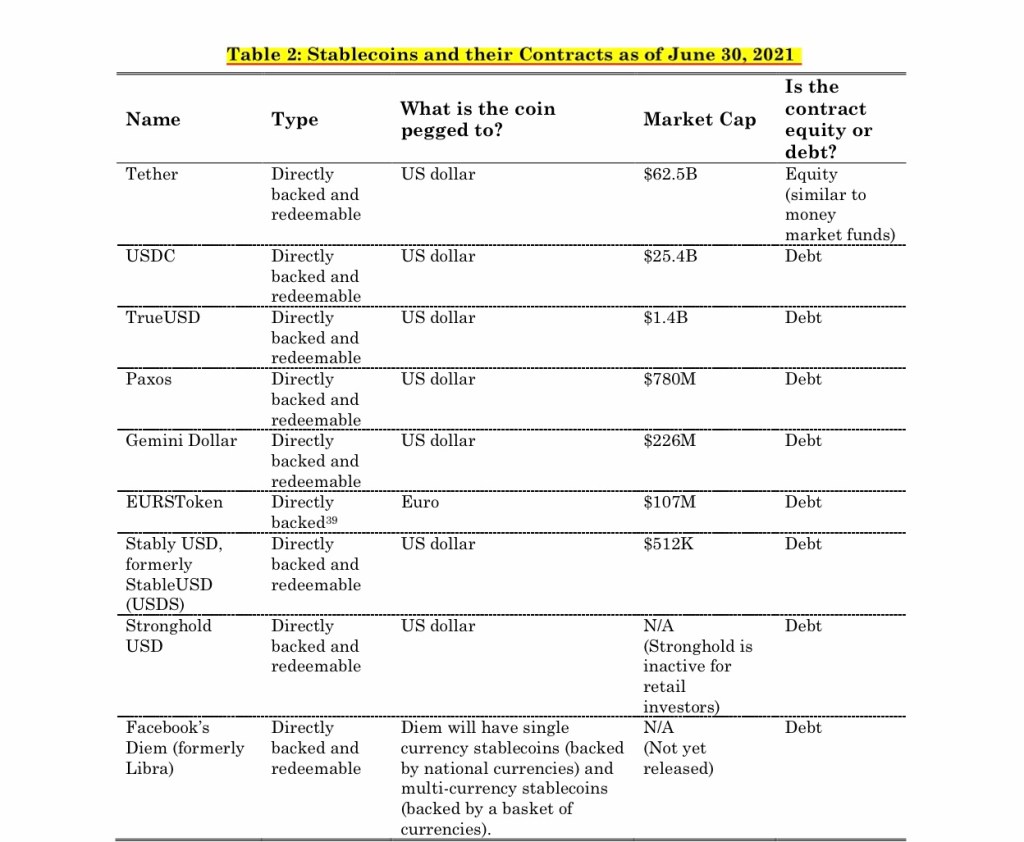
One practical outcome of this analysis that I had not considered previously is that they deem Tether to be based on an “equity contract” relationship with its users whereas the other stablecoins they analyse are “debt contracts” (see below). The link between Tether and a money market fund and the risk of “breaking the buck” has been widely canvassed but I had not previously seen the issue framed in these legal terms.

This technical analysis is summarised in two tables (Table 2: Stablecoins and their Contracts as of June 30, 2021 and Table 3: Stablecoins, Redemptions, and Fiat Money as of June 30. 2021) that offer a useful reference point for understanding the mechanics and details of some of the major stablecoins issued to date. In addition, the appendix to the paper offers links to the sources used in the tables.

Lessons to be learned from history

It may have been repeated to the point of cliche but the idea that “those who cannot remember the past are condemned to repeat it” (George Santayana generally gets the credit for this but variations are attributed to Edmund Burke and Sir Winston Churchill) resonates strongly with me. The general argument proposed by Gorton and Zhang is that lots of the ideas being tried out in stablecoin design and DeFi are variations on general principles that were similarly employed in the lightly regulated Free Banking Era but found wanting.

Even if you disagree with the conclusions they draw, the general principle of using economic history to explore what can be learned and what mistakes to avoid remains a useful discipline for any practitioner of the dark arts of banking and money creation.

Summing up in the authors’ own words

The paper is long (41 pages excluding the Appendix) but I will wrap up this post with an extract that gives you the essence of their argument in their own words.

Tony – From the Outside

Conclusion 

The more things change, the more they stay the same. It is still the case that regulation is being outpaced by innovation—thereby creating an uneven playing field—as it is easier and cheaper for more technologically advanced firms to offer similar products and services. 

In this case, it is also true that the problems associated with privately produced money are the same as they were one hundred and fifty years ago. We stress three points from our review of history. First, the use of private bank notes was a failure because they did not satisfy the NQA principle. Second, the U.S. government took control of the monetary system under the National Bank Act and subsequent legislation in order to eliminate the private bank note system in favor of a uniform currency—namely, national bank notes. Third, runs on demand deposits only ended with deposit insurance in 1934. 

Currently, it does not appear that stablecoins are used as money. But, as stablecoins evolve further, the stablecoin world will look increasingly like an unregulated version of the Free Banking Era—a world of wildcat banking. During the Free Banking Era, private bank monies circulated at time-varying discounts based on geography and the perceived risk of the issuing bank. Stablecoin prices are independent of geography but not independent of the perceived risk of their backing assets. If they succeed in differentiating themselves from fiat cryptocurrencies and become used as money, then they will likely trade at time-varying discounts as well. Policymakers have a couple of ways to address this development, and they better get going. 

Joe Wiesenthal contrasts the differing visions represented by Bitcoin and Ethereum

Joe Weisenthal (Bloomberg) wrote an interesting opinion piece discussing the differing visions that Bitcoin and Ethereum offer for the future of finance and money. I am a self declared neophyte in the world of cryptocurrency and DeFi so it may be that the experts in those domains will find fault but I found his thesis interesting. The article is behind the Bloomberg paywall but this is what I took away from it.

  • He starts with the observation that, after a decade since its inception, we seem to have arrived at the consensus that Bitcoin is best thought of as something like a digital version of gold (or “digital gold”).
  • That was not necessarily the original intent and battles have been fought between different factions in the Bitcoin community over differing visions.
  • The most recent example being the “Blocksize War” that played out between 2015 and 2017 where an initiative to increase transaction capacity by expanding the size of each Bitcoin block was defeated by others in the community who saw this as a threat to the network decentralisation they believed to be fundamental to what Bitcoin is.
  • Weisenthal notes that other players in the Crypto/DeFi domain have a different vision – Ethereum is currently one of the dominant architects of this alternative vision (but not the only one).
  • The distinguishing feature of Ethereum in Weisenthal’s thesis is that, in addition to being a cryptocurrency, it is also a “token”
  • He argues that, whereas Bitcoin requires a fundamental act of faith in the integrity of Bitcoin’s vision of the future of money, token’s have a broader set of uses to which you can assign value.
  • Once you introduce tokens the focus shifts to what precisely do you intend to do with them – in Weisenthal’s words “… once you’re in the realm of tokens, you don’t need faith, but you still need a point
  • He notes that we have already seen some dead ends play out – Initial Coin Offerings were a big thing for a while but not any more partly due to many of the projects not stacking up but also because many of them were just another form of IPO that were still unregistered (hence illegal) securities offerings in the eyes of the law.
  • We have also seen some developments like Non Fungible Tokens that are interesting from a social perspective but not necessarily going to shake the foundations of the status quo.
  • A third possibility is that DeFi starts to become a real force that starts to shake up the existing players in the conventional financial system.
  • This third option is the one that Weisenthal (and I) find most interesting but there is still a long way to go.

This is most definitely a topic where I am likely to be missing something but Weisenthal’s article offers an interesting discussion on the contrasting visions, assumptions and objectives of the two currently dominant tribes (Bitcoin and Ethereum). Most importantly it highlights the fact that the vision of DeFi being pursued by Ethereum (or alternatives such as Solana) is radically different to the vision of the future of money being pursued by Bitcoin.

Tony – From the Outside

Another reason why monetary authorities might not like stablecoins

Marc Rubinstein’s post (here) on Facebook’s attempt to create an alternative payment mechanism offers a useful summary of the state of play for anyone who has not had the time, nor the inclination, to follow the detail. It includes a short summary of its history, where the initiative currently stands and where it might be headed.

What caught my attention was his discussion of why central banks do not seem to be keen to support private sector initiatives in this domain. Marc noted that Facebook have elected to base their proposed currency (initially the “Libre” but relabelled a “Diem” in a revised proposal issued in December 2020) on a stable coin approach. There are variety of stable coin mechanisms (fiat-backed, commodity backed, cryptocurrency backed, seignorage-style) but in the case of the Diem, the value of the instrument is proposed to be based on an underlying pool of low risk fiat currency assets.

A stable value is great if the aim for the instrument is to facilitate payments for goods and services but it also creates concerns for policy makers. Marc cites a couple of issues …

But this is where policymakers started to get jumpy. They started to worry that if payments and financial transactions shift over to the Libra, they might lose control over their domestic monetary policy, all the more so if their currency isn’t represented in the basket. They worried too about the governance of the Libra Association and about its compliance framework. Perhaps if any other company had been behind it, they would have dismissed the threat, but they’d learned not to underestimate Facebook.”

“Facebook’s Big Diem”, Marc Rubinstein – https://netinterest.substack.com/p/facebooks-big-diem
One more reason why stable coins might be problematic for policy makers responsible for monetary policy and bank supervision?

Initiatives like Diem obviously represent a source of competition and indeed disruption for conventional banks. As a rule, policy makers tend to welcome competition, notwithstanding the potential for competition to undermine financial stability. However “fiat-backed” stable coin based initiatives also compete indirectly with banks in a less obvious way via their demand for the same pool of risk free assets that banks are required to hold for Basel III prudential liquidity requirements.

So central banks might prefer that the stock of government securities be available to fund the liquidity requirements of the banks they are responsible for, as opposed to alternative money systems that they are not responsible for nor have any direct control over.

I know a bit about banking but not a lot about cryptocurrency so it is entirely possible I am missing something here. If so then feedback welcome.

Tony – From the Outside

The Bitcoin energy use debate

Bitcoin’s energy use has been one of the more interesting, and less explored, avenues of the brave new world the crypto community is building. To date I have mostly seen this play out in very simplistic arguments along the lines that Bitcoin is bad because it uses as much energy as whole countries use. On those terms it certainly sounds bad but I came across a more nuanced discussion of the question in this post on the “Principlesandinterest” blog.

Toby lays out some of the counter arguments used to support Bitcoin and in doing so gets into some of the history of how we value things. While my bias remains that Bitcoin’s energy use is a concern, Toby’s post opened my mind up to some of the broader issues associated with the question. Definitely worth reading if you are interested in the question of cryptocurrency and the nature of money.

Tony – From the Outside

The potential for computer code to supplant the traditional operating framework of the economy and society

I am very far from expert on the issues discussed in the podcast this post links to, I am trying however to “up-skill”. The subject matter is a touch wonky so this is not a must listen recommendation. That said, the questions of DeFi and cryptocurrency are ones that I believe any serious student of banking and finance needs to understand.

In the podcast Demetri Kofinas (Host of the Hidden Forces podcast) is interviewed by two strong advocates of DeFi and crypto debating the potential of computer code to supplant legal structures as an operating framework for society. Demetri supports the idea that smart contracts can automate agreements but argues against the belief that self-executing software can or should supplant our legal systems. Computer code has huge potential in these applications but he maintains that you will still rely on some traditional legal and government framework to protect property rights and enforce property rights. He also argues that it is naïve and dangerous to synonymize open-source software with liberal democracy.

I am trying to keep an open mind on these questions but (thus far) broadly support the positions Demetri argues. There is a lot of ground to cover but Demetri is (based on my non-expert understanding of the topic) one of the better sources of insight I have come across.

Tony – From the Outside

Bank deposits – turning unsecured loans to highly leveraged companies into (mostly) risk free assets – an Australian perspective

The ability to raise funding via “deposits” is one of the things that makes banks different from other types of companies. As a rule bank deposits benefit from a variety of protections that transform what is effectively an unsecured loan to a highly leveraged company into an (arguably) risk free asset.

This rule is not universal however. The NZ banking system, for example, had (at the time this post was written) a distinctly different approach to bank deposits that not only eschews the protections Australian depositors take for granted but also has the power, via its Open Banking Resolution regime, to write down the value of bank deposits if required to ensure the solvency and viability of a bank. But some form of protection is common.

I previously had a go at the question of “why” bank deposits should be protected here.

This post focuses on the mechanics of “how” AUD denominated deposits held with APRA authorised deposit-taking institutions incorporated in Australia (“Australian ADIs” or “Australian banks”) are protected. In particular, I attempt to rank the relative importance of the various protections built into the Australian system. You may not necessarily agree with my ranking and that is OK – I would welcome feedback on what I may be missing.

Multiple layers of protection

Australian bank deposits benefit from multiple layers of protection:

  1. The risk taking activities of the banks are subject to a high level of supervision and regulation (that is true to varying degrees for most banking systems but Australian standards do seem to be at the more conservative end of the spectrum where Basel Committee standards offer a choice),
  2. The target level of Common Equity Tier 1 (CET1) capital required to support that risk must meet the standard of being “Unquestionably Strong”,
  3. This core capital requirement is supported by a series of supplementary layers of loss absorbing capital that can be converted into equity if the viability of the bank as a going concern comes into doubt,
  4. The deposits themselves have a priority super senior claim on the Australian assets of the bank should it fail, and
  5. The timely repayments of AUD deposits up to $250,000 per person per bank is guaranteed by the Australian Government.

Deposit preference rules …

The government guarantee might seem like the obvious candidate for the layer of protection that counts for the most, but I am not so sure. All the layers of protection obviously contribute but my vote goes to deposit preference. The capacity to bail-in the supplementary capital gets an honourable mention. These seem to me to be the two elements that ultimately underwrite the safety of the majority of bank deposits (by value) in Australia.

The other elements are also important but …

Intensive supervision clearly helps ensure that banks are well managed and not taking excessive risks but experience demonstrates that it does not guarantee that banks will not make mistakes. The Unquestionably Strong benchmark for CET1 capital developed in response to one of the recommendations of the 2014 Financial System Inquiry also helps but again does not guarantee that banks will not find some new (or not so new) way to blow themselves up.

At face value, the government guarantee seems like it would be all you need to know about the safety of bank deposits (provided you are not dealing with the high quality problem of having more than AUD250,000 in your bank account). When you look at the detail though, the role the government guarantee plays in underwriting the safety of bank deposits seems pretty limited, especially if you hold you deposit account with one of the larger ADIs. The first point to note is that the guarantee will only come into play if a series of conditions are met including that APRA consider that the ADI is insolvent and that the Treasurer determines that it is necessary.

In practice, recourse to the guarantee might be required for a small ADI heavily reliant on deposit funding but I suspect that this chain of events is extremely unlikely to play out for one of the bigger banks. That is partly because the risk of insolvency has been substantially reduced by higher CET1 requirements (for the larger ADI in particular) but also because the government now has a range of tools that allow it to bail-in rather than bail-out certain bank creditors that rank below depositors in the loss hierarchy. There are no great choices when dealing with troubled banks but my guess is that the authorities will choose bail-in over liquidation any time they are dealing with one of the larger ADIs.

If deposit preference rules, why doesn’t everyone do it?

Banking systems often seem to evolve in response to specific issues of the day rather than being the result of some grand design. So far as I can tell, it seems that the countries that have chosen not to pursue deposit preference have done so on the grounds that making deposits too safe dilutes market discipline and in the worst case invites moral hazard. That is very clearly the case in the choices that New Zealand has made (see above) and the resources they devote to the disclosure of information regarding the relative risk and strength of their banks.

I understand the theory being applied here and completely agree that market discipline should be encouraged while moral hazard is something to be avoided at all costs. That said, it does not seem reasonable to me to expect that the average bank deposit account holder is capable of making the risk assessments the theory requires, nor the capacity to bear the consequences of getting it wrong.

Bank deposits also function as one of the primary forms of money in most developed economies but need to be insulated from risk if they are to perform this role. Deposit preference not only helps to insulate this component of our money supply from risk, it also tends to transfer the risk to investors (debt and equity) who do have the skills and the capacity to assess and absorb it, thereby encouraging market discipline.

The point I am making here is very similar to the arguments that Grant Turner listed in favour of deposit protection in a paper published in the RBA Bulletin.

There are a number of reasons why authorities may seek to provide greater protection to depositors than to other creditors of banks. First, deposits are a critical part of the financial system because they facilitate economic transactions in a way that wholesale debt does not. Second, they are a primary form of saving for many individuals, losses on which may result in significant adversity for depositors who are unable to protect against this risk. These two characteristics also mean that deposits are typically the main source of funding for banks, especially for smaller institutions with limited access to wholesale funding markets. Third, non-deposit creditors are generally better placed than most depositors to assess and manage risk. Providing equivalent protection arrangements for non-deposit creditors would weaken market discipline and increase moral hazard.

Depositor Protection in Australia, Grant Turner, RBA Bulletin December Quarter 2011 (p45)

For a more technical discussion of these arguments I can recommend a paper by Gary Gorton and George Pennacchi titled “Financial Intermediation and Liquidity Creation” that I wrote about in this post.

Deposit preference potentially strengthens market discipline

I argued above that deposit preference potentially strengthens market discipline by transferring risk to debt and equity investors who have the skills to assess the risk, are paid a risk premium for doing so and, equally as importantly, the capacity to absorb the downside should a bank get into trouble. I recognise of course that this argument is strongest for the larger ADIs which have substantial layers of senior and subordinated debt that help ensure that deposits are materially insulated from bank risk. The capacity to bail-in a layer of this funding, independent of the conventional liquidation process, further adds to the protection of depositors while concentrating the role of market discipline where it belongs.

This market discipline role is one of the chief reasons I think “bail-in” adds to the resilience of the system in ways that higher equity requirements do not. The “skin in the game” these investors have is every bit as real as that the equity investors do, but they have less incentive to tolerate excessive or undisciplined risk taking.

The market discipline argument is less strong for the smaller ADIs which rely on deposits for a greater share of their funding but these entities account for a smaller share of bank deposits and can be liquidated if required with less disruption with the assistance of the government guarantee. The government guarantee seems to be more valuable for these ADIs than it is for the larger ADIs which are subject to a greater level of self-insurance.

Deposit preference plus ex ante funding of the deposit guarantee favours the smaller ADI

Interestingly, the ex ante nature of the funding of the government guarantee means that the ADIs for which it is least valuable (the survivors in general and the larger ADI’s in particular) are also the ones that will be called upon to pay the levy to make good any shortfalls not covered by deposit preference. That is at odds with the principle of risk based pricing that features in the literature about deposit guarantees but arguably a reasonable subsidy that assists the smaller ADIs to compete with larger ADI that have the benefit of risk diversification and economies of scale.

Summing up

If you want to dig deeper into this question, I have summarised the technical detail of the Australian deposit protection arrangements here. It is a little dated now but I can also recommend the article by Grant Turner published in the RBA Bulletin (December 2011) titled “Depositor Protection in Australia” which I quoted from above.

As always, it is entirely possible that I am missing something – if so let me know.

Tony – From The Outside