On olive branches and olive trees

On olive branches and olive trees

On olive branches and olive trees


— Read on capitalissues.co/2019/12/05/on-olive-branches-and-olive-trees/

I have commented on the RBNZ capital proposals before but have not got around to a thorough reading of the decision the RBNZ released today. In the interim, I can point you to a good summary on this blog.

The short version is that the RBNZ does appear to have taken on board some of the feedback they received.

Tony

Mortgage Risk Weights – revisited

I post on a range of topics in banking but residential mortgage risk weights is one that seems to generate the most attention. I first posted on the topic back in Sep 2018 and have revisited the topic a few times (Dec 2018, June 2019#1, June 2019#2, and Nov 2019) .

The posts have tended to generate a reasonable number of views but limited direct engagement with the arguments I have advanced. Persistence pays off however because the last post did get some specific and very useful feedback on the points I had raised to argue that the difference in capital requirements between IRB and Standardised Banks was not as big as it was claimed to be.

My posts were a response to the discussion of this topic I observed in the financial press which just focussed on the nominal difference in the risk weights (i.e. 25% versus 39%) without any of the qualifications. I identified 5 problems with the simplistic comparison cited in the popular press and by some regulators:

  • Problem 1 – Capital adequacy ratios differ
  • Problem 2 – You have to include capital deductions
  • Problem 3 – The standardised risk weights for residential mortgages seems set to change
  • Problem 4 – The risk of a mortgage depends on the portfolio not the individual loan
  • Problem 5 – You have to include the capital required for Interest Rate Risk in the Banking Book

With the benefit of hindsight and the feedback I have received, I would concede that I have probably paid insufficient attention to the disparity between risk weights (RW) at the higher quality end of the mortgage risk spectrum. IRB banks can be seen to writing a substantial share of their loan book at very low RWs (circa 6%) whereas the best case scenario for standardised banks is a 20% RW. The IRB banks are constrained by the requirement that their average RW should be at least 25% and I thought that this RW Floor was sufficient to just focus on the comparison of average RW. I also thought that the revisions to the standardised approach that introduced the 20% RW might make more of a difference. Now I am not so sure. I need to do a bit more work to resolve the question so for the moment I just want to go on record with this being an issue that needs more thought than I have given it to date.

Regarding the other 4 issues that I identified in my first post, I stand by them for the most part. That does not mean I am right of course but I will briefly recap on my arguments, some of the push back that I have received and areas where we may have to just agree to disagree.

Target capital adequacy ratios differ materially. The big IRB banks are targeting CET1 ratios based on the 10.5% Unquestionably Strong Benchmark and will typically have a bit of a buffer over that threshold. Smaller banks like Bendigo and Suncorp appear to operate with much lower CET1 targets (8.5 to 9.0%). This does not completely offset the nominal RW difference (25 versus 39%) but it is material (circa 20% difference) in my opinion so it seem fair to me that the discussion include this fact. I have to say that not all of my correspondents accepted this argument so it seems that we will have to agree to disagree.

You have to include capital deductions. In particular, the IRB banks are required to hold CET1 capital for the shortfall between their loan loss provision and a regulatory capital value called “Regulatory Expected Loss”. There did not appear to be a great awareness of this requirement and a tendency to dismiss it but my understanding is that it can increase the effective capital requirement by 10-12% which corresponds to an effective IRB RW closer to 28% than 25%.

The risk of a mortgage depends on the overall portfolio not the individual loan. My point here has been that small banks will typically be less diversified than big banks and so that justifies a difference in the capital requirements. I have come to recognise that the difference in portfolio risk may be accentuated to the extent that capital requirements applied to standardised banks impede their ability to capture a fair share of the higher quality end of the residential mortgage book. So I think my core point stands but there is more work to do here to fully understand this aspect of the residential mortgage capital requirements. In particular, I would love get more insight into how APRA thought about this issue when it was calibrating the IRB and standardised capital requirements. If they have spelled out their position somewhere, I have not been able to locate it.

You have to include the capital required for Interest Rate Risk in the Banking Book (IRRBB). I did not attempt to quantify how significant this was but simply argued that it was a requirement that IRB banks faced that standardised banks did not and hence it did reduce the benefit of lower RW. The push back I received was that the IRRBB capital requirement was solely a function of IRB banks “punting” their capital and hence completely unrelated to their residential mortgage loans. I doubt that I will resolve this question here and I do concede that the way in which banks choose to invest their capital has an impact on the size of the IRRBB capital requirement. That said, a bank has to hold capital to underwrite the risk in its residential mortgage book and, all other thinks being equal, an IRB bank has to hold more capital for the IRRBB requirement flowing from the capital that it invests on behalf of the residential mortgage book. So it still seems intuitively reasonable to me to make the connection. Other people clearly disagree so we may have to agree to disagree on this aspect.

Summing up, I had never intended to say that there was no difference in capital requirements. My point was simply that the difference is not as big as is claimed and I was yet to see any analysis that considered all of the issues relevant to properly understand what the net difference in capital requirements is. The issue of how to achieve a more level playing field between IRB and Standardised Banks is of course about much more than differences in capital requirements but it is an important question and one that should be based on a firmer set of facts that a simplistic comparison of the 39% standardised versus 25% IRB RW that is regularly thrown around in the discussion of this question.

I hope I have given a fair representation here of the counter arguments people have raised against my original thesis but apologies in advance if I have not. My understanding of the issues has definitely been improved by the challenges posted on the blog so thanks to everyone who took the time to engage.

Tony

Mortgage risk weight fact check

I have posted a couple of times on the merits of the argument that differences in mortgage risk weights are a substantial impediment to the ability of small banks employing the standardised approach to compete against larger banks who are authorised to use the Internal Ratings Based approach.

There was some substance to the argument under Basel II but the cumulative impact of a range of changes to the IRB requirements applying to residential mortgages has substantially narrowed the difference in formal capital requirements.

APRA has commented on this issue previously but that did not seem to have much impact on the extent to which the assertion gets repeated. For anyone still reluctant to let the facts stand in the way of a good story, Wayne Byres has restated APRA’s view on the issue in a speech to the Customer Owned Banking Association’s 2019 conference.

That brings me to the final point I want to make, about mortgage risk weights. Much is made of the headline difference in risk weights between the IRB and standardised approaches. At first glance, they do indeed look different. But as we pointed out in our most recent discussion paper, the comparison is much more complex than a superficial comparison implies: there are differences in capital targets, the treatment of loan commitments, the application of capital for interest rate risk in the balance sheet, and adjustments to expected losses – all of which have the effect of adding to IRB bank capital requirements and mean that the headline gap is greatly narrowed in practice.

When looked at holistically, we think any gap is small. Perhaps most tellingly, we now hear from candidates for IRB status that they are concerned the proposals being developed will not provide them with any capital benefit whatsoever. Whether that is the case or not, we are very conscious of this issue in designing the new proposals, and we have explicitly stated that we intend that any differences will remain negligible.

APRA Chair Wayne Byres – Speech to COBA 2019, the Customer Owned Banking Convention – 11 November 2019

Hopefully that settles the question. There is no question that all banks should be able to compete, as far as possible, on a level playing field but complaints about vast differences in the capital requirements applying to residential mortgages are a distraction not a solution.

Let me know what I am missing …

Tony

Too much information

This post is possibly (ok probably) a bit technical but touches on what I think is an important issue in understanding how the financial system operates. The conventional wisdom as I understand it is that markets thrive on information. I think that is true in some cases but it may not be necessarily true for all markets. If the conventional wisdom is wrong then there are important areas of market and bank regulation that probably need to be reconsidered.

I have written on this topic before in relation to papers by Gary Gorton and Bengt Holmstrom. These papers developed an analytical argument in favour of certain assets (or markets) being “information insensitive”. That argument makes intuitive sense to me and I have used these arguments in a couple of previous posts; one titled “Why banks are different” and another titled “Deposit insurance and moral hazard“.

I hope to eventually do a longer piece where I can bring all these ideas together but the purpose today is simply to flag an interesting post (and associated paper) I came across that offers some empirical evidence in favour of the thesis. The post is titled “(When) Does Transparency Reduce Liquidity” and you can find the paper of the same name here.

This extract from the blog post I think captures the key ideas:

“To sum up, our findings can be grouped under two headings. The first is that more information in financial markets is not always beneficial. It can reduce rather than increase trading and liquidity.

The second is that one size does not fit all in terms of gauging the impact of transparency on liquidity. For the safest of the MBS securities, the impact of transparency is negligible, while for the riskiest, transparency enhances liquidity. It is in the broad middle of the risk spectrum that liquidity is negatively impacted.

Our findings ought to be of interest to regulators on both sides of the Atlantic. In order to promote transparency and to bolster market discipline, supervisors have imposed various loan-level requirements in both Europe and the United States. The assumption seems to be that more transparency is always a good thing.

In such a climate, there has been insufficient investigation or understanding of the effects, including the negative effects, of such requirements on MBS market liquidity. Our work, we believe, begins to put this right.

“(When) Does Transparency Reduce Liquidity?” by Professors Karthik Balakrishnan at Rice University, Aytekin Ertan at London Business School, and Yun Lee at Singapore Management University and London Business School. Posted on “The CLS Blue Sky Blog” October 30 2019

Summing up

If this thesis is correct (i.e. that there are certain types of funding that should be “information insensitive” by design and that it is a mistake to apply to money markets the lessons and logic of stock markets) then this has implications for:

  • thinking about the way that bank capital structure should be designed,
  • questions like deposit preference and deposit insurance, and
  • how we reconcile the need to impose market discipline on banks while ensuring that their liquidity is not adversely impacted.

I have not as yet managed to integrate all of these ideas into something worth sharing but the post referenced above and the associated paper are definitely worth reading if you are engaged with the same questions. If you think I am missing something then please let me know.

Tony

Australian banking – “Unquestionably Strong” gets a bit more complicated

Students of the dark art of bank capital adequacy measurement were excited this week by the release of some proposed revisions to APRA’s “Prudential Standard APS 111 Capital Adequacy” (APS 111); i.e. the one which sets out the detailed criteria for measuring an ADI’s Regulatory Capital.

Is anyone still reading? Possibly not, but there is something I think worth noting here if you want to understand what may be happening with Australian bank capital. This is of course only a consultation at this stage but I would be very surprised if the key proposal discussed below is not adopted.

The Short Version

The consultation paper has a number of changes but the one that I want to focus on is the proposal to apply stricter constraints on the amount of equity an ADI invests in banking and insurance subsidiaries.

In order to understand how this impacts the banks, I have to throw in two more pieces of Australian bank capital jargon, specifically Level 1 and Level 2 capital.

  • Level 1 is the ADI itself on a stand alone basis (note that is a simplification but close enough to the truth for the purposes of this post).
  • Level 2 is defined in the consultation paper as “The consolidation of the ADI and all its subsidiaries other than non-consolidated subsidiaries; or if the ADI is a subsidiary of a non-operating holding company (NOHC), the consolidation of the immediate parent NOHC and all the immediate parent NOHC’s subsidiaries (including any ADIs and their subsidiaries) other than non-consolidated subsidiaries.”

You can be forgiven for not being familiar with this distinction but the capital ratios typically quoted in any discussion of Australian bank capital strength are the Level 2 measures. The Unquestionably Strong benchmark that dominates the discussion is a Level 2 measure. The changes proposed in this consultation however operate at the Level 1 measurement (the ones that virtually no one currently pays any attention to) and not the Level 2 headline rate.

This has the potential to impact the “Unquestionably Strong” benchmark and I don’t recollect seeing this covered in the consultation paper or any public commentary on the proposal that I have seen to date.

APRA has been quite open about the extent to which these changes are a response to the RBNZ proposal to substantially increase equity requirements for NZ banks.

“This review was prompted in part by recent proposals by the Reserve Bank of New Zealand (RBNZ) to materially increase capital requirements in New Zealand. The RBNZ’s proposals and APRA’s processes are a natural by-product of both regulators working to protect their respective communities from the costs of financial instability and the regulators continue to support each other as these reforms are developed.”

The changes have however been calibrated to maintain the status quo based on the amounts of capital the Australian majors currently have invested in their NZ subsidiaries.

“APRA has calibrated the proposed capital requirements so they are broadly consistent with … the current capital position of the four major Australian banks, in respect of these exposures (i.e. preserving most of the existing capital uplift).”

It follows that any material increase in the capital the majors are required to invest in their NZ subsidiaries (in response to the RBNZ’s proposed requirement) will in turn require that they have to hold commensurately more common equity on a 1:1 basis in the Level 1 ADI to maintain the existing Level 1 capital ratios.

So far as I can see, the Level 2 measure does not require that this extra capital invested in banking subsidiaries be subject to the increased CET1 deductions applied at Level 1. It follows that the Level 2 CET1 ratio will increase but the extent to which a creditor benefits from that added strength will depend on which part of the banking group they sit.

I am not saying this a problem in itself. The RBNZ has the authority to set the capital requirements it deems necessary, Australian bank shareholders can make their own commercial decisions on whether the diluted return on equity meets their requirements and APRA has to respond to protect the interests of the Australian banking system.

I am saying that measuring relative capital adequacy is getting more complicated so you need to pay attention to the detail if this matters to you. In particular, I am drawing attention to the potential for the Level 2 CET1 ratios of the Australian majors to increase in ways that the existing “Unquestionably Strong” benchmark is not calibrated to. I don’t think this matters much for Australian bank depositors who have a very safe super senior position in the Australian loss hierarchy. It probably does matter for creditors who are closer to the sharp end of the loss hierarchy including senior and subordinated bondholders.

To date, the Level 2 capital adequacy ratios have been sufficient to provide a measure of relative capital strength; a higher CET1 ratio equals greater capital strength and that was probably all you needed to know. Going forward, I think you will need to pay closer attention to what is happening at the Level 1 measure to gain a more complete understanding of relative capital strength. The Level 2 measure by itself may not tell you the full story.

The detail

As a rule, APRA’s general capital treatment of equity exposures is to require that they be deducted from CET1 Capital in order to avoid double counting of capital. The existing rules (APS 111) however provides a long-standing variation to this general rule when measuring Level 1 capital adequacy. This variation allows an ADI at Level 1 to risk weight (after first deducting any intangibles component) its equity investments in banking and insurance subsidiaries. The risk weight is 300 percent if the subsidiary is listed or 400 per cent if it is unlisted.

APRA recognises that this improves the L1 ratios by around 100bp versus what would be the case if a full CET1 deduction were applied but is comfortable with that outcome based on current exposure levels.

The RBNZ’s (near certain) move towards higher CET1 requirements however threatens to undermine this status quo and potentially see a greater share of the overall pool of equity in the group migrate from Australia to NZ. APRA recognises of course that the RBNZ can do whatever it deems best for NZ depositors but APRA equally has to ensure that the NZ benefits do not come at the expense of Australian depositors (and other creditors).

To address this issue, APRA is proposing to limit the extent to which an ADI may use debt to fund investments in banking and insurance subsidiaries.

  • ADIs, at Level 1, will be required to deduct these equity investments from CET1 Capital, but only to the extent the investment in the subsidiary is in excess of 10 per cent of CET1 Capital.
  • An ADI may risk weight the investment, after deduction of any intangibles component, at 250 per cent to the extent the investment is below this 10 per cent threshold.
  • The amount of the exposure that is risk weighted would be included as part of the related party limits detailed in the recently finalised APS 222.

As APRA is more concerned about large concentrated exposures, it is proposing to limit the amount of the exposure to an individual subsidiary that can be leveraged to 10 per cent of an ADI’s CET1 Capital. This means capital requirements are increasing for large concentrated exposures, as amounts over the 10 per cent threshold would be required to be met dollar-for-dollar by the ADI parent company.

Summing up

What APRA is proposing to do makes sense to me. We can debate the necessity for the RBNZ to insist on virtually 100% CET1 capital (for the record, I continue to believe that a mix of CET1 and contingent convertible debt is likely to be a more effective source of market discipline). However, once it became clear that the RBNZ was committed to its revised capital requirements, APRA was I think left with no choice but to respond.

What will be interesting from here is to see whether investments of CET1 in NZ banking subsidiaries increase in response to the RBNZ requirement or whether the Australian majors choose to reduce the size of their NZ operations.

If the former (i.e. the majors are required to increase the capital committed to NZ subsidiaries) then we need to keep an eye on how this impacts the Level 2 capital ratios and what happens to the “Unquestionably Strong” CET1 benchmark that currently anchors the capital the Australian majors maintain.

This is a pretty technical area of bank capital so it is possible I am missing something; if so please let me know what it is. Otherwise keep an eye on how the capital adequacy targets of the Australian majors respond to these developments.

Tony (From the Outside)
What is wrong with Australian banking?

Spoiler alert, I am not going to provide a definitive answer to that question. I do however want to address a couple of the arguments advanced in an interview with Joseph Healy reported in the Chanticleer section of the AFR this week that I think bear closer scrutiny.

Healy has written a book titled “Breaking the Banks – what went wrong with Australian banking”. At this stage I can only rely on what was reported in the AFR so I may be missing some of the nuance of his argument. It is of course always good fun to see an “insider” spilling the beans on an industry but it is also important that we debate the questions raised on the basis of the facts as opposed to a good story. I have no intention of seeking to argue that there is nothing to see here; there are certainly major issues that need to be addressed. That said, some of the claims he asserts seem wrong to me. I offer an alternative perspective below – it is up to the reader to judge which perspective (dare I say set of facts) they find more convincing.

Let’s start with some elements of his thesis that seem to me to have a foundation of truth:

  • Banks operate under a “social licence” that imposes a higher set of responsibilities than what is dictated by a pure free market philosophy
  • The Cost of Equity for Australian banks is around 6-7% per annum and that banks should only earn a modest premium over their cost of equity in a competitive market

Healy cites the “fact” that major bank ROE around 12-13% is substantially higher than their cost of equity and the recent “failure to pass on the full 25 basis point rate cut” as evidence that the major banks are abusing their market power to extract unreasonable rents from the economy.

I don’t have any issue with the premise that banks (not just Australian banks) have a privileged position in the societies in which they operate and that this privilege carries responsibilities. It follows that earning a return that is materially higher than their COE begs the question how this can be justified. However, simplistic comparisons of a bank’s ROE at a relatively benign point in time with the COE that its shareholders require to be compensated for the risk they underwrite across the full business cycle is a fundamental error of analysis and logic. My reasons for this are set out in more detail in this post, but the key point is that this comparison conflates two things which are related but not the same thing.

The other problem I have is the argument that not reducing lending rates by the same amount as the change in the RBA cash rate amounts to a “failure to pass on” the rate cut. Fortunately I don’t need to lay out the detail of why this is wrong because Michael Pascoe and Stephen Bartholomeusz have both done a more than adequate job here and here.

All always, it is entirely possible that I am missing something but I have to call it as I see it. If you have not read the articles by Pascoe and Bartholomeusz then I can recommend them as well worth your time. Bank bashing is a long standing Australian past time and there is much legitimate cause for bashing them. Banking however is too important to allow yourself to join the mob (which sadly seems to include senior politicians) without understanding what criticism is legitimate and what is not.

Tony

The renaissance of uncertainty

Mervyn King is working on a new book titled “Radical Uncertainty”. This is the term he applies to Knight’s concept of uncertainty as distinct from risk. In his previous book (The End of Alchemy”), it was one of four key ideas he explored in arguing that the risk based capital requirements at the heart of the of the Basel Committee’s approach to bank regulation are fundamentally flawed.

King argued that any risk based approach to capital adequacy is an unreliable foundation for a banking system because it will not capture the uncertain dimension of unexpected loss and that is what we should be really concerned with. I did a post on his last book here . While I did not agree with everything he wrote, I still still found it well worth reading. His discussion of the “prisoner’s dilemma” is I think particularly relevant to the issue of competition in banking but hardly ever mentioned in the debate that Australia is currently having on this question.

His new book won’t be published till next year but I came across an interesting podcast in which he and John Kay discuss some of the history behind the distinction between risk and uncertainty. The podcast covers a lot of familiar ground, but what I found interesting was the history of how probability based measures of risk pushed uncertainty to the sidelines. In particular, the role that individual personalities played and their relative skills in actively selling their ideas.

The importance of understanding what you don’t (and can’t) know has had a renaissance in the aftermath of the GFC but it is alway helpful (for me at least) to spend some time reflecting on where the line lies and why. I have attached a link to the podcast here for anyone interested in digging deeper.

Thinking aloud about Australian bank ROE

I have been wanting to put something down on the question of Australian major bank ROE for a while. The issue generates a lot of heat but the public discussion I have observed has been truncated, in my opinion, by misconceptions.

I think we can agree that banks need to be profitable to be healthy and a healthy banking system underpins the health of the economy as a whole. Excessive profitability however is clearly bad for consumers, business and for the economy as a whole. The problem is determining what level of profitability is excessive. This post is unlikely to be the final word on this topic but hopefully it introduces a couple of considerations that seem to me to be largely missing from the public debate.

Most of what I read on this topic seems to treat the ROE of the Australian majors as self evidently excessive and focuses on what to do about it. Exhibit A is the reported ROE which in the 2019 half year updates varied from 10.05% to 14.10%. This is much less than it was but still substantially better than what is being achieved by most banks outside Australia and by the smaller local banks. Exhibit B is the fact that the Australian banking system is an oligopoly which almost by definition earn excess profits.

Reported ROE exceeds COE – case closed

Any discussion of ROE must be anchored by the estimated Cost of Equity (COE), the minimum return that investors require to hold equity risk. There are a variety of ways of calculating this but all of them generate a number that is much less than the ROE the majors currently earn. So case closed.

There is no question that the Australian majors cover their cost of equity, but it is less clear to me that the margin of excess profitability is as excessive as claimed.

Corporate finance 101 teaches us that we can derive a company’s cost of equity using the Capital Asset Pricing Model (CAPM) which holds that the required return is equal to the Risk Free Return plus the Equity Risk Premium (ERP) multiplied by the extent to which the return the individual stock is correlated with the market as a whole. The general idea of being paid a premium for taking on equity risk makes sense but there are a bunch of issues with the CAPM once you get into the detail. One of the more topical being what do you do when the risk free rate approaches zero.

I don’t want to get into the detail of those issues here but will assume for the purposes of this post that a rate of return in the order of 8-10% can be defended as a minimum acceptable return. I recognise that some of the more mechanical applications of the CAPM might generate a figure lower than this if they simply apply a fixed ERP to the current risk free rate.

Two reasons why a simple comparison of ROE and COE may be misleading

  1. Banking is an inherently cyclical business and long term investors require a return that compensates them for accepting this volatility in returns.
  2. Book value does not define market value

Banking is a highly cyclical business – who knew?

It is often asserted that banking is a low risk, “utility” style business and hence that shareholders should expect commensurately low returns. The commentators making these assertions tend to focus on the fact that the GFC demonstrated that it is difficult (arguably impossible) to allow large banks to fail without imposing significant collateral damage on the rest of the economy. Banks receive public sector support to varying degrees that reduces their risk of failure and hence the risk to shareholders. A variation of this argument is that higher bank capital requirements post the GFC have reduced the risk of investing in a bank by reducing the risk of insolvency.

There is no question that banks do occupy a privileged space in the economy due to the central bank liquidity support that is not available to other companies. This privilege (sometimes referred to as a “social licence”) is I think an argument for tempering the kinds of ROE targeted by the banks but it does not necessarily make them a true utility style investment whose earnings are largely unaffected by cyclical downturns.

The reality is that bank ROE will vary materially depending on the state of the credit cycle and this inherent cyclicality is probably accentuated by accounting for loan losses and prudential capital requirements. Loan losses for Australian banks are currently (October 2019) close to their cyclical low points and can be expected to increase markedly when the economy eventually moves into a downturn or outright recession. Exactly how much downside in ROE we can expect is open to debate but history suggests that loan losses could easily be 5 times higher than what we observe under normal economic conditions.

There is also the issue of how often this can be expected to happen. Again using history as a guide for the base rate, it seems that downturns might be expected every 7-10 years on average and long periods without a downturn seem to be associated with increased risk of more severe and prolonged periods of reduced economic activity.

What kind of risk premium does an investor require for this cyclicality? The question may be academic for shareholders who seek to trade in and out of bank stocks based on their view of the state of the cycle but I will assume that banks seek to cater to the concerns and interests of long term shareholders. The answer for these shareholders obviously depends on how frequent and how severe you expect the downturns to be, but back of the envelope calculations suggest to me that you would want ROE during the benign part of the credit cycle to be at least 200bp over the COE and maybe 300bp to compensate for the cyclical risk.

Good risk management capabilities can mitigate this inherent volatility but not eliminate it; banks are inherently cyclical investments on the front line of the business cycle. Conversely, poor risk management or an aggressive growth strategy can have a disproportionately negative impact. It follows that investors will be inclined to pay a premium to book value for banks they believe have good risk management credentials. I will explore this point further in the discussion of book value versus market value.

Book Value versus Market Value

Apart from the cyclical factors discussed above, the simple fact that ROE is higher than COE is frequently cited as “proof” that ROE is excessive. It is important however to examine the unstated assumption that the market value of a bank should be determined by the book value of its equity. To the best of my knowledge, there is no empirical or conceptual basis for this assumption. There are a number of reasons why a company’s share price might trade at a premium or a discount to its book value as prescribed by the relevant accounting standards.

The market may be ascribing value to assets that are not recognised by the accounting standards.The money spent on financial control and risk management, for example, is largely expensed and hence not reflected in the book value of equity. That value however becomes apparent when the bank is under stress. These “investments” cannot eliminate the inherent cyclicality discussed above but they do mitigate those risk.

A culture built on sound risk management and financial control capabilities is difficult to value and won’t be reflected in book value except to the extent it results in conservative valuation and provisioning outcomes. It is however worth something. Investors will pay a premium for the banks they believe have these intangible strengths while discounting or avoiding altogether the shares of banks they believe do not.

Summing up …

This post is in no way an exhaustive treatment of the topic. Its more modest objective was simply to offer a couple of issues to consider before jumping to the conclusion that the ROE earned by the large Australian banks is excessive based on simplistic comparisons of point in time ROE versus mechanical derivations of the theoretical COE.

As always, it is entirely possible that I am missing something – if so let me know what it is ….

Tony

The rise of digital money

Given the central role that money plays in our economy, understanding how the rise of digital money will play out is becoming increasingly important. There is a lot being written on this topic but today’s post is simply intended to flag a paper titled “The Rise of Digital Money” that is one of the more useful pieces of analysis that I have come across. The paper is not overly long (20 pages) but the authors (Tobias Adrian and Tommaso Mancini-Griffoli) have also published a short summary of the paper here on the VOX website maintained by the Centre for Economic Policy Research.

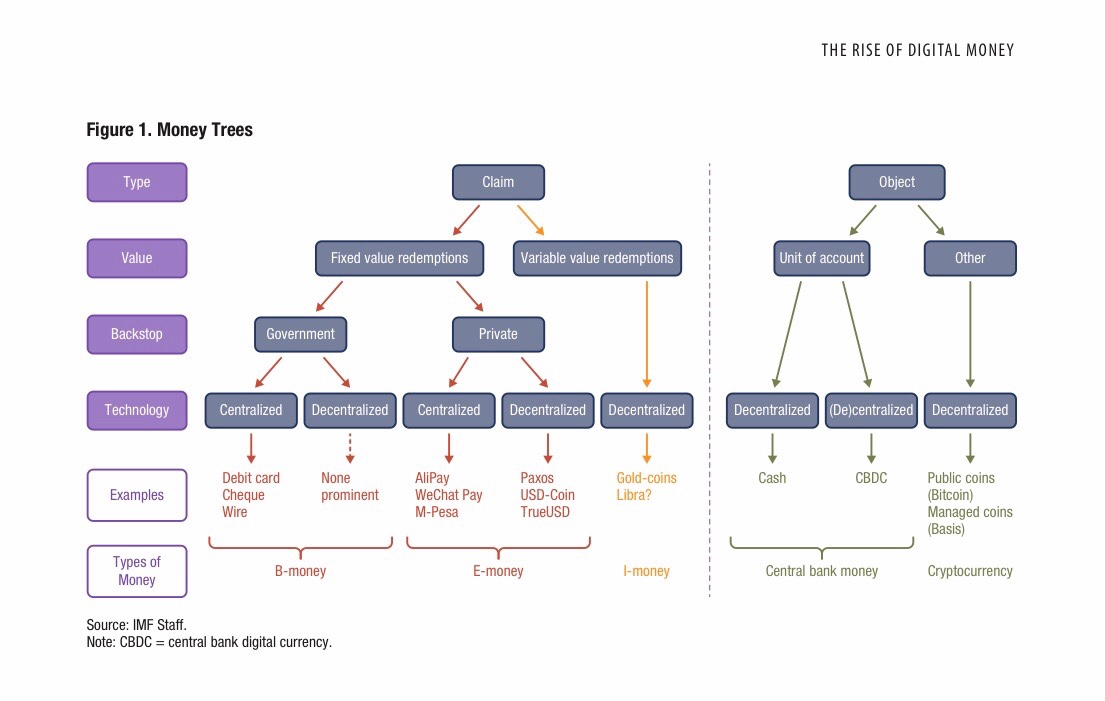
Part of the problem with thinking about the rise of digital money is being clear about how to classify the various forms. The authors offer the following framework that they refer to as a Money Tree.

Adrian, T, and T Mancini-Griffoli (2019), “The rise of digital currency”, IMF Fintech Note 19/01.

This taxonomy identifies four key features that distinguish the various types of money (physical and digital):

  1. Type – is it a “claim” or an “object”?
  2. Value – is it the “unit of account” employed in the financial system, a fixed value in that unit of account, or a variable value?
  3. Backstop – if there is a fixed value redemption, is that value “backstopped” by the government or does it rely solely on private mechanisms to support the fixed exchange rate?
  4. Technology – centralised or decentralised?

Using this framework, the authors discuss the rise of stablecoins

“Adoption of new forms of money will depend on their attractiveness as a store of value and means of payment. Cash fares well on the first count, and bank deposits on both. So why hold stablecoins? Why are stablecoins taking off? Why did USD Coin recently launch in 85 countries,1 Facebook invest heavily in Libra, and centralised variants of the stablecoin business model become so widespread? Consider that 90% of Kenyans over the age of 14 use M-Pesa and the value of Alipay and WeChat Pay transactions in China surpasses that of Visa and Mastercard worldwide combined.

The question is all the more intriguing as stablecoins are not an especially stable store of value. As discussed, they are a claim on a private institution whose viability could prevent it from honouring its pledge to redeem coins at face value. Stablecoin providers must generate trust through the prudent and transparent management of safe and liquid assets, as well as sound legal structures. In a way, this class of stablecoins is akin to constant net asset value funds which can break the buck – i.e. pay out less than their face value – as we found out during the global financial crisis. 

However, the strength of stablecoins is their attractiveness as a means of payment. Low costs, global reach, and speed are all huge potential benefits. Also, stablecoins could allow seamless payments of blockchain-based assets and can be embedded into digital applications by an active developer community given their open architecture, as opposed to the proprietary legacy systems of banks. 

And, in many countries, stablecoins may be issued by firms benefitting from greater public trust than banks. Several of these advantages exist even when compared to cutting-edge payment solutions offered by banks called fast-payments.2 

But the real enticement comes from the networks that promise to make transacting as easy as using social media. Economists beware: payments are not the mere act of extinguishing a debt. They are a fundamentally social experience tying people together. Stablecoins are better integrated into our digital lives and designed by firms that live and breathe user-centric design. 

And they may be issued by large technology firms that already benefit from enormous global user bases over which new payment services could spread like wildfire. Network effects – the gains to a new user growing exponentially with the number of users – can be staggering. Take WhatsApp, for instance, which grew to nearly 2 billion users in ten years without any advertisement, based only on word of mouth!”

“The rise of digital currency”, Tobias Adrian, Tommaso Mancini-Griffoli 09 September 2019 – Vox CEPR Policy Portal

The authors then list the risks associated with the rise of stablecoins:

  1. The potential disintermediation of banks
  2. The rise of new monopolies
  3. The threat to weak currencies
  4. The potential to offer new opportunities for money laundering and terrorist financing
  5. Loss of “seignorage” revenue
  6. Consumer protection and financial stability

These risks are not dealt with in much detail. The potential disintermediation of banks gets the most attention (the 20 page paper explores 3 scenarios for how the disintermediation risk might play out).

The authors conclude with a discussion of what role central banks play in the rise of digital currency. They note that many central banks are exploring the desirability of stepping into the game and developing a Central Bank Digital Currency (CBDC) but do not attempt to address the broader question of whether the overall idea of a CBDC is a good one. They do however explore how central banks could work with stablecoin providers to develop a “synthetic” form of central bank digital currency by requiring the “coins” to be backed with central bank reserves.

This is effectively bringing the disrupters into the fold by turning them into a “narrow bank”. Izabella Kaminska (FT Alphaville) has also written an article on the same issue here that is engagingly titled “Why dealing with fintechs is a bit like dealing with pirates”.

The merits of narrow banking lie outside the scope of this post but it a topic with a very rich history (search on the term “Chicago Plan”) and one that has received renewed support in the wake of the GFC. Mervyn King (who headed the Bank of England during the GFC), for example, is one prominent advocate.

Hopefully you found this useful, if not my summary then at least the links to some articles that have helped me think through some of the issues.

Tony