Mortgage Risk Weights – revisited

I post on a range of topics in banking but residential mortgage risk weights is one that seems to generate the most attention. I first posted on the topic back in Sep 2018 and have revisited the topic a few times (Dec 2018, June 2019#1, June 2019#2, and Nov 2019) .

The posts have tended to generate a reasonable number of views but limited direct engagement with the arguments I have advanced. Persistence pays off however because the last post did get some specific and very useful feedback on the points I had raised to argue that the difference in capital requirements between IRB and Standardised Banks was not as big as it was claimed to be.

My posts were a response to the discussion of this topic I observed in the financial press which just focussed on the nominal difference in the risk weights (i.e. 25% versus 39%) without any of the qualifications. I identified 5 problems with the simplistic comparison cited in the popular press and by some regulators:

  • Problem 1 – Capital adequacy ratios differ
  • Problem 2 – You have to include capital deductions
  • Problem 3 – The standardised risk weights for residential mortgages seems set to change
  • Problem 4 – The risk of a mortgage depends on the portfolio not the individual loan
  • Problem 5 – You have to include the capital required for Interest Rate Risk in the Banking Book

With the benefit of hindsight and the feedback I have received, I would concede that I have probably paid insufficient attention to the disparity between risk weights (RW) at the higher quality end of the mortgage risk spectrum. IRB banks can be seen to writing a substantial share of their loan book at very low RWs (circa 6%) whereas the best case scenario for standardised banks is a 20% RW. The IRB banks are constrained by the requirement that their average RW should be at least 25% and I thought that this RW Floor was sufficient to just focus on the comparison of average RW. I also thought that the revisions to the standardised approach that introduced the 20% RW might make more of a difference. Now I am not so sure. I need to do a bit more work to resolve the question so for the moment I just want to go on record with this being an issue that needs more thought than I have given it to date.

Regarding the other 4 issues that I identified in my first post, I stand by them for the most part. That does not mean I am right of course but I will briefly recap on my arguments, some of the push back that I have received and areas where we may have to just agree to disagree.

Target capital adequacy ratios differ materially. The big IRB banks are targeting CET1 ratios based on the 10.5% Unquestionably Strong Benchmark and will typically have a bit of a buffer over that threshold. Smaller banks like Bendigo and Suncorp appear to operate with much lower CET1 targets (8.5 to 9.0%). This does not completely offset the nominal RW difference (25 versus 39%) but it is material (circa 20% difference) in my opinion so it seem fair to me that the discussion include this fact. I have to say that not all of my correspondents accepted this argument so it seems that we will have to agree to disagree.

You have to include capital deductions. In particular, the IRB banks are required to hold CET1 capital for the shortfall between their loan loss provision and a regulatory capital value called “Regulatory Expected Loss”. There did not appear to be a great awareness of this requirement and a tendency to dismiss it but my understanding is that it can increase the effective capital requirement by 10-12% which corresponds to an effective IRB RW closer to 28% than 25%.

The risk of a mortgage depends on the overall portfolio not the individual loan. My point here has been that small banks will typically be less diversified than big banks and so that justifies a difference in the capital requirements. I have come to recognise that the difference in portfolio risk may be accentuated to the extent that capital requirements applied to standardised banks impede their ability to capture a fair share of the higher quality end of the residential mortgage book. So I think my core point stands but there is more work to do here to fully understand this aspect of the residential mortgage capital requirements. In particular, I would love get more insight into how APRA thought about this issue when it was calibrating the IRB and standardised capital requirements. If they have spelled out their position somewhere, I have not been able to locate it.

You have to include the capital required for Interest Rate Risk in the Banking Book (IRRBB). I did not attempt to quantify how significant this was but simply argued that it was a requirement that IRB banks faced that standardised banks did not and hence it did reduce the benefit of lower RW. The push back I received was that the IRRBB capital requirement was solely a function of IRB banks “punting” their capital and hence completely unrelated to their residential mortgage loans. I doubt that I will resolve this question here and I do concede that the way in which banks choose to invest their capital has an impact on the size of the IRRBB capital requirement. That said, a bank has to hold capital to underwrite the risk in its residential mortgage book and, all other thinks being equal, an IRB bank has to hold more capital for the IRRBB requirement flowing from the capital that it invests on behalf of the residential mortgage book. So it still seems intuitively reasonable to me to make the connection. Other people clearly disagree so we may have to agree to disagree on this aspect.

Summing up, I had never intended to say that there was no difference in capital requirements. My point was simply that the difference is not as big as is claimed and I was yet to see any analysis that considered all of the issues relevant to properly understand what the net difference in capital requirements is. The issue of how to achieve a more level playing field between IRB and Standardised Banks is of course about much more than differences in capital requirements but it is an important question and one that should be based on a firmer set of facts that a simplistic comparison of the 39% standardised versus 25% IRB RW that is regularly thrown around in the discussion of this question.

I hope I have given a fair representation here of the counter arguments people have raised against my original thesis but apologies in advance if I have not. My understanding of the issues has definitely been improved by the challenges posted on the blog so thanks to everyone who took the time to engage.

Tony

Mortgage risk weight fact check

I have posted a couple of times on the merits of the argument that differences in mortgage risk weights are a substantial impediment to the ability of small banks employing the standardised approach to compete against larger banks who are authorised to use the Internal Ratings Based approach.

There was some substance to the argument under Basel II but the cumulative impact of a range of changes to the IRB requirements applying to residential mortgages has substantially narrowed the difference in formal capital requirements.

APRA has commented on this issue previously but that did not seem to have much impact on the extent to which the assertion gets repeated. For anyone still reluctant to let the facts stand in the way of a good story, Wayne Byres has restated APRA’s view on the issue in a speech to the Customer Owned Banking Association’s 2019 conference.

That brings me to the final point I want to make, about mortgage risk weights. Much is made of the headline difference in risk weights between the IRB and standardised approaches. At first glance, they do indeed look different. But as we pointed out in our most recent discussion paper, the comparison is much more complex than a superficial comparison implies: there are differences in capital targets, the treatment of loan commitments, the application of capital for interest rate risk in the balance sheet, and adjustments to expected losses – all of which have the effect of adding to IRB bank capital requirements and mean that the headline gap is greatly narrowed in practice.

When looked at holistically, we think any gap is small. Perhaps most tellingly, we now hear from candidates for IRB status that they are concerned the proposals being developed will not provide them with any capital benefit whatsoever. Whether that is the case or not, we are very conscious of this issue in designing the new proposals, and we have explicitly stated that we intend that any differences will remain negligible.

APRA Chair Wayne Byres – Speech to COBA 2019, the Customer Owned Banking Convention – 11 November 2019

Hopefully that settles the question. There is no question that all banks should be able to compete, as far as possible, on a level playing field but complaints about vast differences in the capital requirements applying to residential mortgages are a distraction not a solution.

Let me know what I am missing …

Tony

What is wrong with Australian banking?

Spoiler alert, I am not going to provide a definitive answer to that question. I do however want to address a couple of the arguments advanced in an interview with Joseph Healy reported in the Chanticleer section of the AFR this week that I think bear closer scrutiny.

Healy has written a book titled “Breaking the Banks – what went wrong with Australian banking”. At this stage I can only rely on what was reported in the AFR so I may be missing some of the nuance of his argument. It is of course always good fun to see an “insider” spilling the beans on an industry but it is also important that we debate the questions raised on the basis of the facts as opposed to a good story. I have no intention of seeking to argue that there is nothing to see here; there are certainly major issues that need to be addressed. That said, some of the claims he asserts seem wrong to me. I offer an alternative perspective below – it is up to the reader to judge which perspective (dare I say set of facts) they find more convincing.

Let’s start with some elements of his thesis that seem to me to have a foundation of truth:

  • Banks operate under a “social licence” that imposes a higher set of responsibilities than what is dictated by a pure free market philosophy
  • The Cost of Equity for Australian banks is around 6-7% per annum and that banks should only earn a modest premium over their cost of equity in a competitive market

Healy cites the “fact” that major bank ROE around 12-13% is substantially higher than their cost of equity and the recent “failure to pass on the full 25 basis point rate cut” as evidence that the major banks are abusing their market power to extract unreasonable rents from the economy.

I don’t have any issue with the premise that banks (not just Australian banks) have a privileged position in the societies in which they operate and that this privilege carries responsibilities. It follows that earning a return that is materially higher than their COE begs the question how this can be justified. However, simplistic comparisons of a bank’s ROE at a relatively benign point in time with the COE that its shareholders require to be compensated for the risk they underwrite across the full business cycle is a fundamental error of analysis and logic. My reasons for this are set out in more detail in this post, but the key point is that this comparison conflates two things which are related but not the same thing.

The other problem I have is the argument that not reducing lending rates by the same amount as the change in the RBA cash rate amounts to a “failure to pass on” the rate cut. Fortunately I don’t need to lay out the detail of why this is wrong because Michael Pascoe and Stephen Bartholomeusz have both done a more than adequate job here and here.

All always, it is entirely possible that I am missing something but I have to call it as I see it. If you have not read the articles by Pascoe and Bartholomeusz then I can recommend them as well worth your time. Bank bashing is a long standing Australian past time and there is much legitimate cause for bashing them. Banking however is too important to allow yourself to join the mob (which sadly seems to include senior politicians) without understanding what criticism is legitimate and what is not.

Tony

The renaissance of uncertainty

Mervyn King is working on a new book titled “Radical Uncertainty”. This is the term he applies to Knight’s concept of uncertainty as distinct from risk. In his previous book (The End of Alchemy”), it was one of four key ideas he explored in arguing that the risk based capital requirements at the heart of the of the Basel Committee’s approach to bank regulation are fundamentally flawed.

King argued that any risk based approach to capital adequacy is an unreliable foundation for a banking system because it will not capture the uncertain dimension of unexpected loss and that is what we should be really concerned with. I did a post on his last book here . While I did not agree with everything he wrote, I still still found it well worth reading. His discussion of the “prisoner’s dilemma” is I think particularly relevant to the issue of competition in banking but hardly ever mentioned in the debate that Australia is currently having on this question.

His new book won’t be published till next year but I came across an interesting podcast in which he and John Kay discuss some of the history behind the distinction between risk and uncertainty. The podcast covers a lot of familiar ground, but what I found interesting was the history of how probability based measures of risk pushed uncertainty to the sidelines. In particular, the role that individual personalities played and their relative skills in actively selling their ideas.

The importance of understanding what you don’t (and can’t) know has had a renaissance in the aftermath of the GFC but it is alway helpful (for me at least) to spend some time reflecting on where the line lies and why. I have attached a link to the podcast here for anyone interested in digging deeper.

The rise of digital money

Given the central role that money plays in our economy, understanding how the rise of digital money will play out is becoming increasingly important. There is a lot being written on this topic but today’s post is simply intended to flag a paper titled “The Rise of Digital Money” that is one of the more useful pieces of analysis that I have come across. The paper is not overly long (20 pages) but the authors (Tobias Adrian and Tommaso Mancini-Griffoli) have also published a short summary of the paper here on the VOX website maintained by the Centre for Economic Policy Research.

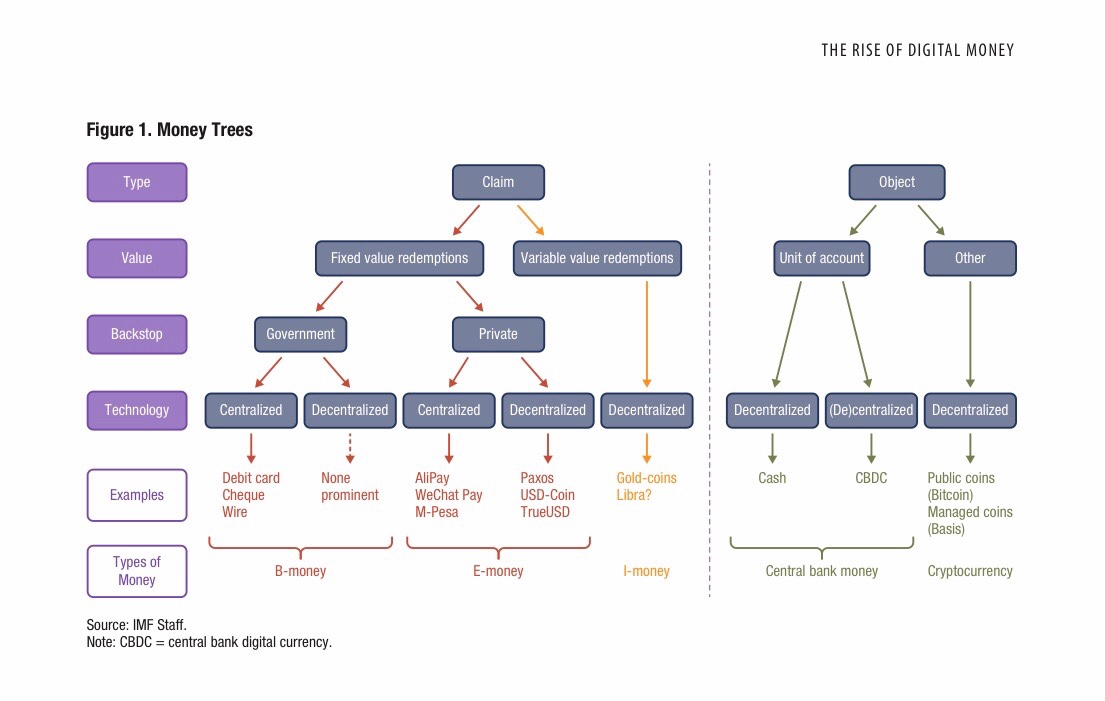
Part of the problem with thinking about the rise of digital money is being clear about how to classify the various forms. The authors offer the following framework that they refer to as a Money Tree.

Adrian, T, and T Mancini-Griffoli (2019), “The rise of digital currency”, IMF Fintech Note 19/01.

This taxonomy identifies four key features that distinguish the various types of money (physical and digital):

  1. Type – is it a “claim” or an “object”?
  2. Value – is it the “unit of account” employed in the financial system, a fixed value in that unit of account, or a variable value?
  3. Backstop – if there is a fixed value redemption, is that value “backstopped” by the government or does it rely solely on private mechanisms to support the fixed exchange rate?
  4. Technology – centralised or decentralised?

Using this framework, the authors discuss the rise of stablecoins

“Adoption of new forms of money will depend on their attractiveness as a store of value and means of payment. Cash fares well on the first count, and bank deposits on both. So why hold stablecoins? Why are stablecoins taking off? Why did USD Coin recently launch in 85 countries,1 Facebook invest heavily in Libra, and centralised variants of the stablecoin business model become so widespread? Consider that 90% of Kenyans over the age of 14 use M-Pesa and the value of Alipay and WeChat Pay transactions in China surpasses that of Visa and Mastercard worldwide combined.

The question is all the more intriguing as stablecoins are not an especially stable store of value. As discussed, they are a claim on a private institution whose viability could prevent it from honouring its pledge to redeem coins at face value. Stablecoin providers must generate trust through the prudent and transparent management of safe and liquid assets, as well as sound legal structures. In a way, this class of stablecoins is akin to constant net asset value funds which can break the buck – i.e. pay out less than their face value – as we found out during the global financial crisis. 

However, the strength of stablecoins is their attractiveness as a means of payment. Low costs, global reach, and speed are all huge potential benefits. Also, stablecoins could allow seamless payments of blockchain-based assets and can be embedded into digital applications by an active developer community given their open architecture, as opposed to the proprietary legacy systems of banks. 

And, in many countries, stablecoins may be issued by firms benefitting from greater public trust than banks. Several of these advantages exist even when compared to cutting-edge payment solutions offered by banks called fast-payments.2 

But the real enticement comes from the networks that promise to make transacting as easy as using social media. Economists beware: payments are not the mere act of extinguishing a debt. They are a fundamentally social experience tying people together. Stablecoins are better integrated into our digital lives and designed by firms that live and breathe user-centric design. 

And they may be issued by large technology firms that already benefit from enormous global user bases over which new payment services could spread like wildfire. Network effects – the gains to a new user growing exponentially with the number of users – can be staggering. Take WhatsApp, for instance, which grew to nearly 2 billion users in ten years without any advertisement, based only on word of mouth!”

“The rise of digital currency”, Tobias Adrian, Tommaso Mancini-Griffoli 09 September 2019 – Vox CEPR Policy Portal

The authors then list the risks associated with the rise of stablecoins:

  1. The potential disintermediation of banks
  2. The rise of new monopolies
  3. The threat to weak currencies
  4. The potential to offer new opportunities for money laundering and terrorist financing
  5. Loss of “seignorage” revenue
  6. Consumer protection and financial stability

These risks are not dealt with in much detail. The potential disintermediation of banks gets the most attention (the 20 page paper explores 3 scenarios for how the disintermediation risk might play out).

The authors conclude with a discussion of what role central banks play in the rise of digital currency. They note that many central banks are exploring the desirability of stepping into the game and developing a Central Bank Digital Currency (CBDC) but do not attempt to address the broader question of whether the overall idea of a CBDC is a good one. They do however explore how central banks could work with stablecoin providers to develop a “synthetic” form of central bank digital currency by requiring the “coins” to be backed with central bank reserves.

This is effectively bringing the disrupters into the fold by turning them into a “narrow bank”. Izabella Kaminska (FT Alphaville) has also written an article on the same issue here that is engagingly titled “Why dealing with fintechs is a bit like dealing with pirates”.

The merits of narrow banking lie outside the scope of this post but it a topic with a very rich history (search on the term “Chicago Plan”) and one that has received renewed support in the wake of the GFC. Mervyn King (who headed the Bank of England during the GFC), for example, is one prominent advocate.

Hopefully you found this useful, if not my summary then at least the links to some articles that have helped me think through some of the issues.

Tony

Company purpose

There has been a lot written on this topic recently, particularly in response to the recent announcement by the Business Roundtable of it decision that corporations should seek to serve all stakeholders rather than focusing on shareholders. I don’t propose to add anything new to the discussion in this post but simply to call out a couple of references I have found useful in trying to make sense of the issues.

This post by Aswath Damodaran offers a useful review of the issues associated with choosing what purpose a company should serve, and what might go wrong as the current debate plays out. Damodaran identifies 5 variations on how companies pursue their purpose

  1. Cut throat corporatism
  2. Crony corporatism
  3. Managerial corporatism
  4. Constrained corporatism
  5. Confused corporatism

“Confused corporatism” is the label Damodaran applies to the “stakeholder” approach. No surprises that he is not a fan. This extract from his post captures his core arguments.

“I know that this is a trying time to be a corporate CEO, with people demanding that you cure society’s ills and the economy’s problems, with the threat of punitive actions, if you don’t change. That said, I don’t believe that you can win this battle or even recoup some of your lost standing by giving up on the focus on shareholder wealth and replacing it with an ill-thought through and potentially destructive objective of advancing stakeholder interests. In my view, a much healthier discussion would be centered on creating more transparency about how corporations treat different stakeholder groups and linking that information with how they get valued in the market. I think that we are making strides on the first, with better information disclosure from companies and CSR measures, and I hope to help on the second front by connecting these disclosures to intrinsic value. As I noted earlier, if we want companies to behave better in their interactions with society, customers and employees, we have to make it in their financial best interests to do so, buying products and services from companies that treat other stakeholders better and paying higher prices for their shares.”

“From Shareholder wealth to Stakeholder interests: CEO Capitulation or Empty Doublespeak?”; Musings on Markets, 28 August 2019

The Economist also offers a perspective on what might go wrong with the “stakeholder” version of corporate purpose. The Economist uses the term “Collective Capitalism” to label this alternative formulation.

I am not convinced the answer proposed by The Economist is going to solve the problem but I still found it worth reading. Firstly, it reminds us that companies have been granted unique rights – in particular “limited liability”. We probably take this for granted but recognising that it is a privilege begs the question what does society get in return.

“Ever since businesses were granted limited liability in Britain and France in the 19th century, there have been arguments about what society can expect in return”

Like Damodaran, The Economist questions the ways in which companies might make the social choices not being addressed now.

“Consider accountability first. It is not clear how CEOs should know what “society” wants from their companies. The chances are that politicians, campaigning groups and the CEOs themselves will decide—and that ordinary people will not have a voice. Over the past 20 years industry and finance have become dominated by large firms, so a small number of unrepresentative business leaders will end up with immense power to set goals for society that range far beyond the immediate interests of their company.”

The Economist also reminds us that it is not clear how this kinder form of capitalism retains the creative destruction that has been part and parcel of the process of economic growth

The second problem is dynamism. Collective capitalism leans away from change. In a dynamic system firms have to forsake at least some stakeholders: a number need to shrink in order to reallocate capital and workers from obsolete industries to new ones. If, say, climate change is to be tackled, oil firms will face huge job cuts. Fans of the corporate giants of the managerial era in the 1960s often forget that AT&T ripped off consumers and that General Motors made out-of-date, unsafe cars. Both firms embodied social values that, even at the time, were uptight. They were sheltered partly because they performed broader social goals, whether jobs-for-life, world-class science or supporting the fabric of Detroit.

Lastly, this opinion piece by Barry Ritholz is also worth reading for a fairly blunt reminder of the parts of the system status quo that fall far short of the free market fairy tale. I have only scratched the surface of this topic but hopefully you will find the articles and blog posts referenced above useful.

Tony

Building applied critical thinking into the structure of an organisation

This article in Bloomberg caught my attention. It is a background piece on a team known as the “Applied Critical Thinking” unit that has been operating inside the New York Federal Reserve since 2016.

The general idea of contrarian thinking and recognising the limitations of what is and is not knowable are not huge innovations in themselves. What was interesting for me is the extent to which this unit can be thought of as a way of building that thought process into the structure of organisations that might otherwise tend towards consensus and groupthink built on simple certainties.

I have touched on this general topic in some previous posts. A review of Paul Wilmott and David Orrell’s book (The Money Formula), for example, discussed their use of the idea of a “Zone of Validity” to define the boundaries of what quantitative modelling could reveal about the financial system. Pixar (the digital animation company) also has some interesting examples of how a culture of candour and speaking truth to power can be built into the structure of an organisation rather than relying on slogans that people be brave or have courage.

I don’t have all the answers but this initiative by the NY Fed is I think worth watching. Something like this seem to me to have the potential to help address some of the culture problems that have undermined trust in large companies (it is not just the banks) and the financial system as a whole.

Tony

Deposit insurance and moral hazard

Depositors tend to be a protected species

It is generally agreed that bank deposits have a privileged position in the financial system. There are exceptions to the rule such as NZ which, not only eschews deposit insurance, but also the practice of granting deposits a preferred (or super senior) claim on the assets of the bank. NZ also has a unique approach to bank resolution which clearly includes imposing losses on bank deposits as part of the recapitalisation process. Deposit insurance is under review in NZ but it is less clear if that review contemplates revisiting the question of deposit preference.

The more common practice is for deposits to rank at, or near, the top of the queue in their claim on the assets of the issuing bank. This preferred claim is often supported by some form of limited deposit insurance (increasingly so post the Global Financial Crisis of 2008). An assessment of the full benefit has to consider the cost of providing the payment infrastructure that bank depositors require but the issuing bank benefits from the capacity to raise funds at relatively low interest rates. The capacity to raise funding in the form of deposits also tends to mean that the issuing banks will be heavily regulated which adds another layer of cost.


The question is whether depositors should be protected

I am aware of two main arguments for protecting depositors:

  • One is to protect the savings of financially unsophisticated individuals and small businesses.
  • The other major benefit relates to the short-term, on-demand, nature of deposits that makes them convenient for settling transactions but can also lead to a ‘bank run’.

The fact is that retail depositors are simply not well equipped to evaluate the solvency and liquidity of a bank. Given that even the professionals can fail to detect problems in banks, it is not clear why people who will tend to lie at the unsophisticated end of the spectrum should be expected to do any better. However, the unsophisticated investor argument by itself is probably not sufficient. We allow these individuals to invest in the shares of banks and other risky investments so what is special about deposits.

The more fundamental issue is that, by virtue of the way in which they function as a form of money, bank deposits should not be analysed as “investments”. To function as money the par value of bank deposits must be unquestioned and effectively a matter of faith or trust. Deposit insurance and deposit preference are the tools we use to underwrite the safety and liquidity of bank deposits and this is essential if bank deposits are to function as money. We know the economy needs money to facilitate economic activity so if bank deposits don’t perform this function then you need something else that does. Whatever the alternative form of money decided on, you are still left with the core issue of how to make it safe and liquid.

Quote
“The capacity of a financial instrument like a bank deposit to be accepted and used as money depends on the ability of uninformed agents to trade it without fear of loss; i.e. the extent to which the value of the instrument is insulated from any adverse information about the counterparty”

Gary Gorton and George Pennacchi “Financial Intermediaries and Liquidity Creation”

I recognise that fintech solutions are increasingly offering alternative payment mechanisms that offer some of the functions of money but to date these still ultimately rely on a bank with a settlement account at the central bank to function. This post on Alphaville is worth reading if you are interested in this area of financial innovation. The short version is that fintechs have not been able to create new money in the way banks do but this might be changing.

But what about moral hazard?

There is an argument that depositors should not be a protected class because insulation from risk creates moral hazard.

While government deposit insurance has proven very successful in protecting banks from runs, it does so at a cost because it leads to moral hazard (Santos, 2000, p. 8). By offering a guarantee that depositors are not subject to loss, the provider of deposit insurance bears the risk that they would otherwise have borne.

According to Dr Sam Wylie (2009, p. 7) from the Melbourne Business School:

“The Government eliminates the adverse selection problem of depositors by insuring them against default by the bank. In doing so the Government creates a moral hazard problem for itself. The deposit insurance gives banks an incentive to make higher risk loans that have commensurately higher interest payments. Why?, because they are then betting with taxpayer’s money. If the riskier loans are repaid the owners of the bank get the benefit. If not, and the bank’s assets cannot cover liabilities, then the Government must make up the shortfall”

Reconciling Prudential Regulation with Competition, Pegasus Economics, May 2019 (p17)

A financial system that creates moral hazard is clearly undesirable but, for the reasons set out above, it is less clear to me that bank depositors are the right set of stakeholders to take on the responsibility of imposing market discipline on banks. There is a very real problem here but requiring depositors to take on this task is not the answer.

The paper by Gorton and Pennacchi that I referred to above notes that there is a variety of ways to make bank deposits liquid (i.e. insensitive to adverse information about the bank) but they argue for solutions where depositors have a sufficiently deep and senior claim on the assets of the bank that any volatility in their value is of no concern. This of course is what deposit insurance and giving deposits a preferred claim in the bank loss hierarchy does. Combining deposit insurance with a preferred claim on a bank’s assets also means that the government can underwrite deposit insurance with very little risk of loss.

It is also important I think to recognise that deposit preference moves the risk to other parts of the balance sheet that are arguably better suited to the task of exercising market discipline. The quote above from Pegasus Economics focussed on deposit insurance and I think has a fair point if the effect is simply to move risk from depositors to the government. That is part of the reason why I think that deposit preference, combined with how the deposit insurance is funded, are also key elements of the answer.

Designing a banking system that addresses the role of bank deposits as the primary form of money without the moral hazard problem

I have argued that the discussion of moral hazard is much more productive when the risk of failure is directed at stakeholders who have the expertise to monitor bank balance sheets, the capacity to absorb the risk and who are compensated for undertaking this responsibility. If depositors are not well suited to the market discipline task then who should bear the responsibility?

  • Senior unsecured debt
  • Non preferred senior debt (Tier 3 capital?)
  • Subordinated debt (i.e. Tier 2 capital)
  • Additional Tier 1 (AT1)
  • Common Equity Tier 1 (CET1)

There is a tension between liquidity and risk. Any security that is risky may be liquid during normal market conditions but this “liquidity” cannot be relied on under adverse conditions. Senior debt can in principle be a risky asset but most big banks will also aim to be able to issue senior debt on the best terms they can achieve to maximise liquidity. In practice, this means that big banks will probably aim for a Long Term Senior Debt Rating that is safely above the “investment grade” threshold. Investment grade ratings offer not just the capacity top issue at relatively low credit spreads but also, and possibly more importantly, access to a deeper and more reliable pool of funding.

Cheaper funding is nice to have but reliable access to funding is a life and death issue for banks when they have to continually roll over maturing debt to keep the wheels of their business turning. This is also the space where banks can access the pools of really long term funding that are essential to meet the liquidity and long term funding requirements that have been introduced under Basel III.

The best source of market discipline probably lies in the space between senior debt and common equity

I imagine that not every one will agree with me on this but I do not see common equity as a great source of market discipline on banks. Common equity is clearly a risky asset but the fact that shareholders benefit from taking risk is also a reason why they are inclined to give greater weight to the upside than to the downside when considering risk reward choices. As a consequence, I am not a fan of the “big equity” approach to bank capital requirements.

In my view, the best place to look for market discipline and the control of moral hazard in banking lies in securities that fill the gap between senior unsecured debt and common equity; i.e. non-preferred senior debt, subordinated debt and Additional Tier 1. I also see value in having multiple layers of loss absorption as opposed to one big homogeneous layer of loss absorption. This is partly because it can be more cost effective to find different groups of investors with different risk appetites. Possibly more important is that multiple layers offer both the banks and supervisors more flexibility in the size and impact of the way these instruments are used to recapitalise the bank.

Summing up …

I have held off putting this post up because I wanted the time to think through the issues and ensure (to the best of my ability) that I was not missing something. There remains the very real possibility that I am still missing something. That said, I do believe that understanding the role that bank deposits play as the primary form of money is fundamental to any complete discussion of the questions of deposit insurance, deposit preference and moral hazard in banking.

Tony
A BCBS review of the costs and benefits of higher bank capital requirements

The economic rational for higher bank capital requirements that have been implemented under Basel III is built to a large extent on an analytical model developed by the BCBS that was published in a study released in 2010. The BCBS has just (June 2019) released a paper by one of its working groups which reviews the original analysis in the light of subsequent studies into the optimal capital question. The 2019 Review concludes that the higher capital requirements recommended by the original study have been supported by these subsequent studies and, if anything, the optimal level of capital may be higher than that identified in the original analysis.

Consistent with the Basel Committee’s original assessment, this paper finds that the net macroeconomic benefits of capital requirements are positive over a wide range of capital levels. Under certain assumptions, the literature finds that the net benefits of higher capital requirements may have been understated in the original Committee assessment. Put differently, the range of estimates for the theoretically-optimal level of capital requirements … is likely either similar or higher than was originally estimated by the Basel Committee.

The costs and benefits of bank capital – a review of the literature; BCBS Working Paper (June 2019)

For anyone who is interested in really understanding this question as opposed to simply looking for evidence to support a preconceived bias or vested interest, it is worth digging a bit deeper into what the paper says. A good place to start is Table 1 from the 2019 Review (copied below) which compares the assumptions, estimates and conclusions of these studies:

Pay attention to the fine print

All of these studies share a common analytical model which measures Net benefits as a function of:

Reduced Crisis Probability x Crisis Cost – Output Drag (loan spreads).

So the extent of any net benefit depends on the extent to which:

  • More capital actually reduces the probability of a crisis and/or its economic impact,
  • The economic impact of a financial crisis is a permanent or temporary adjustment to the long term growth trajectory of the economy – a permanent effect supports the case for higher capital, and
  • The cost of bank debt declines in response to higher capital – in technical terms the extent of the Modigliani Miller (MM) offset, with a larger offset supporting the case for higher capital.

The authors of the 2019 Review also acknowledge that interpretation of the results of the studies is complicated by the fact that different studies use different measures of capital adequacy. Some of the studies provide optimal capital estimates in risk weighted ratios, others in leverage ratios. The authors of the 2019 Review have attempted to convert the leverage ratios to a risk weighted equivalent but that process will inevitably be an imperfect science. The definition of capital also differs (TCE, Tier 1 & CET1).

The authors acknowledge that full standardisation of capital ratios is very complex and lies beyond the scope of their review and nominate this as an area where further research would be beneficial. In the interim (and at the risk of stating the obvious) the results and conclusions of this 2019 Review and the individual studies it references should be used with care. The studies dating from 2017, for example, seem to support a higher value for the optimal capital range compared to the 2010 benchmark. The problem is that it is not clear how these higher nominal ratio results should be interpreted in the light of increases in capital deductions and average risk weights such as we have seen play out in Australia.

The remainder of this post will attempt to dig a bit deeper into some of the components of the net benefit model employed in these types of studies.

Stability benefits – reduced probability of a crisis

The original 2010 BCBS study concluded that increasing Tangible Common Equity from 7% to 10% would reduce the probability of a financial crisis by 1.6 percentage points.

The general principle is that a financial crisis is a special class of economic downturn in which the severity and duration is exacerbated by a collapse in confidence in the banking system due to widespread doubts about the solvency of one or more banks which results in a contraction in the supply of credit.

It follows that higher capital reduces the odds that any given level of loss can threaten the actual or perceived solvency of the banking system. So far so good, but I think it is helpful at this point to distinguish the core losses that flow from the underlying problem (e.g. poor credit origination or risk management) versus the added losses that arise when credit supply freezes in response to concerns about the solvency or liquidity of the banking system.

Higher capital (and liquidity) requirements can help to mitigate the risk of those second round losses but they do not in any way reduce the economic costs of the initial poor lending or risk management. The studies however seem to use the total losses experienced in historical financial crises to calculate the net benefit rather than specific output losses that can be attributed to credit shortages and any related drop in employment and/or the confidence of business and consumers. That poses the risk that the studies may be over estimating the potential benefits of higher capital.

This is not saying that higher capital requirements are a waste of time but the modelling of optimal capital requirements must still understand the limitations of what capital can and cannot change. There is, for example, evidence that macro prudential policy tools may be more effective tools for managing the risk of systemic failures of credit risk management as opposed to relying on the market discipline of equity investors being required to commit more “skin in the game“.

Cost of a banking crisis

The 2019 Review notes that

“recent refinements associated with identifying crises is promising. Such refinements have the potential to affect estimates of the short- and long-run costs of crises as well as our understanding of how pre-crisis financial conditions affect these costs. Moreover, the identification of crises is important for estimating the relationship between banking system capitalisation and the probability of a crisis, which is likely to depend on real drivers (eg changes in employment) as well as financial drivers (eg bank capital).

We considered above the possibility that there may be fundamental limitations on the extent to which capital alone can impact the probability, severity and duration of a financial crisis. The 2019 Review also acknowledges that there is an ongoing debate, far from settled, regarding the extent to which a financial crisis has a permanent or temporary effect on the long run growth trajectory of an economy. This seemingly technical point has a very significant impact on the point at which these studies conclude that the costs of higher capital outweigh the benefits.

The high range estimates of the optimal capital requirement in these studies typically assume that the impacts are permanent. This is big topic in itself but Michael Redell’s blog did a post that goes into this question in some detail and is worth reading.

Banking funding costs – the MM offset

The original BCBS study assumed zero offset (i.e. no decline in lending rates in response to deleveraging). This assumption increase the modelled impact of higher capital and, all other things equal, reduces the optimal capital level. The later studies noted in the BCBS 2019 Review have tended to assume higher levels of MM offset and the 2019 Review concludes that the “… assumption of a zero offset likely overstated the costs of higher capital nonbank loan rates”. For the time being the 2019 Review proposes that “a fair reading of the literature would suggest the middle of the 0 and 100% extremes” and calls for more research to “… help ground the Modigliani-Miller offset used in estimating optimal bank capital ratios”.

Employing a higher MM offset supports a higher optimal capital ratio but I am not convinced that even the 50% “split the difference” compromise is the right call. I am not disputing the general principle that risk and leverage are related. My concern is that the application of this general principle does not recognise the way in which some distinguishing features of bank balance sheets impact bank financing costs and the risk reward equations faced by different groups of bank stakeholders. I have done a few posts previously (here and here) that explore this question in more depth.

Bottom line – the BCBS itself is well aware of most of the issues with optimal capital studies discussed in this post – so be wary of anyone making definitive statements about what these studies tell us.

The above conclusion is however subject to a number of important considerations. First, estimates of optimal capital are sensitive to a number of assumptions and design choices. For example, the literature differs in judgments made about the permanence of crisis effects as well as assumptions about the efficacy of post crisis reforms – such as liquidity regulations and bank resolution regimes – in reducing the probability and costs of future banking crisis. In some cases, these judgements can offset the upward tendency in the range of optimal capital.

Second, differences in (net) benefit estimates can reflect different conditioning assumptions such as starting levels of capital or default thresholds (the capital ratio at which firms are assumed to fail) when estimating the impact of capital in reducing crisis probabilities.2

Finally, the estimates are based on capital ratios that are measured in different units. For example, some studies provide optimal capital estimates in risk-weighted ratios, others in leverage ratios. And, across the risk-weighted ratio estimates, the definition of capital and risk-weighted assets (RWAs) can also differ (eg tangible common equity (TCE) or Tier 1 or common equity tier 1 (CET1) capital; Basel II RWAs vs Basel III measures of RWAs). A full standardisation of the different estimates across studies to allow for all of these considerations is not possible on the basis of the information available and lies beyond the scope of this paper.

This paper also suggests a set of issues which warrant further monitoring and research. This includes the link between capital and the cost and probability of crises, accounting for the effects of liquidity regulations, resolution regimes and counter-cyclical capital buffers, and the impact of regulation on loan quantities.

The costs and benefits of bank capital – a review of the literature; BCBS Working Paper (June 2019)

Summing up

I would recommend this 2019 Literature Review to anyone interested in the question of how to determine the optimal capital requirements for banks. The topic is complex and important and also one where I am acutely aware that I may be missing something. I repeat the warning above about anyone (including me) making definitive statements based on these types of studies.

That said, the Review does appear to offer support for the steps the BCBS has taken thus far to increase capital and liquidity requirements. There are also elements of the paper that might be used to support the argument that bank capital requirements should be higher again. This is the area where I think the fine print offers a more nuanced perspective.

Tony